The release also coincides with growing discontent over Sony's business decisions. In April 2026, the company raised the price of the PS5 worldwide and, since May 20, increased the monthly and quarterly PlayStation Plus fees. It also argues before a federal court that its customers acquire licenses to use, not ownership of, the games they buy. Relapse thus arrives at a moment when the price of playing and control over what is bought are at the center of the debate.
Unleashing the PS5 from its chains
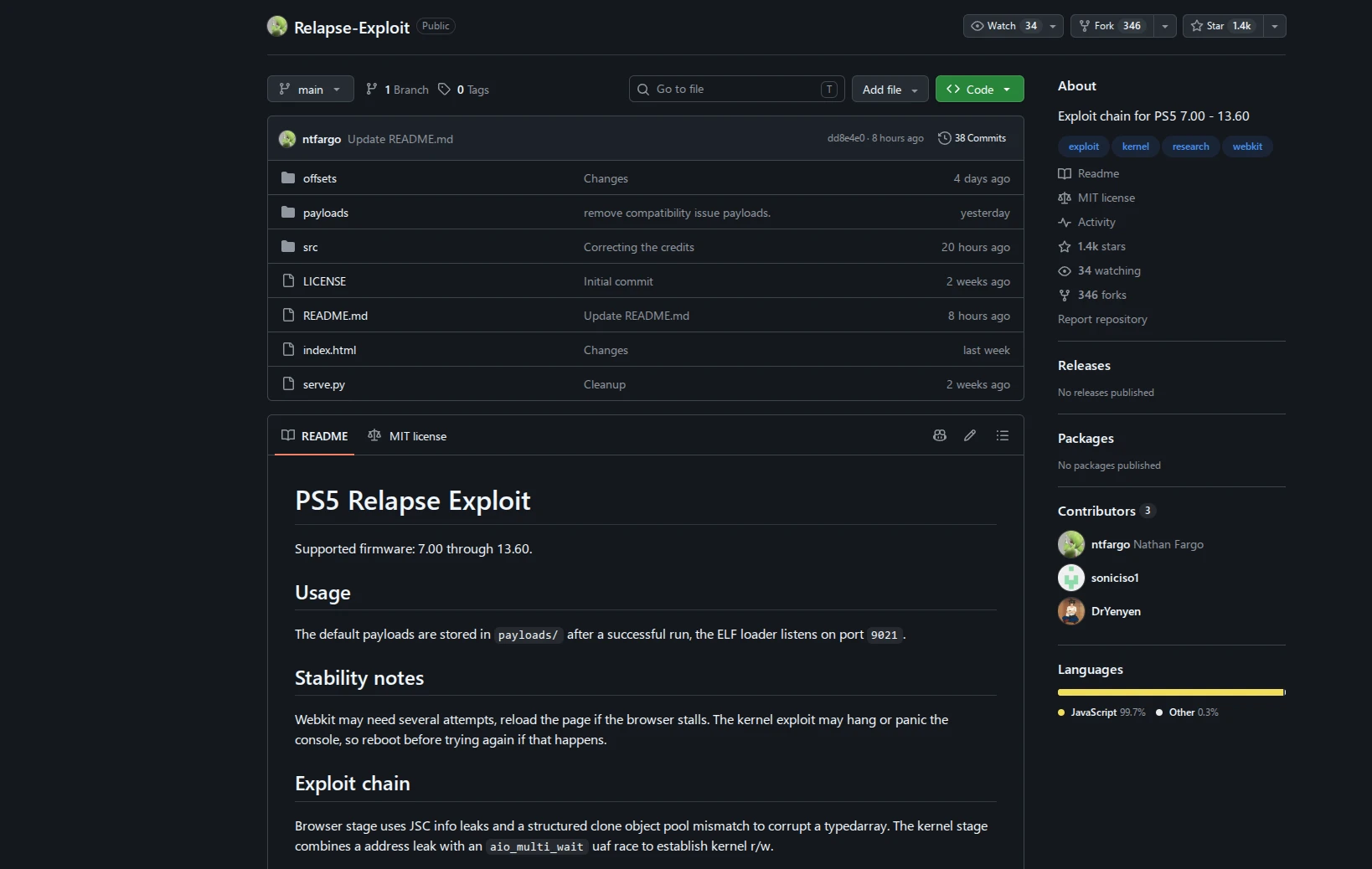
Nathan Fargo, known in the scene as ntfargo, did not start from scratch, but chained two known flaws with very careful engineering. The first stage attacks JavaScriptCore inside WebKit, the engine of the console's hidden browser that also displays the store and the guides, combining a memory leak with a defect in the copying of complex objects that corrupts a typed array and grants access to forbidden memory. The second stage exploits a race condition in the function aio_multi_wait, a function of the asynchronous input/output subsystem inherited from FreeBSD that underpins Orbis OS, to achieve read and write access to the kernel, according to the technical analysis by Pasquale Pillitteri.
The entry method seems like a trick from another era because of how simple it is. It is enough to point the primary DNS to 45.56.67.85, open the console's user guide and type the address of the exploit page in the URL box, as the ApolloHB scene account spread after publication. When the chain succeeds, the console leaves an ELF loader listening on port 9021, the door through which homebrew programs, emulators and backup copies of legitimate games for personal use enter.
What can you do with an open PS5?
It is worth clarifying that the robustness attributed to Relapse comes from the scene itself, which gave it more than a thousand stars on GitHub in a few days and considers it stable compared to inflated announcements of the past. The repository explicitly cites historical researchers such as TheFlow, Flatz, Sleirsgoevy, ufm42 and Sonic_Iso, which indicates continuity with years of work on PS4 and PS5 rather than an isolated finding. That heritage explains why the exploit covers such a broad range of firmwares, from 7.00 to 13.60, on both the standard model and the PS5 Pro.
This is Jev, the AI that doesn't write and decides at bargain prices
With kernel access, the console stops being a closed appliance and behaves more like a computer under your control. The scene uses Relapse to dump its own discs and run backup copies without going through the drive on every boot, to run homebrew such as file managers and alternative players, to apply unofficial 60 frames per second mods to PS4 games and to test emulators of classic systems. Developers are also working on a full Linux implementation for PS5, although today that route remains limited to older firmwares up to 7.61, as Ars Technica specifies in its coverage of the release.
Each game requires the firmware current at its launch
The difference is important compared to the earlier exploits the scene had been carrying for years. Projects such as P2JB in its version 2.6 or Y2JB in 1.5, based on the YouTube app as an entry point, only reached firmwares up to 12.40 and required processes that could stretch beyond half an hour with frequent freezes, according to the tracking by Nydus in May 2026. Relapse raises the ceiling to 13.60 from July 2026, works in seconds when the chain catches and opens the door to many more titles, because each game requires the firmware current at its launch and the community database of requirements confirms that expanded compatibility.
After all, the technical improvement has a flip side that the repository itself highlights without mincing words. The WebKit stage may need several attempts and reloads if the browser freezes, the kernel stage can hang the console and force a restart, and everything achieved is lost on shutdown, so the ritual must be repeated on every power-up. There is no persistent custom firmware for PS5 nor official firmware downgrading, so anyone who has already updated to 14.00 cannot go back to use Relapse no matter how much they want to.
NVIDIA OpenShell: how to stop AI agents from doing whatever they want
Sony's reaction between patches and courts
Sony responded as the industry usually does to every public jailbreak, with official silence and a quick patch. Firmware 14.00 distributed on September 16, 2026 closes the hole by updating the vulnerable code, so consoles fresh from the factory or updated by mistake are out of Relapse's reach. The pattern is familiar to anyone who followed the history of PS3 and PS4, where every exploit by TheFlow or Flatz ended up fixed in the next system version without completely redesigning the attack surface posed by the browser and the kernel.
The legal front adds a different tension that goes beyond the technical patch. Four customers sued Sony in June 2026 in California over the Buy Now button, understanding that it suggests ownership of digital games that are in fact revocable licenses. The company responded on August 21 that it is not plausible that a reasonable consumer believed they were obtaining ownership, according to Decrypt. Researcher Primavera De Filippi sums up the substance of the litigation by recalling that the platform always retains control of the digital asset, no matter how much the user has paid to access it.
How Sony squeezed the player's pocket
This is where the hack takes on prominence beyond the technical trick. Relapse does not dispute what you own in the store, but what you can do with the machine you already paid for and have in your living room. That distinction between store ownership and hardware control explains why the scene celebrates every advance as a partial return of power to the user, even at the price of being anchored to an old firmware and giving up releases that require later versions, including the awaited GTA VI when it demands a more recent system.
To understand the anger it is worth reviewing the price sequence with concrete figures, because we are not talking about an isolated adjustment. Sony announced on March 27, 2026 a worldwide PS5 price increase effective from April 2, justified by continued pressures from the global economy, which in the United States raised the digital edition from 499 to 599 dollars and the PS5 Pro from 750 to 899 dollars, with the Portal player at 250 dollars, as detailed by Bloomberg Línea. It was the second increase in less than a year after the one in August 2025, an unusual trajectory in an industry where hardware used to get cheaper over time.
PlayStation Plus fees
Barely a month and a half later came the second blow, this time to the service. Sony announced on May 18, 2026 that from May 20 PlayStation Plus fees would rise for new customers in regions selected by current market conditions. In Spain, the monthly Essential plan went from 8.99 to 9.99 euros and the quarterly from 24.99 to 27.99 euros, while monthly Extra and Premium rose two euros to 15.99 and 18.99 euros respectively, according to the tracking by El Chapuzas Informático. Active subscribers keep their rate unless there is a change or expiry, except in Turkey and India, but anyone returning after a pause already pays the new price.
The business context helps read the strategy without falling into the simplism of the movie villain. The video game division forecast an annual sales decline of 6 percent to 4.42 trillion yen due to weaker hardware momentum in its sixth year, offset by a 30 percent increase in profit thanks to its own software and the end of provisions such as the one tied to Bungie, according to IGN. Add to that the memory shortage caused by the rise of artificial intelligence, which according to Sony itself leaves the date and price of PlayStation 6 up in the air. Raising the price of the console and the service before the GTA VI surge, which will require Plus for its online mode, maximizes revenue just when the most new players are appearing.
Fedora Linux explained, the distro Linus Torvalds uses
Why does piracy sound like a way out again?
When hardware rises twice in a year and mandatory online gets more expensive, part of the community does the math with calculator in hand. A player who bought their PS5 in 2020 for 399 or 499 euros, pays the annual Plus of 71.99 to 151.99 euros depending on tier and adds games at 79.99 euros, easily exceeds a thousand euros in total cost before counting the extra controller. In forums and social media the same complaint repeats, that the PlayStation ecosystem became notably more expensive throughout this generation while the subscription remains mandatory to play online in 2026.
In any case, understanding should not be confused with apology, because the shortcut of the hack has very concrete tolls. Sony can permanently ban both the account and the console's hardware identifier, which erases access to PlayStation Network and to digital games already purchased on that profile, as the Relapse repository itself warns. Add to that the opportunity cost of being frozen on firmware 13.60, outside security patches, online play and releases that require 14.00 or higher, a harsh choice between local freedom and staying current.
Real risks before touching the DNS
The difference is important compared to the piracy of twenty years ago, because today the debate mixes ownership, preservation and service. Those who defend the hack talk about backup copies of discs they already own, mods that rejuvenate PS4 classics and homebrew that extends the device's useful life. Those who criticize it recall that every unlicensed copy subtracts revenue from studios that take five years to deliver a triple A and that online play needs servers that someone pays for. Both reasons coexist and neither disappears by ignoring the other.
If you are tempted to try Relapse out of technical curiosity, at least do it with your eyes open and on hardware of your own in a region where research is legal. The exploit lives in memory and requires repeating it after every shutdown, the WebKit stage can freeze the browser and the kernel stage can cause a kernel panic that forces a hard restart. The repository mentions possible system failures and data loss, so an external backup of your saves and disabling automatic updates are the minimum before starting.
Playing with a hacked console
The disciplinary risk weighs as much as the technical one. Playing with a hacked console connected to the network exposes the main account to a ban, and hardware bans are not resolved by creating another profile, because the machine is flagged. The veteran scene recommends separating devices, keeping the main console clean and updated for online play and purchases, and reserving the device for testing without linking it to the account where you keep hundreds of euros in games. That hygiene does not eliminate the risk, but at least it prevents an experiment from ruining your library.
It is worth remembering how the patch cycle works so as not to be misled about the future. Sony will close the race condition as soon as it can distribute it to the entire fleet, the scene will look for the next crack in the browser or the hypervisor and the cat and mouse will continue, as happened with PS3 after the 2010 cryptographic flaw and with PS4 for years. Relapse unifies an unprecedented range of firmwares in a single project, but it is not an endpoint, but a window that firmware 14.00 already began to close last September.
AllUnity launches USDAU, a dollar stablecoin under MiCA regulation
What the hack reveals about the PlayStation model
Relapse will go down in history as the exploit that democratized PS5 hacking by bringing it down from the half hour of YouTube to a few seconds in the browser, but its true legacy points to the business model. A console that goes up in price instead of down, a mandatory online service that gets more expensive in waves and a store where you pay for licenses you do not own make up a cocktail that pushes a noisy minority toward the technical backroom. Sony thereby protects its margins in the final stretch of the generation, in exchange for eroding the perception of fair treatment that sustained PlayStation for decades.
We will have to wait for the ban figures, the pace of adoption of firmware 14.00 and the fine print of GTA VI to know whether the Relapse window was a scene anecdote or a lasting symptom. What no one disputes anymore is that total control over hardware and store has a psychological limit, and that every euro added to the bill brings that limit a little closer. When the master key fits in a DNS change, the best defense of a platform remains the usual one, offering so much value for the price that the shortcut stops being worth it.