Jev, the AI that doesn't write and decides, this is how the technology changes
Jev, the new artificial intelligence model from TypeSafe AI, is born with a difficult ambition: to get AI to stop being brilliant at conversing and start being truly reliable at working. Current models converse better than almost any human, but real automation is still stuck in demos that only work some of the time.
TypeSafe AI is a small San Francisco company that came out of stealth on September 15, 2026, with $40 million in funding in a round led by DCVC, according to Forbes.
Jev is an artificial intelligence that understands language but never writes a single word. You give it a situation in text and a closed list of possible answers, and it returns the chosen decision with its confidence level, all in tenths of a second. TypeSafe presents it as the first System One Model, a nod to the fast, intuitive thinking described by Daniel Kahneman, and promises latencies of 70 to 500 milliseconds at a price of $0.042 per million input text units (tokens), according to its own data.
What is Jev and why is it not just another chatbot?
If that promise holds outside the lab, the change is enormous, because the cost of deciding collapses and millions of small decisions that are expensive today with a large language model would come to cost fractions of a cent. The best part? Jev is already available to everyone today, and although its most aggressive figures come from evaluations designed by the company itself, the reality is that this model is changing everything in the world of AI.
Think of the difference between a waiter who converses and a vending machine that delivers. Models like GPT-5.6 or Claude are waiters who write answers word by word and sometimes make up the dish (or the entire menu). Jev is the opposite: it is a smart vending machine that understands what you describe and returns a valid decision with its probability, without writing anything. And there lies the magic: Jev doesn't overwhelm you with grandiloquence, it simply gives you an answer based on the parameters you have set, that and nothing more.
The idea for Jev was born at TypeSafe AI, a company that originated in San Francisco in 2024 at the hands of Diogo Almeida together with Erik Gafni and Sasha Sheng, after some four years of Almeida at OpenAI working on reinforcement learning from human feedback that shaped InstructGPT and ChatGPT, according to Forbes and TechCrunch.
The Jevons Paradox
After almost two years of working in silence, the company presented Jev as its first public model and opened a waitlist to try it, with a $40 million seed round led by DCVC that values the company at around $200 million.
Now, the name Jev may seem like a bad joke, but it has its charm and its own story. The name pays tribute to the economist William Stanley Jevons and his paradox (the Jevons Paradox), which says that when a resource becomes cheaper it is consumed much more, while the System One label comes from Daniel Kahneman's System 1, the fast and intuitive mental mode.
Almeida's bet is that software needs exactly that, fast and reliable answers instead of brilliant chatter, because a program doesn't want to converse but to decide what to do with each piece of data it receives.
The key lies in the request format, which always has two pieces. You send a context block with the situation in free text and a set of questions with closed answers, and Jev evaluates all the questions at once against that context.
If you manage support, the context can be a customer's history and the questions the case category and its urgency from zero to one hundred, and the answer arrives as typed values with probability, with no text to interpret or validate.
{ "model": "jev-latest", "state": "The customer wrote twice about a failed refund...", "questions": { "categoria": {"type": "choice", "options": ["facturacion", "soporte", "ventas"]}, "urgencia": {"type": "score", "min": 0, "max": 100} } }
The question catalog has three pieces that cover almost everything. Choice picks an option within a defined set, such as classifying a ticket among billing, technical support, sales or spam. Score rates the context on ordered levels, such as the probability of churn.
Noul answers yes or no with a probability between zero and one, such as deciding whether a message violates a policy, and each answer comes with its confidence because the schema defines all valid values in advance, according to the official documentation.
Beyond general LLMs
The problem is that language models (LLMs or AIs as we know them) write like someone dictating a sentence word by word, with each fragment conditioned by the previous one, which makes each response more expensive and longer when all you need is a decision.
In Jev's case, it fills in the entire form at once in a single parallel pass over the hardware, and that is why TypeSafe reports latencies of 70 to 500 milliseconds versus the 3 to 329 seconds that an independent comparator measured in frontier models.
Training also changes its objective with a method called reinforcement learning for calibrated decisions. While human feedback tuning rewards answers that people like and verifiable rewards tuning rewards checkable solutions, this method rewards numerical honesty, that a 70 percent confidence is right about seven times out of ten, like a well-calibrated thermometer.
How is it different from the LLMs you are used to?
Because valid values are declared before the call, the model cannot return anything outside the schema or make type errors, and TypeSafe maintains that format-level hallucination is eliminated by construction.
Calibration also makes it possible to set a threshold and act automatically above it while doubtful cases are routed to a person or a larger model, which is exactly what unattended workflows need.
The honest comparison is not which model is smarter in the abstract, but which piece solves each job. A large language model generates open text that then has to be interpreted and validated, with the risk that it makes up data or disobeys the format.
Instead, Jev returns closed values that the program consumes without intermediaries, and that renunciation of text is what buys speed and price, according to the technical comparison published by DataCamp after the launch.
Aspect
Frontier language model
TypeSafe's Jev
Output
Free text that has to be interpreted
Closed values ready for code
Sampling
Word by word in sequence
All at once in a single pass
Input price
From $0.20 to $10 per million
$0.042 per million
Output price
Up to five times the input
Free because it is cheap to measure
Latency
From seconds to minutes
From 70 to 500 milliseconds
Confidence
Sure even when it doubts
Probability adjusted to its accuracy
Typical failure
Makes up data or breaks the format
Picks wrong within what is allowed
$0.042 per million
The numbers TypeSafe gives mark the distance. Input costs $0.042 per million versus a range of $0.20 to $10 in frontier models, output is free because it is cheap to measure, and the 70 to 500 millisecond latency leaves behind the usual seconds.
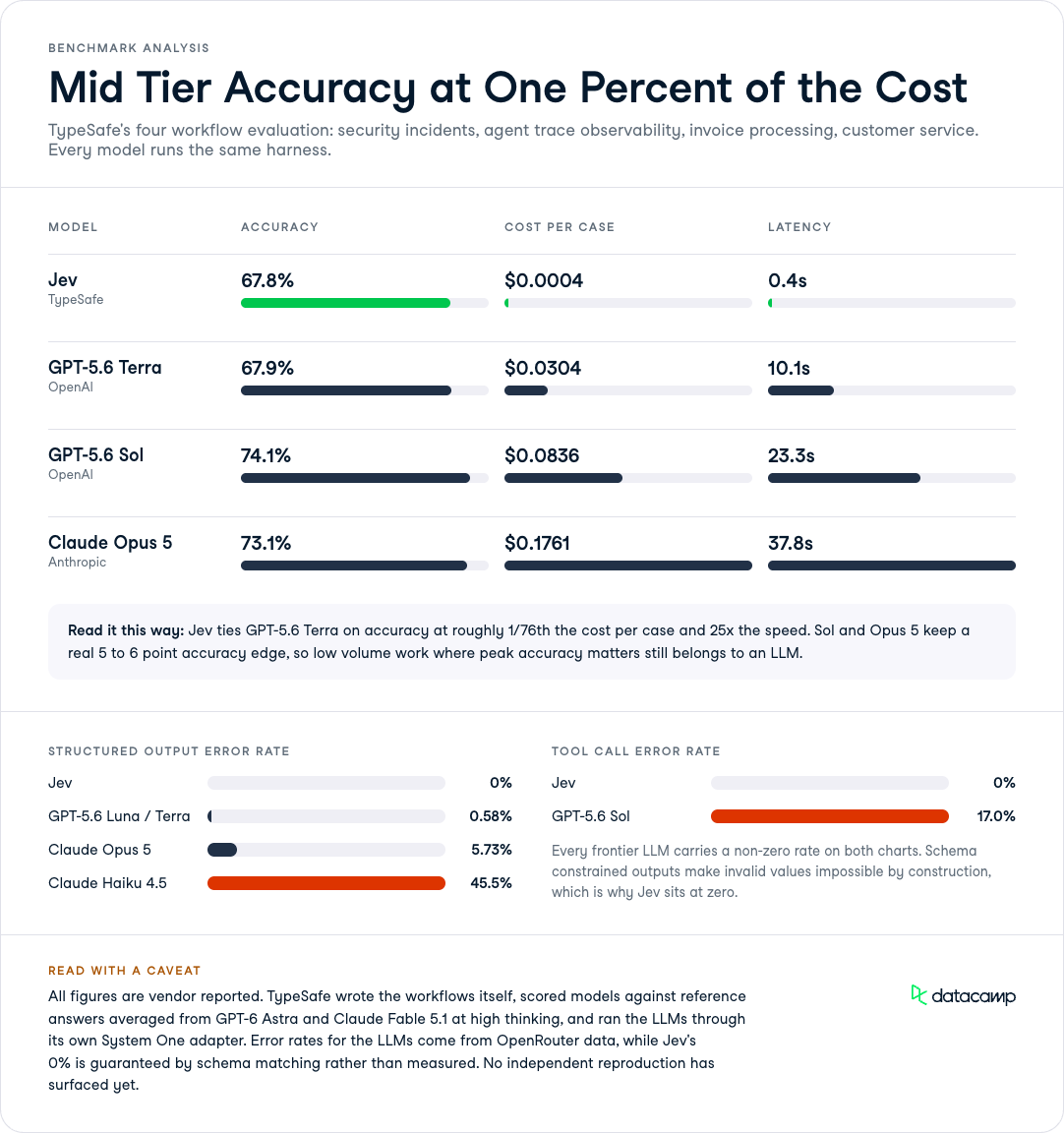
In its four internal test workflows, Jev matches GPT-5.6 Terra with 67.8 percent versus 67.9, below Sol with 74.1 and Opus 5 with 73.1, with a cost per case of $0.0004, according to DataCamp.
Data from DataCamp analyzing Jev against OpenAI and Anthropic models
That picture leaves a clear trade-off for system designers. Leading models retain five to six points of accuracy in low-volume tasks where every hit is worth gold, while Jev takes the volume where the cent rules. Neither retires the other, and the trick is to split the work between both.
What is an AI that only knows how to decide good for?
On format reliability, Jev declares zero errors by construction versus 0.58 percent for OpenAI's small models, 5.73 for Opus 5 and a striking 45.5 for Haiku 4.5, with Sol at 17 percent failures in tool calls.
A format error buries an unattended workflow at three in the morning, and that is why the schema guarantee weighs as much as speed for teams that automate seriously every night.
Jev shines where the decision repeats millions of times with answers known in advance. Classifying and routing tickets, scoring customers, extracting fields from invoices, monitoring other models' responses and detecting jailbreaks are jobs of that kind, and TypeSafe sums them up as fuzzy if statements that code uses without fear.
Monitoring language models themselves
There are official SDKs for Python and JavaScript that let you declare the schema and call the hosted API, which makes it easy to integrate in minutes into workflows that already exist in your company.
Another natural fit is monitoring language models themselves, with Jev as a judge that scores each response, detects data leaks and stops improper uses before they reach the user.
Because that control runs on every call, the tenths-of-a-second latency and the cost per case of $0.0004 make it viable where a large judge would ruin the team's budget every month.
The door to real-time interactive systems
Speed also opens the door to real time, where a large model cannot reach. TypeSafe showed Jev playing Doom by reacting to the game state about ten times per second at an approximate cost of seven dollars per hour, and solving Wikiracing by choosing among hundreds of links without making up a single one.
A hand-programmed bot would play better, but the point is that Jev decides intelligently in states it has never seen, something rigid code cannot do when the context changes.
Jev AI playing Doom
The ridiculous price per decision also makes it possible to sweep gigantic datasets that would be extremely expensive with a frontier model. Scoring a store's 50 million reviews for sentiment and policy violations would cost about $20 at the stated rate, versus thousands with a large model.
In practice, both worlds combine, with Jev as a fast layer that classifies and routes and a large model for the few difficult cases that require written explanation and open human judgment.
What should be scrutinized before celebrating?
Almost all the spectacular figures come from TypeSafe itself and do not yet have an independent replication. The four workflows were written by its capabilities team and the reference answers average two specific OpenAI and Anthropic models.
The company itself admits that the peaks of 193.6 times faster and 444.6 times cheaper are at the high end of what is expected. The independent analysis by TrueFoundry insists on reading the intelligence parity as promising rather than settled.
There is a conceptual nuance worth not losing. Jev cannot make up a field or return an invalid format, but it can choose the wrong allowed category with high confidence, and that is an error of judgment, not of format.
Jev does not generate text or explanations
TypeSafe's answer to that risk is calibration, precisely the property that no external lab has yet verified, and the model also arrives as a proprietary API with no weights or technical paper.
There are practical limits that the launch acknowledges. Each choice question accepts up to 255 options and above that there is a two-phase system that scores and then chooses, with somewhat less speed.
Jev does not generate text or explanations, so a regulated team that must justify why it denied a request will have to route those cases to a model that writes the reason and leaves an auditable trail.
In this way, TypeSafe's move targets the economy rather than cleverness, because every order of magnitude that the cost of deciding falls opens uses that were not worthwhile before.
The Jevons paradox says that the efficient steam engine triggered coal consumption, and Almeida expects the same from cheap intelligence, a continuous spread of automatic decisions into every corner of software.
The problem is that no one outside TypeSafe has verified whether calibration holds in others' hands or whether the $0.042 price will survive without subsidy when the waitlist opens fully.
If both answers come back affirmative, teams will stop asking which model they use and move on to deciding which task deserves each type of model, with a stable orchestration layer always in front.