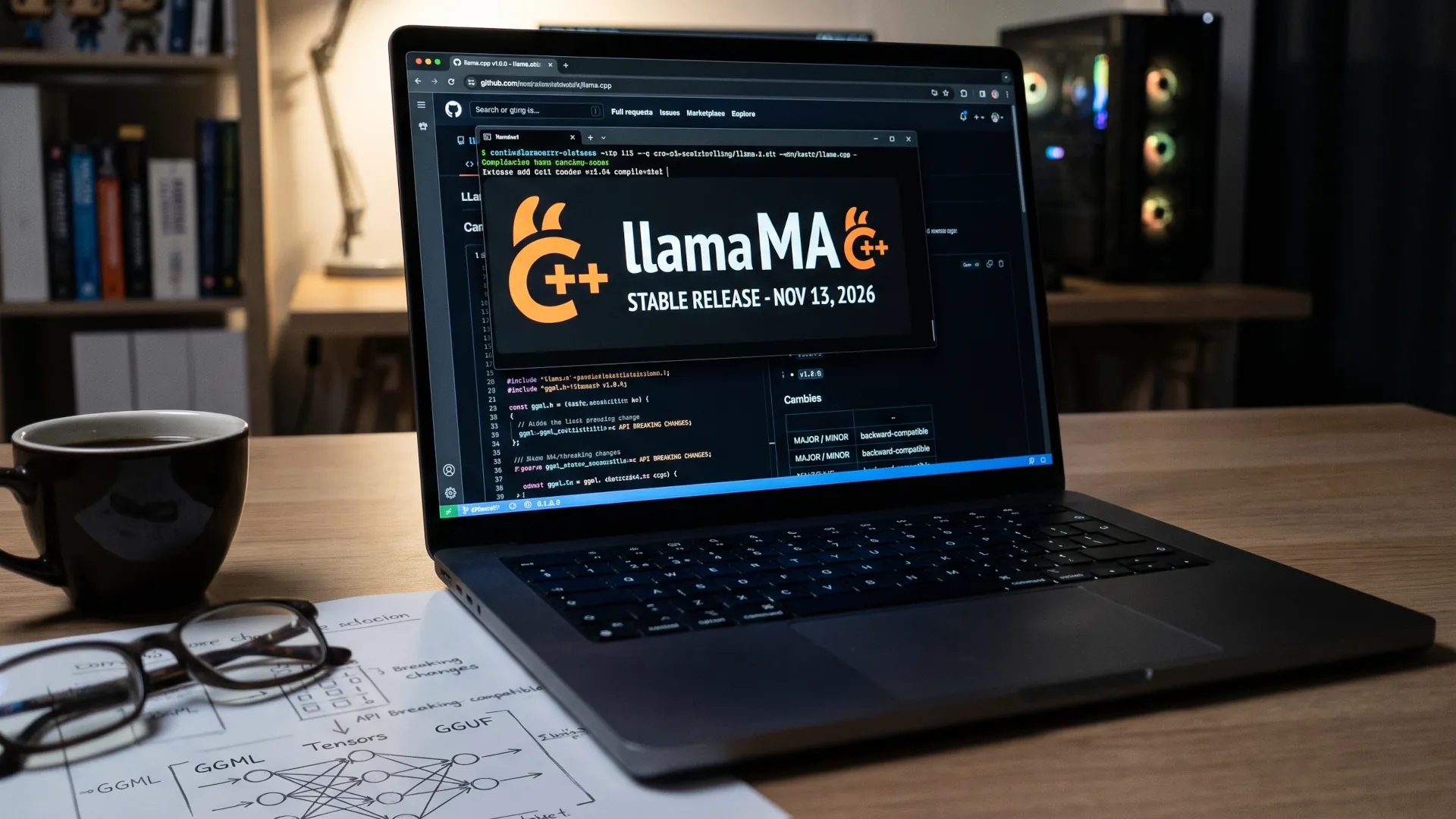
On November 12, 2026, Edge0 published two open-weight models, Edge0-145B and Edge0-120B, alongside the inference engine that runs them. The figure that frames the story is the size: 145 billion parameters on a laptop, with a stated peak of 29 GB, more than 80 tokens per second when generating and a 128K to 256K token window, according to the Edge0-145B announcement.
Until September 2026, the artificial intelligence that fit on a personal device stayed below 10 billion parameters. Apple Intelligence's local model was around 3 billion, and Gemini Nano came in versions of 1.8 and 3.25 billion. The 35B that Edge0 launched for phones already needed 2.5 GB and delivered 37 tokens per second on an iPhone 18 Pro Max.
The jump in scale is not incremental: it quadruples the ceiling for the category and moves to a laptop a task that until now required renting compute. It is worth separating two things from the outset, because the announcement conflates them. The model exists and has downloadable weights, and the company presents it as the first open 145-billion model that runs on a personal device. The performance figures come from the manufacturer, with no independent replication, and the license is not that of a conventional open source project.
The architecture that makes the size possible
A dense 145-billion model would occupy, at 4-bit quantization, more memory than any laptop has. Edge0 sidesteps that wall with a sparse mixture of experts: 512 experts per layer, of which only 10 plus one shared one work on each token.
The result is about 10.12 billion active parameters per step, according to the model cardThe separation between total and active parameters explains the arithmetic miracle: the engine does not need the 145,000 billion in memory at once.
The design splits the work across three tiers. The hot experts live on the graphics card, a library of about 40 GB waits in system memory, and the vocabulary table, some 48 GB, is read from disk when needed. Reads overlap with computation so the machine does not sit idle.
The price of that design is paid in latency and disk speed. Each token may require fetching an expert that was not resident, and at that point the machine stops resembling a server and starts resembling a program waiting on the storage bus. Speculative decoding offsets part of the bill.
The manufacturer's figures, one by one
Edge0 compares its model with Qwen3.8-Flash-Next, DeepSeek-V4-Flash-0731 and Claude-Opus-4.6 across six tests. The results are in the announcement and in the model card, and they match because they come from the same lab. The average puts Edge0-145B at 72.8 points versus 71.7 for the closest rival, with a declared footprint of 29 GB against an estimated 70 GB for Qwen at 4 bits.
| Test |
Edge0-145B |
Qwen3.8-Flash-Next |
Claude-Opus-4.6 |
| Code and agents (DeepSWE 1.1) |
64,6 |
58,7 |
no data |
| Terminal-Bench 2.1 |
86,5 |
83,3 |
78,2 |
| Reasoning (GPQA-Diamond) |
90,4 |
91,7 |
91,3 |
| Instruction following (IFBench) |
80,6 |
81,3 |
62,5 |
| Long context (AA-LCR) |
79,3 |
79,1 |
78,0 |
The table disproves the claim that the local model sweeps the frontier models. It wins where tool execution calls the shots and loses by tenths of a point on expert knowledge. What does support the commercial argument is the relationship between score and memory: a 72.8 average in 29 GB is a combination that until now required a machine costing several thousand euros.
Speed depends on the weight format and the chip. The Q3_K variant reaches 2,169 tokens per second for prefill at 4K and 99.7 in conversation on a 24 GB RTX 5090 D, while NVFP4 drops to 1,839 and 79.6. On an Apple M2 Ultra with Metal the same model stays at 60.9 tokens per second.
That last figure matters because the laptop in the promotional example is a MacBook Pro. The 80 tokens per second in the headline were measured on a high-end graphics card connected via PCIe, not on the computer most readers have on their desk.
The license is not Apache and the Mac is not there
The repository presents itself as open weights, and it is in the literal sense: anyone can download them. The license, however, is the Edge0 Community Model License 1.0, stacked on top of the Qwen Community License 1.0. The model is based on Qwen3.8-Flash-Next, so anyone using it must comply with both sets of terms.
The license authorizes personal and research use, as well as internal use and commercial exploitation of what you generate. Selling the model or building a commercial service with it, by contrast, requires a separate agreement with the company. It is a legitimate business decision and a real obstacle for anyone planning to integrate it into a product.
The contrast with what the rest of the industry publishes is the most uncomfortable part of the launch. A mid-sized model such as Nanbeige4.3-33B, with Apache 2.0 and 524,288 tokens of context, allows redistribution and charging without asking anyone.
There is a second piece of fine print that the announcement glosses over. The text says the model works out of the box on macOS, Windows and Linux, with support for Apple M chips and for RTX Spark, 4090 and 5090. The build instructions in the spec point to NVIDIA GPUs with CUDA 13 on Linux or Windows.
The spec adds that the M2 Ultra measurements use Metal but do not certify that a macOS version exists. In other words, the model is benchmarked on a Mac and packaged for Windows and Linux. For an Apple user, the announcement promises more than the day-one package delivers.
The 75 points and 18 comments that the Hacker News thread had accumulated by that same November 12 confirm the interest and the skepticism in equal parts. Several participants noted that the NVFP4 version only runs on Blackwell and that the release came with no executable for Mac. The discussion is, for now, the only public review of the launch.
What it costs not to pay for tokens
The cost argument has two halves and only one is usually told. The first is that local inference pays no per-token fee, something already measured: the calculation that local AI can be up to 70 times cheaper than commercial APIs comes from comparing cost per task.
The second half is the bill that does not disappear. A laptop capable of running this model costs money, draws about 120 W sustained according to the manufacturer and heats up like an intensive work machine. Electricity and depreciation are fixed costs, and anyone making twenty queries a day will take years to recoup what an API would charge them in months.
The calculation flips sign in agent tasks, the ones that chain dozens of steps with failed executions and corrections. There the cost per task in the cloud multiplies and the local one stays flat. Edge0 illustrates the point with projects lasting several hours, from a Manhattan scene in Blender to the design of a board in KiCad.
None of those demonstrations comes with a reproducible log, and that is the gap. The video proves that someone chained the tools; it does not prove how many times it failed beforehand or how much human intervention there was behind the scenes. The difference between an agent that finishes and one that appears to finish separates a demo from a product.
The test that has not yet been done
The question that decides the future of this model is not technical, because the design is published and can be audited. It is social: if an independent lab reproduces the figures on a 48 GB laptop, Edge0 will have shifted the floor of the category. If it does not reproduce them, it will remain a brilliant demonstration with a restrictive license.
The sector has spent months debating whether access to the model is the strategic variable. The case of Gemini 4 Carbon, which Google reserves for selected advocates, showed the closed version of the same dilemma. Edge0 does the opposite in form and the same underneath: it publishes the weights and keeps the commercial key.
While that test arrives, it is worth holding on to the fact that depends on no one. A model with 145,000 million parameters, 10,120 million active, 256K of context and 40.81 GiB of weights fits today on a laptop's disk. That it is also fast, cheap and free of ties is the part the manufacturer still signs off on.