For years, Silicon Valley giants pushed a convenient narrative: frontier artificial intelligence was territory reserved exclusively for billion-dollar corporations capable of erecting cathedrals of compute and subsidizing colossal electricity bills. However, the cracks in this private monopoly model have turned into an irreversible tectonic rupture.
The proprietary paradigm, led by emblematic firms such as Anthropic and its Claude series, today faces an existential crossroads. The launch of open-weight models like Kimi K3 (developed by Moonshot Labs) and Qwen 3.8 (from Alibaba) shows that the performance frontier is no longer the exclusive fiefdom of closed software. These models not only match or surpass the analytical capacity of proprietary giants like Claude Fable 5, but they do so at a drastic fraction of the cost and with the intrinsic possibility of being deployed, modified and audited sovereignly by any infrastructure on the planet.
Vitalik presents a prototype of an anonymous social network on the Aztec blockchain
The relentless economics of compute
The battle for supremacy in AI has ceased to be solely a software architecture challenge and has become a war of infrastructure economics. To understand why proprietary models are losing ground, it is essential to analyze the value chain of inference cost, that is, the real operating expense when a user submits a query to the neural network.
Building a model requires three basic assets: research through human talent, compute through accelerator chips and electricity. Once trained, the recurring cost of serving the model is dominated by data centers and energy.
Three types of key players coexist on this board. On one hand are the owners of energy and data, such as SpaceXAI or Meta, which build their own data centers and power plants to turn their variable costs into fixed ones. On the other are the integrated cloud giants, such as Alibaba and Google, which amortize inference through gigantic pre-existing architectures.
Finally, there are the pure model labs, startups like Anthropic or Knowledge Atlas that must rent compute and pay market electricity rates to third parties.
The collapse of inference costs
For a pure lab, every query represents a direct cost that scales linearly with revenue. Without ownership of servers or energy, the only way to survive is to charge a margin on every query. The problem arises when open competitors offer equivalent performance at an abysmally lower cost.
That is why, when comparing the economic efficiency per intelligence task, the difference becomes overwhelming. Models like DeepSeek V4 Pro offer the lowest base cost at just $0.04 USD per task. They are closely followed by open-source alternatives such as gpt-oss-120b at $0.06 USD and NVIDIA's Nemotron 3 Ultra at $0.23 USD. Commercial and open frontier models like GLM-5.2 (Max) and Moonshot's Kimi K3 operate in the $0.47 USD and $0.95 USD range respectively.
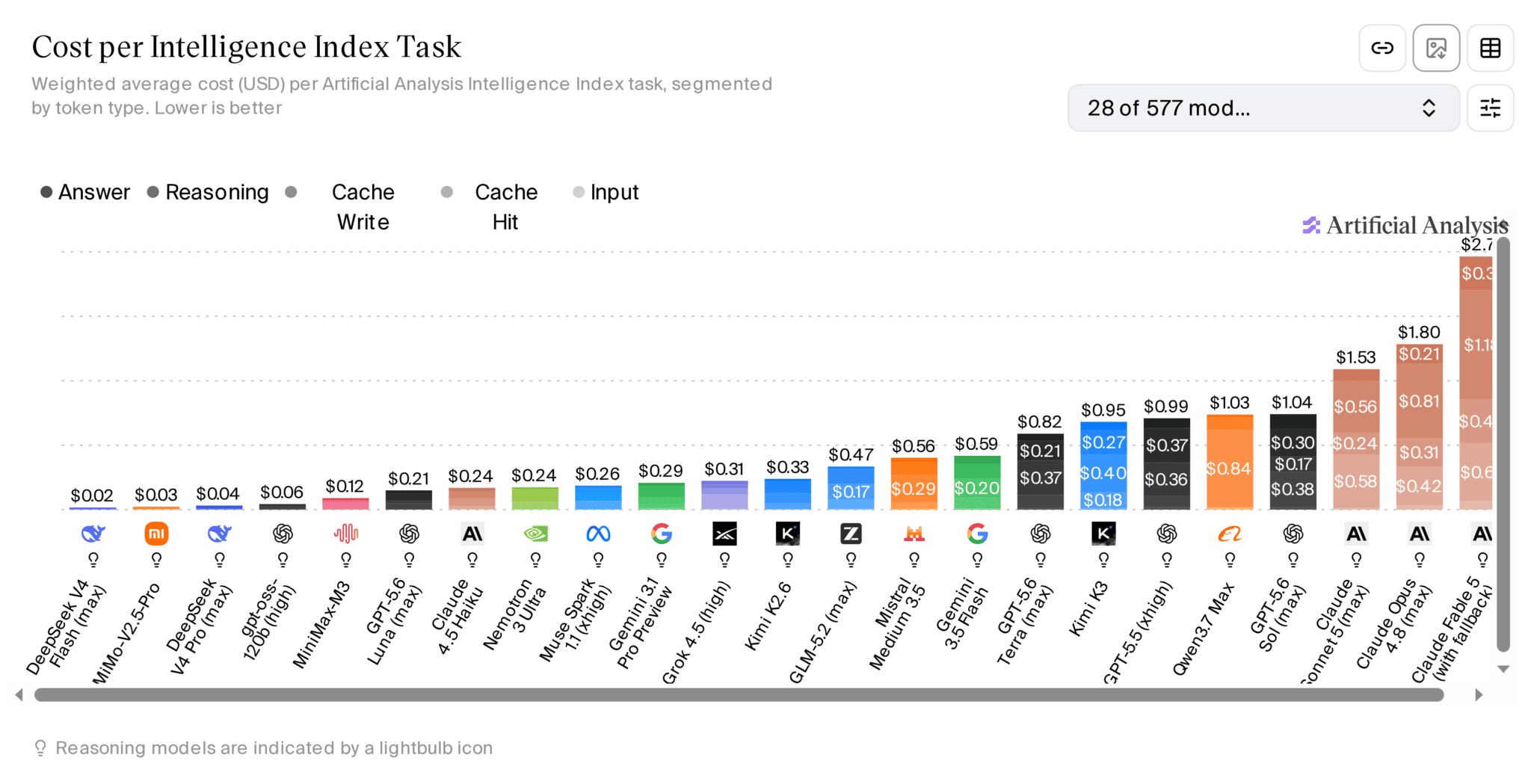
By contrast, closed proprietary options show substantially higher figures: OpenAI's GPT-5.6 Sol (Max) sits at $1.04 USD, while Anthropic's Claude Fable 5 reaches $2.75 USD per task. As the operational evidence shows, running a complex task on Claude Fable 5 is almost three times more expensive than on GPT-5.6 Sol and up to sixty-eight times more expensive than on advanced open models. Faced with this asymmetry, the competitive advantage of proprietary restriction is dissolving rapidly.
The society of AI agents: When machines start debating each other
The dismantling of the «Harnesses» and the rise of the community
The initial response of companies like Anthropic to the loss of exclusivity in base models was to build wrapping application layers or captive ecosystems, known as harnesses, among which Claude Code and various guided interaction systems stand out.
An example of these changes can be seen recently, with the fact that Claude Code is now not available on platforms like npm, which limits the scope of use of that tool, something that affects several operating systems such as OpenBSD or NetBSD, where the current Claude Code tool can no longer be used.
However, software history shows that closed environments can rarely compete against the speed of community iteration. Open-source projects like OpenCode, OpenClaw and Hermes have shown that the barrier to entry for creating control interfaces, agent orchestration and integration with development environments is virtually nil.
While erecting a hundred-million-dollar base model requires colossal capital, developing the interaction software surrounding the model is within reach of thousands of global developers iterating simultaneously. The proprietary model tried to sell the enclosure as a security advantage, but the open community showed that the enclosure only served to inflate the final bill.
Real-world impact? +400 CVEs in the Linux Kernel in just 24 hours
But what real impact does all this have? Where is the substance? The answer lies in an unprecedented milestone: the Linux kernel security announcements list recorded the massive, uninterrupted publication of more than four hundred common vulnerabilities and exposures identifiers, or CVEs, in just 24 hours, all of them driven by AI.
And we are not talking about low-quality reports; we are talking about real reports, with well-documented code, fixes and review by figures of the caliber of Greg Kroah-Hartman, the second in command of the Linux kernel. Perhaps the worst part is that close to 70% of all reports are classified as HIGH/CRITICAL, which sends a powerful message: the use of AI will be vital for software development and the wave of «rejection» of this technology could be swept away by the technology's potential to help solve this type of problem.
A vital tool for development
After all, previously, hunting for memory bugs, race conditions or resource leaks in the kernel required months of manual analysis by highly qualified engineers. Today, open models adapted locally are inspecting millions of lines of C code at massive scale, identifying anomalous patterns that had remained hidden for decades.
This event highlights the true paradox of the democratization of technology. On one hand, it guarantees sovereignty at the local scale, since a development team or a public entity cannot afford to send internal or critical infrastructure source code to Silicon Valley's proprietary APIs for reasons of cost and confidentiality. On the other, it enables a fully decentralized audit, because by having frontier-level open models running on local servers or private nodes, organizations can subject their operating systems, databases and kernels to continuous security reviews without depending on third parties.
AI Agent Economy Observatory, a new section in our newspaper
Geopolitical reconfiguration of access to technology
The proprietary paradigm tried to sustain its hegemony through regulatory pressure, seeking to close the market under the argument of existential risks, as well as through trade blocking. However, the emergence of labs like Moonshot Labs with Kimi K3, Alibaba with Qwen 3.8 and Zhipu with GLM 5.2 shows that the knowledge frontier is a distributed phenomenon.
The mass adoption of open-weight AI ensures that access to computational cognitive capacity cannot be blocked through sanctions, fees or corporate monopolies. Soon, a university in Latin America, a hospital in Africa or a startup in South Asia will have at their disposal the same analytical power as a Fortune 500 corporation, running on their own local or regional infrastructure.
The end of the illusion
And we are witnessing the breaking of an illusion. The idea that a single company would maintain a monopoly on artificial general intelligence through a closed and expensive API has become outdated in the face of the strength of free software. Neither Anthropic, nor OpenAI, nor SpaceXAI will be able to do so. Here, perhaps, Elon Musk's musings, when he says that OpenAI was born with a vision to build free AI, are entirely right, no matter what Sam Altman says to the contrary.
Because, just as Linux ended up powering all supercomputers and the global cloud despite corporations' initial efforts to discredit it, open AI models are conquering the substrate of technological development.



