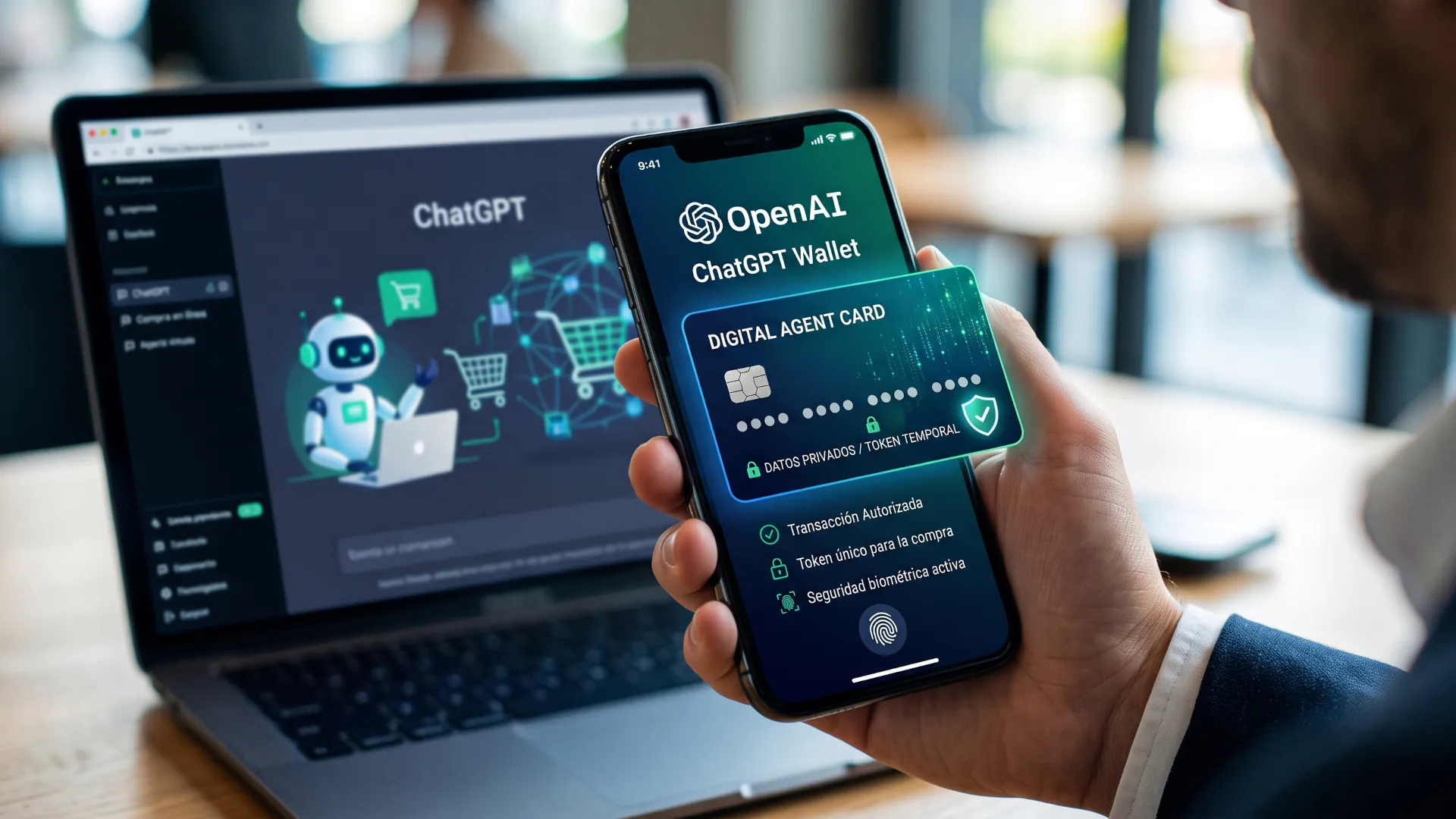
On November 13, 2026, OpenAI opened the ChatGPT wallet with a concrete promise: the agent buys and never sees the card number. The ChatGPT Wallet announcement describes it as the first wallet that requires a security check on every transaction and that preserves the card's rewards and protections. The figure the company repeats to justify the move is the 1.2 billion people who use ChatGPT every week, compared with almost 100 million paying accounts at the end of the third quarter.
What matters is not the new object but the signal the store receives. Until now an anti-fraud engine decided based on the device, the network address and that buyer's history; with the wallet it receives a network token and an agent identifier. A system trained to tell humans from bots sees a bot approving a purchase with its owner's face and with the backing of the card network.
The rollout is narrow: ChatGPT Pro, over 18s, a card issued in the United States and the dots agents. No cryptoassets, no balance and no stablecoins. The usual card, tokenized by the usual network, and the merchant deciding whether to accept that cart.
A card that exists only for one purchase
The flow has three steps and none of them is autonomous. The user saves the card once and asks their dot, one of the agents OpenAI presented in September, to look for something. Before paying, they review the item, the total and the chosen card on screen.
Approval goes through a biometric check on the device and leaves a record of exactly what was authorized and for how much. Each permission is valid for that order: if the agent wants to buy something else, it asks again.
After signing, the network issues a payment token with its own number, security code and expiry, valid for that transaction. The merchant charges the amount to the user's card, but neither the store nor the agent receives the real data. The agent does transmit the shipping address and contact details, essential to fulfil the order, so the merchant keeps the relationship and the logistics even though it loses the card number.
The wallet relies on the checkout page that already exists and does not require a new integration to accept the token. Launch coverage adds two practical details: the card's rewards are maintained and disputes over defective products follow their normal course. What there is not yet are spending limits or purchases pre-authorized by the user.
| Party |
Examples |
What it controls |
What it assumes |
| OpenAI |
ChatGPT and the dots |
Shows the order and collects approval |
Does not open an account, hold a balance or lend money |
| Card network |
Visa, Mastercard, American Express |
Issues the token for that purchase |
Applies its dispute rule |
| Issuing bank |
The user's bank |
Authorizes the charge |
Handles the unrecognized charge |
| Merchant |
The store |
Price, stock and delivery |
Returns, fraud and customer service |
| Anti-fraud |
Forter, Riskified, Sardine and Signifyd |
Scores the token's risk |
May mistake the agent for a bot |
| Gateway |
Adyen, Checkout.com and Stripe |
Processes the merchant's charge |
Declines or settles the sale |
The merchant loses the buyer's signals
Accepting the token does not solve the underlying problem: the store no longer sees the buyer. A mid-sized merchant's anti-fraud system compares the device, geolocation, typing speed and account history; the agent arrives from a cloud browser, on behalf of a person who is not watching. That gap explains why OpenAI published a manual for merchants on the same day as the announcement.
The Commerce Partner Playbook calls for four things. Claim the business inside ChatGPT and upload a catalogue with up-to-date prices and availability. Configure the firewall or the distribution network to recognize requests signed with Web Bot Auth. Coordinate with your risk provider so the token does not flag as suspicious. The manual also suggests building plugins or WebMCP tools to check stock and manage the cart without leaving the conversation.
On risk, the company says it works with four anti-fraud firms and three payment gateways, which appear in the table above and which should recognize the pattern as a legitimate purchase. It is a promise of coordination, not a published standard: each merchant will have to check with its provider whether its engine accepts the agent's token or blocks it in the first week.
Two refusals set the tone for the ecosystem. Amazon prevents agents from buying on its marketplace and prefers to push users toward its own assistant. United Airlines announced on November 11, 2026 that it will block agent access to its booking systems.
Two of the country's largest consumer storefronts are left out of the wallet. The battle between commerce protocols for agents explains why each platform wants the agent to speak its language.
Who is liable when the agent buys wrong?
The wallet's terms, in force since November 12, 2026, distribute risk without moving it from where it sits. OpenAI does not open a payment account, does not hold a balance and does not extend credit; the issuer remains the user's bank and the network, the usual one. The same document warns that artificial intelligence systems make mistakes and that approval covers only what appeared on screen, so an order with a misspelled address is not cancelled on its own.
The split is as follows: the merchant is liable for delivery, stock and the fraud decision; refunds are requested from the store; and an unrecognized charge is claimed from the issuer, which applies the network's dispute rules. The wallet does not change the chargeback regime, it only changes who presses the button. The launch of the wallet to pay for purchases arrives with no transaction fee, and OpenAI has not promised to keep that zero.
The choice of rail also says something. Cards already have network tokens, a dispute framework and acceptance at millions of merchants; an instant bank transfer would force every store to integrate something new and give up chargebacks.
Mastercard's stablecoin payment in 11 currencies shows that programmable money already moves business-to-business payments, but it does not solve the consumer cart or the refund of a shirt bought by an agent.
What comes next is in the announcement: spending limits, permitted categories and time windows so the agent can buy without asking every time. There the wallet stops being a borrowed card and becomes a standing mandate. The micropayments for autonomous commerce discuss that same piece, that of an agent that pays within a budget rather than transaction by transaction.
The toll the merchant pays without seeing it
A merchant that accepts agents gains purchase intent already cooked and loses the raw material of its anti-fraud system, which is the human's trail. It also accepts a buyer who does not browse its website, does not remember its brand and delegates the refund to someone who never saw the product. The trade-off is volume, and in a long catalogue volume trumps almost everything else.
The question that will decide the rest is whether the network token is enough as identity. If the networks and gateways accept the pattern, the wallet becomes invisible and the agents' cart will look like a mobile one. If they do not accept it, it will remain a ChatGPT feature for small stores, with Amazon and the airlines watching from outside. On November 13 the first door opened and it is still narrow.