Meta launches Muse Ember, its cheapest model per token
On November 9, Meta introduced Muse Ember, the smallest model in its family and the cheapest per token: $0.10 per million input tokens and $0.50 per million output tokens, with a one-million-token context window and the ability to read text, images, audio, video and PDF. It is not competing to be the smartest. It is competing to be the one that carries out the boring tasks an agent repeats all day, such as calling tools, routing requests and extracting data from long documents.
The move is consistent with what is happening in the market. For months, labs have been releasing frontier models with falling prices and new names every week, while the real bill for those building agents comes from the thousands of small calls nobody looks at. Meta is entering exactly there, with a model that costs a tenth of what a large model does and that, in several tests of repetitive tasks, comes out ahead of more expensive rivals.
The detail that sets Ember apart from any run-of-the-mill budget model is the combination of price and context. A one-million-token window allows a code repository or a set of documents to be fed in a single call, and output supports up to 512,000 tokens. That capacity, at that price, turns tasks that previously required breaking the problem into chunks into something that is solved in one go.
A multitasking model
The model's spec sheet lists specific uses, and they all have something in common: they are tasks that are repeated hundreds of times a day and do not need the reasoning of a large model.
Meta's documentation is explicit about the intended use: tool calls, coding subtasks, routing, extraction and analysis of lengthy documents. It is the work an agent does dozens of times in a session and that does not require the deep reasoning of a large model, but rather speed, context and a cost that does not blow the budget.
The presentation of Muse Ember also positions it as part of a two-tier system. The large model, Muse Wonder, plans and orchestrates; Ember executes the volume. That division of labor is the same one other labs already apply, and it responds to a simple economic reality: there is no point paying for frontier reasoning on a task that consists of reading a JSON and returning a field.
Muse Ember data
In multimodality, the model covers considerable ground for its size. It accepts images, audio and video as input, which allows an agent to interpret screenshots, charts, scanned documents or voice notes without turning to a different model for each format. It returns text; it does not generate image or audio, a reasonable limitation in a model designed to execute.
Meta also publishes the architecture figure, which helps explain the price: 816 billion total parameters and 42 billion active per token. It is a sparse model, and that is why it can offer a one-million-token window at a rate that two years ago would have looked like a typo.
Prices and the 200,000-token threshold
The input rate is the lowest in the Muse family and hides a billing catch worth understanding before scaling an application that already works in testing with few users.
The rate of $0.10 and $0.50 per million applies only to requests of up to 200,000 input tokens. Beyond that, Meta's pricing table it switches to 0.30 and 1.50, and it does so for the entire request, not just for the part that exceeds the threshold. A 200,000-token prompt and a 200,001-token prompt pay different rates for the whole.
That detail matters more than it seems in a model that boasts about context. An application that puts an entire repository into every call can cross the threshold without realizing it and triple the bill. The obvious recommendation, which the documentation itself hints at, is to measure prompt sizes before scaling up and to use caching, which lowers the price to $0.004 per million repeated input tokens.
The price of caching
Caching is the real cost lever in this type of model. An agent that works on the same documents during a session can keep the context stable and pay only for what is new, which makes the cost per task plummet. For a system that makes a hundred calls a day on the same manual, the difference between caching and not caching is the difference between a viable project and one that gets shut down.
That lever also changes product design. A well-built agent reuses context and measures what it costs; a poorly built one resends the same prompt every time and pays the full price at every step.
There is also a licensing decision worth reading. Muse Ember is proprietary and distributed under Meta's model license, with acceptable use policies. The weights are not open, so anyone integrating it depends on the provider maintaining the model and the prices. It is the same relationship that exists with any commercial API, and in a component that can be the centerpiece of a product, it is worth keeping in mind.
The comparison that matters
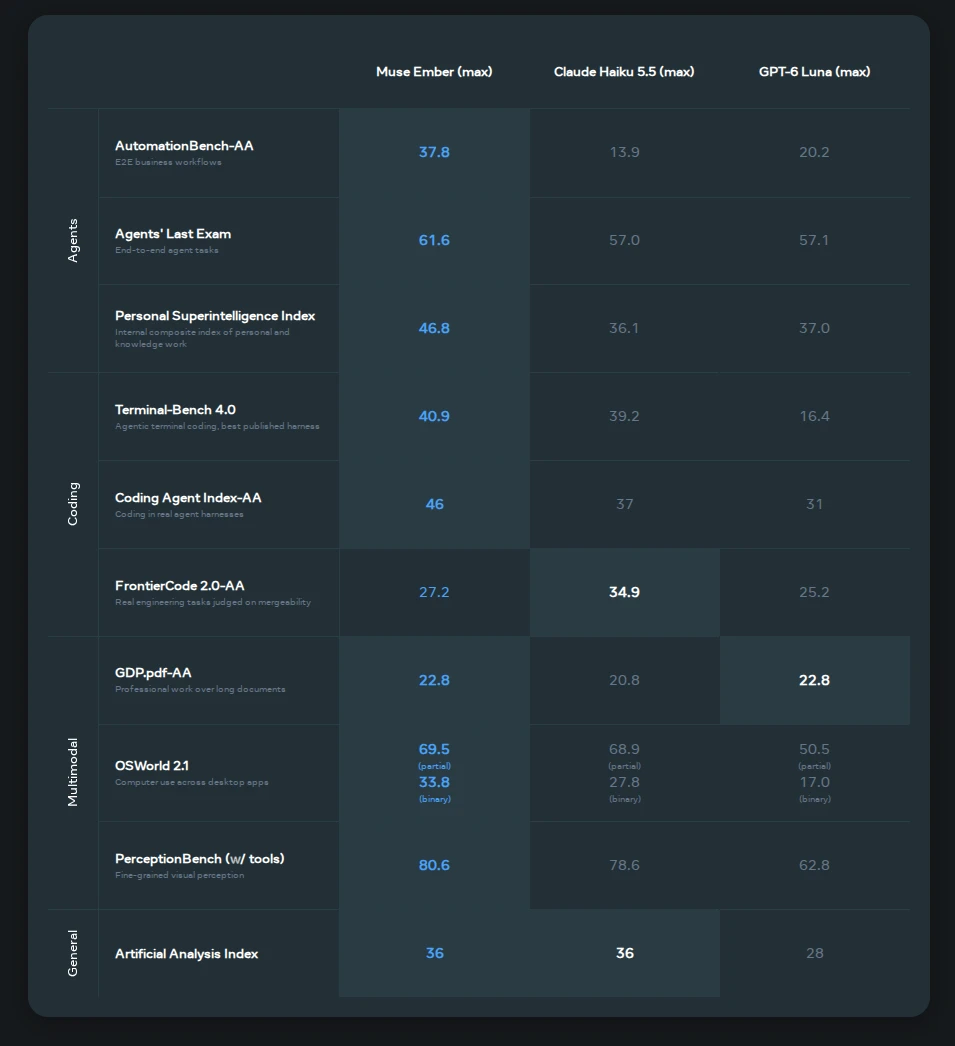
Meta publishes an evaluation table in which Ember wins several tests against Claude Haiku 5.5 and GPT-6 Luna, its two direct rivals in the budget tier, although it loses in the one that measures merge-ready code.
In AutomationBench, which measures end-to-end business workflows, it scores 37.8 versus 13.9 and 20.2. The Agents' Last Exam test comes in at 61.6, ahead of 57.0 and 57.1. In Terminal-Bench 4.0, which evaluates terminal programming, it gets 40.9 versus 39.2 and 16.4.
It does not win on everything. In FrontierCode 2.0, which judges engineering tasks by their ability to be merged, it stays at 27.2 versus 34.9 for Haiku 5.5. On Artificial Analysis's aggregate index it ties at 36 with the Anthropic model and beats the OpenAI model's 28. The honest reading is that Ember is competitive at task execution and somewhat weaker at production code, which is exactly the profile Meta promises.
The reference figures come from the manufacturer and are selected to show the product in its best light, as happens in every launch in this industry. An independent evaluation takes weeks to arrive and usually qualifies the narrative. In the meantime, what is verifiable is the price, the context size and the availability, which is already in Meta's API and in Muse Code.
The agent business is decided in pennies
For two years the conversation about artificial intelligence revolved around which model reasons best. In 2026 the center of gravity has shifted to cost per task, because the products that work are not the ones that answer a brilliant question, but the ones that execute a thousand steps without the bill eating the margin. Muse Ember is Meta's response to that economy, and its price forces the others to move. The price war was already under way before: Gemini 4 Carbon landed with a promotional rate four times lower than Anthropic's, and each launch nudges the floor a little lower. The risk of the tool chain was already seen with Claude Code credentials leaked in 1,122 public repositories, a reminder that the agent also inherits the flaws of whoever operates it.
It remains to be seen whether the model holds up under real-world use, with messy prompts, tools that fail and documents that do not fit. Lab numbers and production numbers look little alike, and the verdict will come with the first serious integrations. What is already clear is that the economy tier of models is no longer a dumping ground for old versions and has become the business line where it is decided who sells agents.