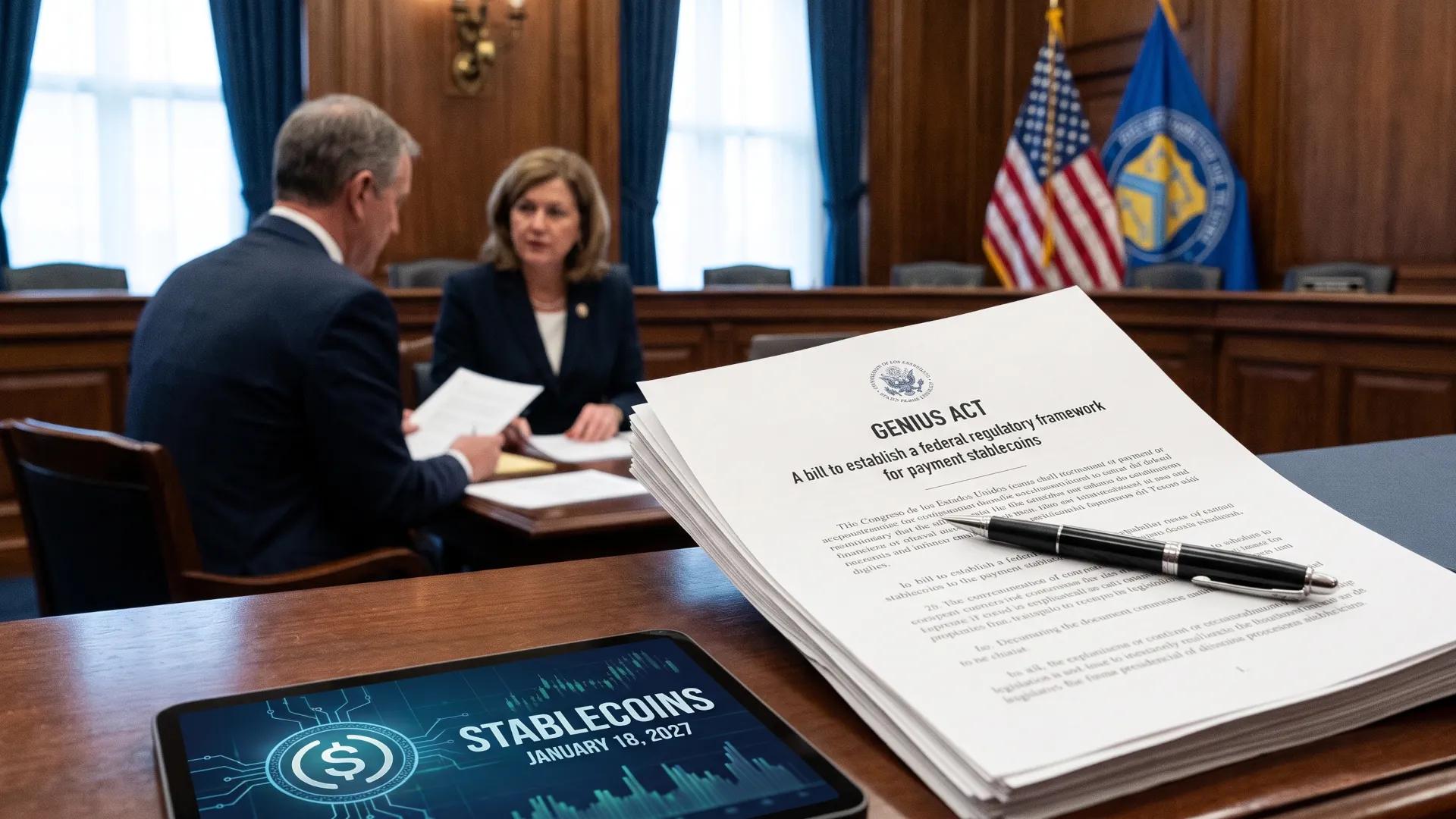
At a time marked by a profound regulatory restructuring of global financial markets and the consolidation of a pro-technology framework in the United States, President Donald J. Trump signed an Executive Order of historic significance titled "Integrating Financial Technology Innovation into Regulatory Frameworks."
This new presidential directive seeks to dismantle the bureaucratic barriers that have traditionally excluded financial technology firms and cryptoasset issuers from national payment systems, opening the door to unprecedented integration between sovereign monetary rails and distributed ledger technologies.
In short, the order instructs supervisory agencies to simplify regulation and formally requests that the Federal Reserve evaluate and design safe mechanisms to grant payment accounts and settlement services to non-bank financial institutions and digital asset platforms.
How Fireblocks could connect European banks with the AI economy
Political context and objectives of the new presidential directive
This Executive Order is part of a systematic and integrated government strategy to consolidate US leadership in the global digital asset economy. Since the creation of the Working Group on Digital Asset Markets in early 2025 and the formulation of a Strategic Bitcoin Reserve backed by federal seizures, the current administration has prioritized the deregulation of advanced financial services. Official government policy holds that the growth of financial technology firms and the free circulation of cryptoassets represent critical engines of economic opportunity for citizens.
Accordingly, the government seeks to update regulatory frameworks inherited from the analog era to enable agile convergence between traditional capital and blockchain infrastructure. The presidential mandate explicitly denounces that existing rules on third-party risk management and access to clearing services unduly favor established banking institutions.
By removing these regulatory protections for incumbents, the state seeks to encourage direct competition that lowers transaction costs and democratizes payment services in the country.
Timeline and scope of the regulatory review
The practical implementation of this presidential order is governed by strict deadlines imposed on the main financial supervisory bodies. Fundamental institutions such as the SEC, the CFTC, the FDIC, the OCC, the NCUA and the CFPB are immediately affected and must submit rigorous audits of the regulatory obstacles applied to technology firms within 90 days.
This review of supervisory rules focuses on simplifying partnerships between traditional banks and non-traditional financial services firms, as well as streamlining the requirements for obtaining national bank charters.
Within 180 days of the directive's signing, each federal financial regulator must have implemented concrete regulatory reforms stemming from that review. These reforms aim to unify criteria on bank licenses, deposit insurance and registration regimes, preventing digital asset developers from being stifled by fragmented bureaucracy.
The Federal Reserve, although excluded from the direct administrative mandate to preserve its monetary policy autonomy, has been given 120 days to submit a complete report to the presidency.
Why is Santander distancing itself from Qivalis's European stablecoin?
The debate over Federal Reserve master accounts and Level 3
Access to so-called master accounts represents the greatest competitive and systemic security advantage within the global financial system. These accounts act as a bank for banks, granting direct connection to high-speed transfers via Fedwire and to real-time transfers via FedNow without relying on intermediary entities.
Under the access guidelines issued by the Federal Reserve in 2022, institutions that are not federally insured and not directly prudentially supervised are classified as Level 3 entities. These institutions have traditionally faced restrictive audits and systematic denials under allegations of systemic and reputational risk.
Recent case law, including disputes brought by firms such as Custodia Bank, demonstrates the historical difficulty digital asset platforms have had in forcing the granting of these accounts through the courts.
However, the recent authorization granted to Kraken Financial by the Federal Reserve Bank of Kansas City to operate with a limited-purpose account marked a milestone in this legal confrontation. The decision validated on a pilot basis the viability of integrating restricted cryptoasset services with the US central bank's payment rails without undermining the stability of the system.
As a complementary response to the Executive Branch's mandate, the Federal Reserve Board formally presented a proposal on May 20, 2026 to create special-purpose payment accounts. These accounts, colloquially known as skinny accounts, are designed to settle only the issuer's own payment activity, without offering access to intraday credit or the discount window. The central bank has proposed pausing the evaluation of individual Level 3 applications until the end of 2026 while this unified framework is defined.
The GENIUS Act, the Clarity Act and the end of Operation Choke Point 2.0
The technology integration directive operates in coordination with the Executive Order on restoring the integrity of the financial system, which meant the end of the so-called Operation Choke Point 2.0.
This controversial informal campaign by the previous administration exerted veiled pressure on traditional banking to exclude digital asset firms. With the new federal order, debanking decisions on political or sectoral grounds are strictly prohibited, forcing regulators to base their examinations on quantifiable and objective financial risks.
This restoration of banking neutrality converges with the imminent entry into force of the Guiding and Establishing National Innovation for US Stablecoins Act, known as the GENIUS Act. Mandatorily in force by early 2027, the GENIUS Act establishes a dual regime of federal and state licenses that legally validates the issuance of dollar-backed stable tokens. However, the legislation expressly prohibits these issuers from paying yields or passive interest to holders to prevent a massive flight of capital from community deposit banking.
At the same time, the legislative acceleration of the Clarity Act in the Senate offers the legal certainty framework the industry has demanded for years. The Clarity Act precisely delimits the jurisdictional boundaries of the market: the CFTC assumes oversight of digital commodities (the category in which assets such as Bitcoin and Ethereum fall), while the SEC retains control over digital representations of securities and investment contracts. In this way, the industry moves from an ad hoc enforcement-based regulatory regime to a structured regulatory scheme.
Warren warns that Coinbase, Ripple and Paxos operate as shadow banks
Project Crypto and the SEC's Innovation Exemption
In line with the presidency's deregulation and competition-promotion guidelines, the Securities and Exchange Commission, under the chairmanship of Paul Atkins, has transformed its stance toward the digital asset sector. The joint Project Crypto program, established together with the CFTC in early 2026, eliminated the duplicate and inconsistent compliance processes that were stifling the development of innovative financial technologies. The approvals granted in March and April 2026 to trade tokenized securities directly on Nasdaq and the New York Stock Exchange demonstrated the efficiency of integrating crypto settlement into Wall Street.
The most advanced expression of this institutional reform materializes in the imminent publication of the Tokenized Equity Innovation Exemption. This measure allows native digital asset platforms to facilitate the trading and clearing of tokenized US equities under considerably reduced registration requirements during a coordinated pilot period. By enabling the listing and exchange of traditional equity instruments on-chain, the SEC tears down the historical physical separation between digital wallets and traditional investment accounts.
The Kevin Warsh era at the Federal Reserve
Kevin Warsh's assumption of the Federal Reserve chairmanship, following his narrow and divisive Senate confirmation on May 13, 2026, adds a decisive macroeconomic dimension to the digital asset integration process. Warsh stands out as the first leader in the central bank's history to hold a direct equity stake in digital asset payment platforms, having divested more than 100 million dollars of his personal wealth before taking the oath. His statements backing Bitcoin as a form of intergenerational digital gold and an effective barometer against fiat debasement signal a profound shift in attitude at the issuer.
DeFi 2026: 1 billion stolen, rescues and attention on Discord
Nevertheless, the direction the central bank will take under his leadership is based on a rigorous differentiation between assets of consolidated value and purely speculative tokens. The Federal Reserve chairman defends the private issuance of stable tokens backed by the US dollar as an indispensable tool for projecting the currency's global hegemony, firmly opposing the development of a centralized state digital currency. Likewise, his monetary hawk profile warns that containing inflation at 3.8% due to global geopolitical tensions will postpone the rate-easing cycle, projecting a tight liquidity scenario in the medium term.