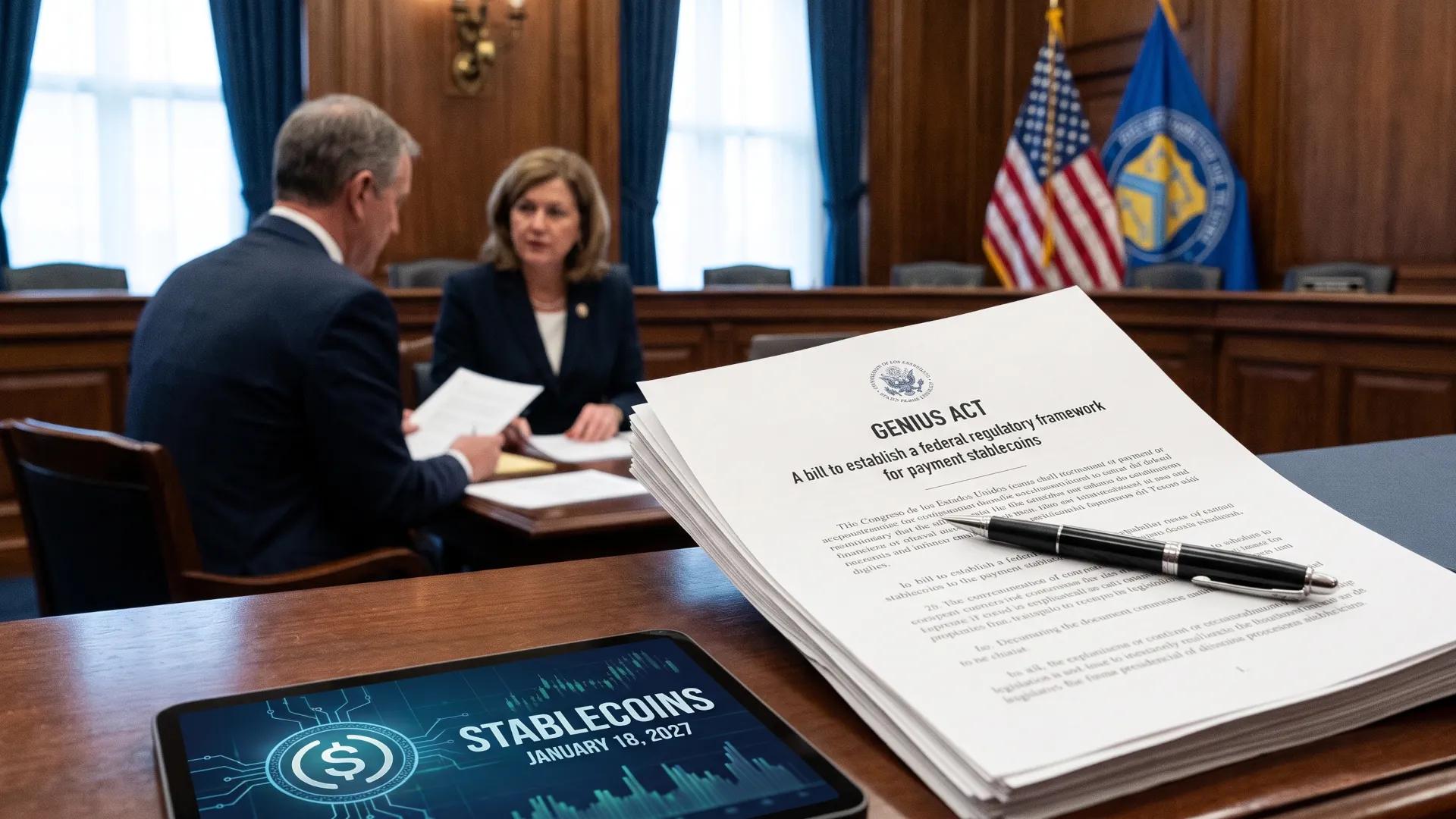
The Democratic victory in the November 3 legislative elections changed the regulatory map for cryptocurrencies in the United States, but it did not touch the one piece that already had a date. The GENIUS Act, which created a federal framework for payment stablecoin issuers, takes effect on January 18, 2027 alongside the Office of the Comptroller of the Currency's final rule, and that date falls fifteen days after the new Congress is seated.
The contrast with the rest of the agenda is the story. The CLARITY Act, which was meant to bring order to the digital asset market, stalled at 49 votes in favor and 50 against on a Senate procedural motion, falling short of the sixty needed. With both chambers in Democratic hands, that initiative will not move again in this legislature.
Stablecoins, by contrast, have a statute and a regulation. GENIUS passed with Democratic votes in 2025, so issuers have a rule to work with regardless of who legislates. Everything else continues to live on interpretations and proposed rules.
What changes on January 18 for an issuer?
That day, the law and the OCC regulation implementing it begin to apply at the same time; the rule runs 721 pages and creates a new part 15 of title 12 of the Code of Federal Regulations. It covers authorized payment stablecoin issuers and also foreign issuers that want to operate under US jurisdiction.
In practice, issuing a payment stablecoin in the United States will require a federal or state license, with reserve and redemption standards attached. The previous regime, in which each state set its own conditions and issuers picked the most convenient one, is no longer enough for anyone wanting to operate under the federal label. The comment period that closed on October 19 was the last chance to move the text before it was fixed.
For the ordinary user the change is invisible on the 18th and enormous six months later: a part 15 stablecoin will have to prove that its reserves exist and that redemption does not depend on the issuer's goodwill.
What the OCC eased compared with its proposal
The regulator softened several quantitative requirements between the proposal and the final text. The minimum reserves in demand deposits, checking accounts or Federal Reserve balances drops from 10% to 5%, and a 40% exposure limit to a single counterparty is maintained, with the exception of the US Government, custodians and centrally cleared repo.
Three requirements included in the proposal also disappear: the 30% weekly liquidity, the twenty-day weighted average maturity cap and the minimum insured deposit requirement for large issuers. Instead, the final text calls for monetization plans, stress tests and liquidity buffers, which are process obligations rather than fixed numbers.
The reading among the law firms that have analyzed the text is that the OCC preferred case-by-case supervision over a rigid rule. For a small issuer that means less certainty and more documentation work; for a large one, more room to organize its reserves as it sees fit as long as it can justify it.
What did not move: yield and anti-circumvention
All three changes point in the same direction: fewer numbers in the regulation and more ability to justify decisions before a specific regulator, with the workload that entails for a mid-sized issuer's compliance team.
The point that moves the most money remains unchanged. The law prohibits paying interest or yield to holders of a payment stablecoin, and the final text keeps that prohibition without qualification. What changed is how it is monitored: the proposal established a rebuttable presumption that arrangements with affiliates and related third parties violated the rule, and the final text eliminates that presumption and simply restates the statutory prohibition.
The OCC keeps its anti-evasion authority, adopted no safe harbor and warned that it will assess these arrangements case by case during licensing and supervision. The difference with the Federal Reserve and the FDIC is notable: those two regulators do maintain the rebuttable presumption for third-party arrangements that share yield, including yield-as-a-service providers.
That mismatch between regulators is the part of the text that will generate the most litigation. An issuer can comply with the OCC rule and find that its partner's banking regulator applies a different standard, and products that promise yield without calling it yield live in that gap.
Why does CLARITY fail and GENIUS not?
The difference between the two laws is not one of content but of timing. GENIUS was passed in 2025 with bipartisan support and its rulebook was already written; CLARITY reached the Senate without the sixty votes and with a Congress about to change color. A rule that already exists defends itself; a bill that depends on a future vote does not.
The fifteen-day detail best sums up the situation. The new Congress sits on January 3, 2027, and the rule takes effect on the 18th, so the legislators arriving will have no room to delay it even if they wanted to. The only way to change it would be to pass another law, and that requires a majority that no one has today.
For the sector, the practical consequence is that the debate on market structure is shelved and the one on stablecoins continues on its course. Firms advising exchanges in expectation of CLARITY will have to pivot toward OCC supervision, which is less glamorous and more concrete.
The risk of deciding case by case
The OCC chose flexibility, and flexibility has a price: uncertainty shifts from the regulator to the issuer, which will have to defend its structure without knowing what standard its neighbor's regulator will apply. In a market where yield is the only customer-acquisition lever left, that ambiguity becomes an advantage for anyone willing to play at the edge.
European issuers reach that date with an unexpected advantage. Those already operating under MiCA have been through an exercise in reserves, custody and governance that part 15 will now require, and the ten associations that defended euro stablecoins have been arguing exactly that for months. The Circle's quarterly results, with $658 million in reserve income and a return that falls from 4.1% to 3.5%, show the other side: compliance does not guarantee profit.
The calendar no longer depends on a vote, and that changes the conversation: the question is no longer what law will come but what the regulator will do with each file.
What remains to be written is the part no regulation resolves. A regulated, audited, licensed stablecoin is still a liability of the issuer, and the rule does not change that; it only means that the day it fails, someone has to answer with signed paperwork. For those who use them as money, that difference is worth less than knowing whether the refund will arrive on Monday.