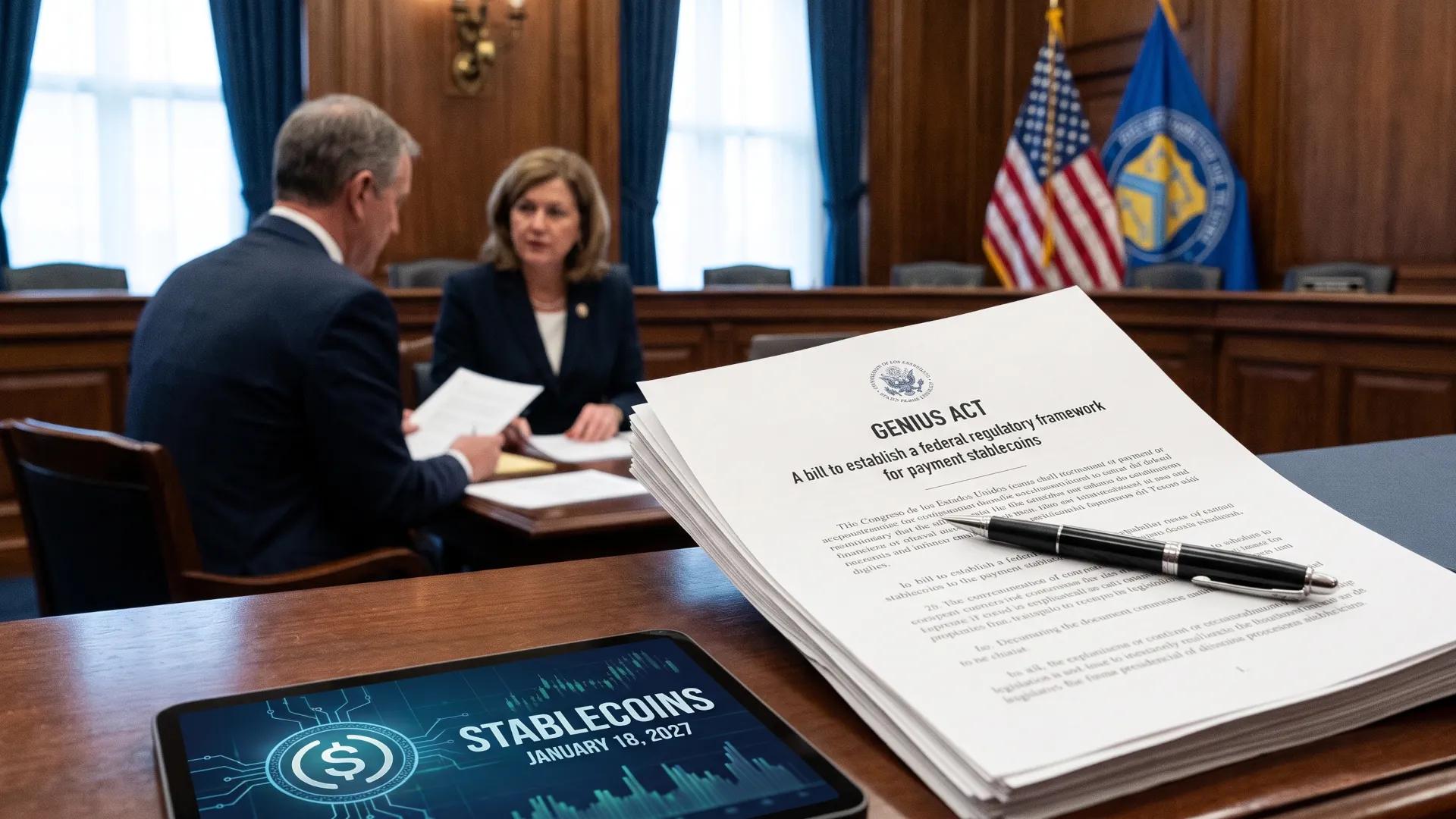
This Monday, October 26, the Office of the Comptroller of the Currency (OCC) published a booklet encouraging US community banks to enter the stablecoin business, applying for permission to issue dollar-pegged tokens under the GENIUS Act, in their own name or through a subsidiary.
The timetable adds urgency. According to the October 21 bulletin, from January 18, 2027 only an authorized issuer will be able to issue a payment stablecoin in the country, and doing so without permission carries criminal penalties. The regulator, moreover, is not yet accepting issuance applications.
Those already issuing can request a temporary exemption if their application is substantially complete by January 18. The arithmetic comes next: community banks account for 3,818 of the 4,238 FDIC-insured institutions as of June 30, 90% of the total, and hold $2.77 trillion in assets with a median of $345 million. For that median bank the framework is not just another product: it requires a minimum of $5 million in capital and a twelve-month expense buffer. The OCC uses small banks as a counterweight to large issuers and asks them for an investment few can justify on their own.
A $300 billion business with two owners
The market they are being invited into is worth $299,998 million and is split in two. Tether accounts for $182,234 million (60.75% of the total) and Circle adds $71,675 with its USDC; between the two firms they hold 84.6% of the stable money in circulation, according to data from DefiLlama this Monday.
The issuer's business is the interest rate spread, not the fee. Reserves must be held in cash, demand deposits, 93-day Treasury bills or funds that only buy those assets, and the yield goes to the company that issues.
With the three-month bill at 4,22% and Circle's reserve return at 3.48% last quarter, every $1 billion in circulation leaves between $34 million and $42 million a year before costs.
What the issuer cannot do is share that yield with whoever holds the token. The law prohibits paying interest or rewards for holding a payment stablecoin, and the OCC has just reaffirmed the prohibition without the presumption against workarounds it had proposed in March.
What it costs to enter: five million and a year of expenses
The final rule, published in the Federal Register on October 23 and in force from January 18, sets a minimum of $5 million in capital that stays with the issuer for its entire life, not just at the start.
On top of that goes an operational buffer separate from reserves, with liquid assets equivalent to twelve months of expenses and subordinated debt that can cover at most half. Non-compliance has staggered consequences, and none of them is decorative.
The issuer notifies the OCC within 24 hours if it falls below the minimum, publishes each quarter whether it complied and, if it ends the quarter short, stops issuing new tokens the following month.
Reserves have rules of form. They are worth at least what has been issued, are segregated from the rest of the balance sheet and must be spread out so as not to concentrate risk in a single entity; they include cash and balances at the Federal Reserve, 93-day Treasury bills, deposits and funds that only invest there, including ETFs and tokenized versions of those same assets.
The OCC will examine small issuers every 18 or 24 months, the same extended cycle it offers small banks. The question a CEO will ask is not whether the token looks nice, but who uses it: without its own merchant network, a small-town bank's digital dollar competes with the app of the big bank that already has the customer on the phone.
The closed door and the exemption shortcut
The booklet arrives before the window. The OCC repeats on its program page that it is not accepting applications or exemptions until the Office of Management and Budget approves the information collection for the forms.
A bank that wanted to submit its file this Monday would have nowhere to deliver it. When it opens, the clock is set by rule: the OCC has 30 days to say whether the file is substantially complete and up to 120 to decide from that declaration.
If it is still incomplete after a first request, it returns it within 60 days. The structure matters more than it seems: the Section 5(f) exemption covers the subsidiary of an insured entity, not the insured entity issuing in its own name.
There is a second door that does not go through the OCC. The law lets an issuer with less than $10 billion in circulation opt for a state regime substantially similar to the federal one, and anyone who exceeds that threshold afterwards has 360 days to move to the federal framework or stop issuing. For a $2 billion bank, that lane may be cheaper than the federal review if its state has certified its rules.
Two pressures on the same vault
The regulator asking small banks to issue faces two pressures that point at their deposit vault. The first is judicial: the ICBA, the community banking trade group, sued the OCC and its comptroller, Jonathan Gould, on October 2 over the rule that opened trust banking to crypto companies.
The filing seeks to annul that rule, the interpretive letter that supports it and Protego's license, and notes that there are 21 trust banking licenses approved or conditionally approved, at least 13 of them for digital firms.
The second pressure is political. In May, Senator Elizabeth Warren complained about at least nine licenses of trust banking granted to crypto companies since December 2025, arguing that they operate as banks without the obligations of a bank.
The OCC maintains that it applies the same requirements to bank and non-bank issuers, with examinations tailored to the size of each and an extended cycle for small ones, so that the small-town bank does not carry the same team as a custody giant.
The other front is yield. The American Bankers Association criticized on October 21 that the final rule has withdrawn the presumption against arrangements that share yield through exchanges and distribution partners, and argues that this pays equivalently without breaching the letter of the law.
Behind it all is deposit flight, with estimates that do not resemble each other because they measure different scenarios. The four circulating in public debate range from a loss of $850 billion in credit to a gain of $2.1 billion.
| Who estimates |
What it measures |
Figure |
| ICBA, May 2026 |
Community deposits lost if yield is allowed |
1.3 of the 4.8 trillion, with $850 billion less credit |
| Federal Reserve, in the calculation cited by the ICBA |
High-adoption scenario |
$1 trillion in deposits outside the system and $1.26 trillion less lending |
| US Treasury, according to the ABA |
Bank deposits at risk |
6.6 trillion |
| Council of Economic Advisers, April 2026 |
Effect of prohibiting yield |
$2.1 billion more credit, with $800 million net cost |
The OCC itself admits in the booklet that the effect on community deposits remains unresolved. The datum that weighs most in its argument is another: the law allows bank deposits to serve as reserves for stablecoins, so that a small bank can earn even if it issues nothing.
The small issuer as a shop window
Having seen the pieces, the invitation has a narrower target than the headline suggests. A $345 million bank that issues its own digital dollar takes on minimum capital, a twelve-month buffer and a compliance team to fight in a market where two firms split 84.6%.
What it gains without dispute is the other role, that of custodian for a third party's reserves. It remains to be seen whether the OMB approves the forms to see if the first in line is a $2 billion bank or a consortium of towns.
The OCC has set a date, requirements and an exemption of up to twelve months. What it has not yet set is a single name, and that absence says more about the timetable than about community banking's appetite.