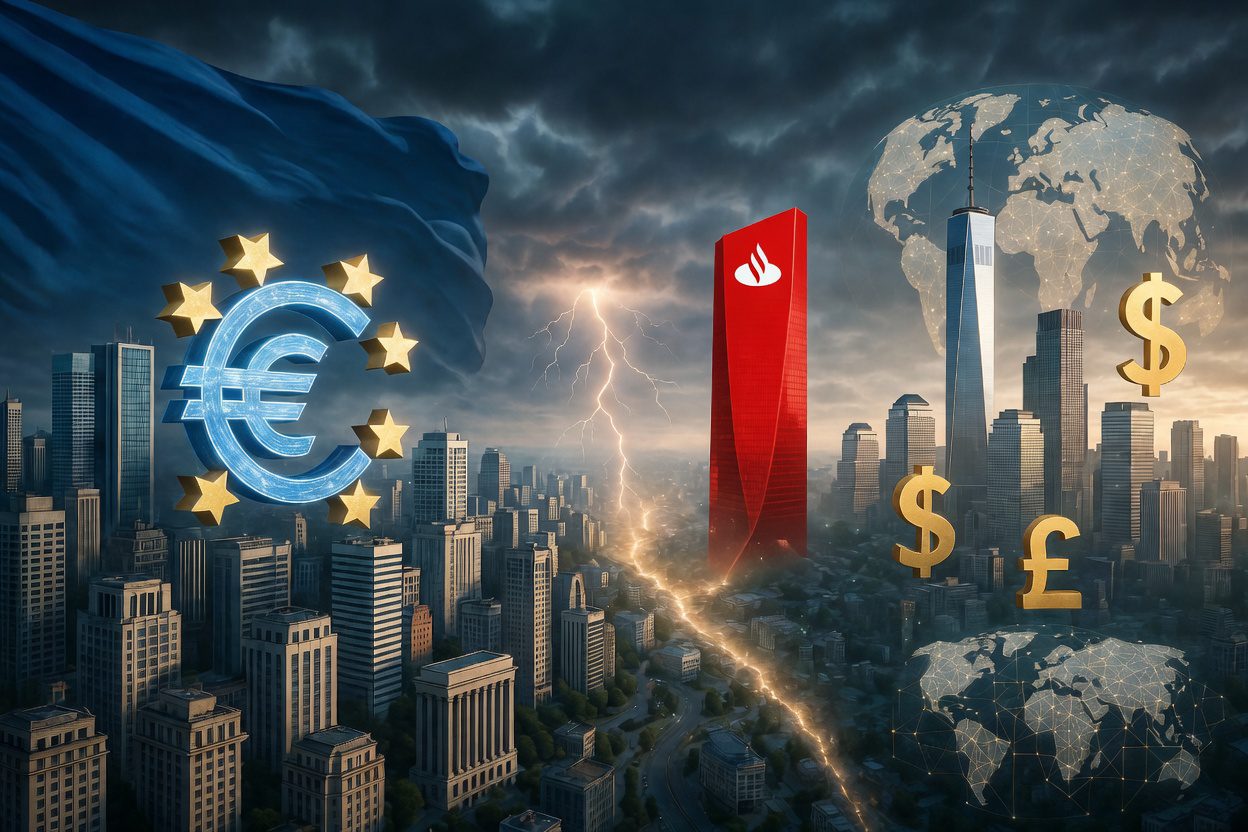
While much of Spanish and European banking has rallied around the company Qivalis to build its own infrastructure based on a stablecoin pegged to the euro, Banco Santander has decided to play a different game. The entity chaired by Ana Botín has opted to strengthen its positions in the major international financial tokenization networks driven from Wall Street and London, where the issuance of institutional stablecoins backed by G7 currencies is being explored.
Santander is not in Qivalis
The European consortium Qivalis, the platform promoted by major institutions to develop a stablecoin pegged to the euro, has announced the addition of Banco Sabadell, Bankinter, ABANCA, Kutxabank and Cecabank. These entities join BBVA and CaixaBank, which were already part of the project, in building a pan-European digital payments network. With these new members, the consortium now has 37 banks integrated into the initiative to launch this pan-European stablecoin.
Qivalis brings together 37 banks to create a private digital euro outside the ECB
In this entire rollout by European banking there is one absence that stands out above the rest: that of Banco Santander. The Cantabrian entity has preferred to stay out of the continental bloc that seeks to counter, through a commercial alternative, the expansion of digital dollars issued by US firms.
According to sources at Santander confirmed to this newspaper, the bank has opted for a different strategic course. Instead of focusing exclusively on the euro orbit, the entity is participating in an international initiative alongside some of the world's largest financial giants, such as Bank of America, Barclays, BNP Paribas, Citigroup, Deutsche Bank, Goldman Sachs, MUFG Bank Ltd, TD Bank Group and UBS.
Santander and the big G7 banks prepare their own global stablecoinl
G7 currencies
The purpose of this alliance was reflected in a statement releasedby Santander in October 2025, in which the entities detail that they are jointly exploring the issuance of a new digital money fully backed by reserves. The idea is to develop a stable payment asset that can operate on public blockchains, with an initial focus on G7 currencies.
According to the participants, the goal is to analyze whether a solution driven by the financial industry itself can deliver the benefits of digital assets and foster competition, always guaranteeing regulatory compliance and best practices in risk management.
Qivalis challenge: European banking takes on the ECB in the cold war over digital money
Santander's decision to bet on G7 currencies, rather than joining the pan-European project focused exclusively on the euro, also reflects the undisputed weight of the dollar on the global financial map. After all, most international trade and large cross-border transactions are still settled in the US currency, which makes this market an indispensable piece for any global digital payments infrastructure.
Markets in Latin America
Unlike other European banks with a more domestic profile, a substantial part of Santander's revenue comes from Brazil, the United Kingdom, the United States or Mexico. In Brazil or Mexico, the use of stablecoins has ceased to be a novelty and become an everyday reality, routinely used for savings, international trade, corporate payments and remittances.
For the group, participating in these international networks is a way to shield its position against the advance of the large fintech and US financial platforms in those markets.