Chainlink CustodySync: lending without moving assets out of the custodian
Chainlink presented CustodySync this Monday, a solution that keeps the system of a qualified custodian and a DeFi lending market synchronized throughout the entire loan cycle, from deposit to settlement, without the client having to move the assets out of custody. The launch partner is Anchorage Digital Bank, N.A., the first digital asset bank with a US federal charter, approved by the OCC in January 2021, which contributes its Atlas Collateral Management product as collateral agent.
The need the product addresses has been on the table for years. To borrow against assets held in custody, an institution had to move them out, which clashes with its internal policies and with the limits most impose on direct exposure to smart contract risk. Chainlink compares the available inventory with that of classic banking: some $700 billion in digital assets under custody versus $250 trillion in traditional assets, less than 0.5%.
The practical consequence is less commercial than it sounds. If the collateral never leaves the custodian, there is also no on-chain auction to execute it: when a loan breaches the threshold, the custodian sells the asset off the ledger and CustodySync records the commitment. That is where it is decided whether this is DeFi with a regulated wrapper or institutional lending with a new accounting book, and it is worth looking at the mechanism before the headline.
How the two systems hook up
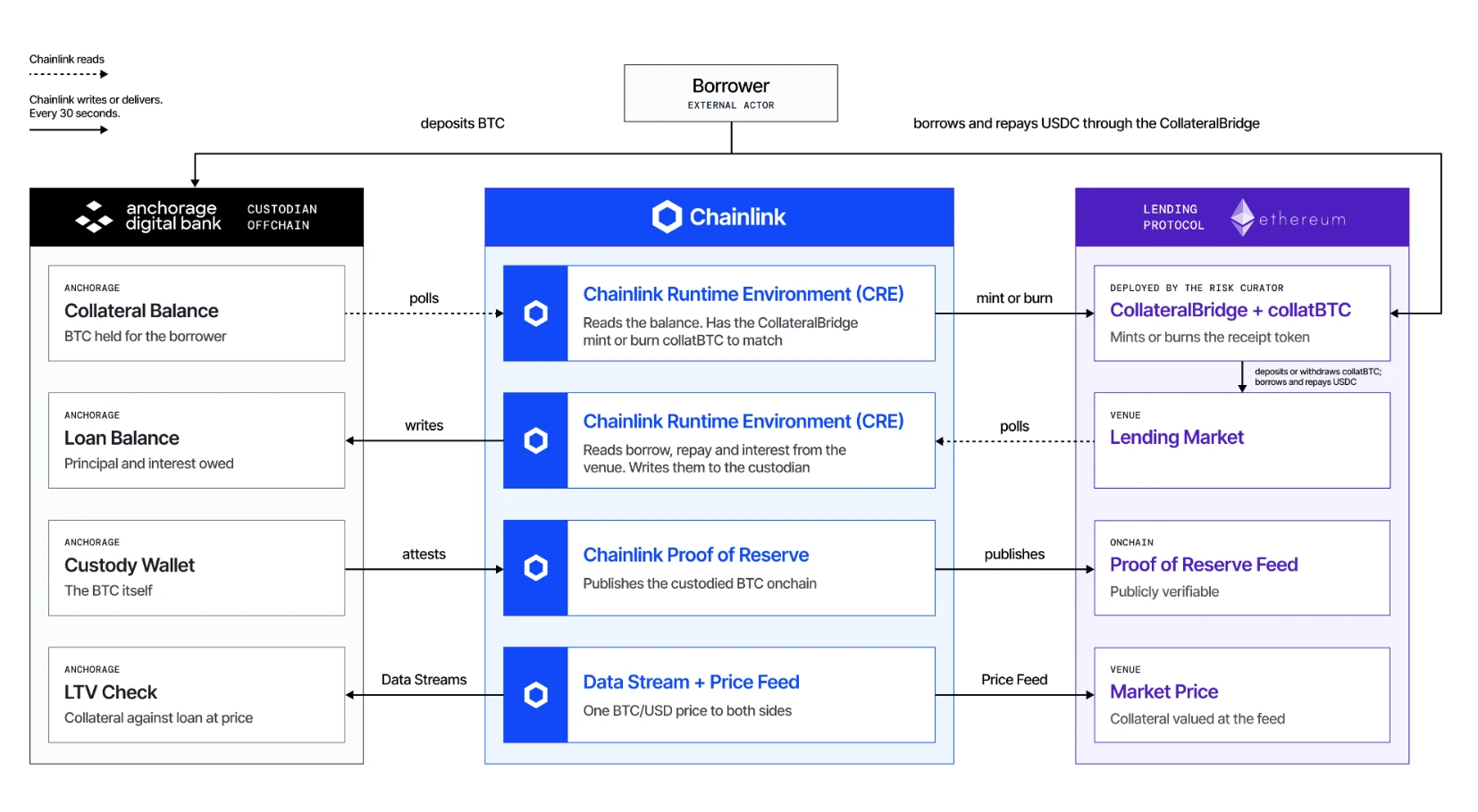
Chainlink CustodySync is not a new protocol or an end-user application. It is a set of standard contracts that Chainlink designs and that the lending market or its risk curator deploys, with the firm's runtime as the plumbing.
The hookup has four steps and none of them moves the asset. When the institution deposits collateral with the custodian, the balance is published on-chain via Proof of Reserve; then a receipt token with restricted transfers is issued and deposited into the lending market as collateral, and its supply reflects what is held in custody. The loan reaches the client in a single transaction and every repayment or interest accrual is recorded in the custodian's books without anyone having to reconcile by hand.
Component
What it contributes to the whole
Runtime Environment (CRE)
Monitors the custodian's system, triggers on-chain actions and writes loan activity back
Data Feeds
Price consumed by the lending market on-chain
Data Streams
The same price, delivered to the custodian's system
Proof of Reserve
Publishes the custodial balance so any third party can verify it
The price is the piece that prevents the two sides from arguing over different numbers. The market reads the Data Feeds on-chain and the custodian receives the same values via Data Streams, so the loan-to-value ratio is calculated with an identical figure on both sides of the mirror. Synchronization is reconciled on every cycle, so a missed event is corrected on the next pass without having to redo the entire position.
Settlement happens off-chain
The design that is best seen from the inside is the proposal Aave Labs published on September 14, six weeks ago, to open an isolated Aave V4 market with custodial collateral. There the receipt token is called CoCT, it is issued and burned only by CustodySync, it allows transfers only to a closed list covering the Hub, the Spoke and the bridge itself, and there is one contract per borrower position. It is not a tradable asset nor does it grant a direct right over the bitcoin backing it: the legal recourse runs through an account control agreement.
Diagram of how ChainLink CustodySync works
Settlement breaks the intuition of anyone expecting a public auction with anonymous bidders. If the position crosses the threshold, Anchorage sells the collateral in an over-the-counter transaction with its desks and CustodySync records the committed amount on-chain while the sale settles, with final closing in a single atomic transaction. Risk parameters, caps and price sources are left to the DAO's risk providers, so the proposed market is not yet operational.
The CoCT disposal cap on the Hub is permanently set to zero, precisely so that the token representing the collateral cannot leave the isolated market and end up circulating as if it were the tradable asset it is not.
Who is liable when the collateral moves
Tripartism is not new in finance, but it is in an open market. Until now, the promise of tokenization consisted of removing intermediaries; what is being sold here is keeping them and making their book square with a contract. Chainlink does not custody or lend, and its own text clarifies that it does not hold the asset at any point in the process: the borrower's legal counterparty is the custodian bank. The logic is not new at the firm: Chainlink has already presented itself as the way to tokenize shares without breaking intermediation.
The split leaves three questions that no product note resolves. The first is what happens if the custodian defaults; the second, who audits the balance published by Proof of Reserve when the custodian itself is the source of truth; the third, how much it costs to keep the mirror updated daily. All three are answered by contract and not by code, and the institutional client usually prefers that order, even though it turns the custodian into the single point where the entire chain breaks.
Potential is not the same as demand
DeFi lending deposits exceed $80 billion and active loans $30 billion, according to Chainlink's own figures. That is almost two orders of magnitude below the custodial inventory, and no one guarantees that gap will close.
The $700 billion figure serves to size an opportunity, not to announce clients. Chainlink compares it with the $250 trillion of traditional custody to stress that 0.5% is room for growth, and by the way recalls that it already secures tens of billions across 70% of DeFi markets, a figure from the firm itself that works as a starting position and not as a share audited by anyone. The firm's track record in institutional infrastructure plays in its favor, as shown by its arrival at AWS for tokenization.
Demand does not depend on the product alone either. A fund that already pays for regulated custody has few incentives to add protocol risk unless the loan turns out cheap or strategic, and lending in stablecoins against custodial bitcoin competes with classic repo, which needs neither oracles nor governance. The real argument is continuous liquidity on weekends and the speed to mobilize a dormant position, not saving on intermediaries.
What is missing for it to become a standard
The launch has one partner and no confirmed lending market. Chainlink does not name a protocol; the concrete path runs through the Aave proposal, which is still under discussion with risk parameters unresolved. The rest of the sector is watching whether the format takes hold before committing inventory.
Anchorage is not a small custodian: its Atlas network exceeds 800 participants and reports $12.5 billion in secured collateral as of June 30, 2026, cumulative activity figures that do not measure live loans.
The acid test will come when a second custodian adopts the same set of contracts without Chainlink having to build it a custom integration, and when a real liquidation is resolved without anyone asking about the price. Until then, Chainlink CustodySync is well-thought-out plumbing with a luxury client, and the market it promises to connect remains, for the most part, money that has not yet moved.