THORChain reopens 10 of 13 chains after the refund bug
A deposit of ten ethers that existed for one block and ceased to exist in the next was enough to halt an entire network of cross-chain exchanges. On October 31, THORChain detected that it had refunded a deposit it never received, activated its automatic solvency checker, and node operators shut down trading on nearly all connected chains while they investigated what had happened.
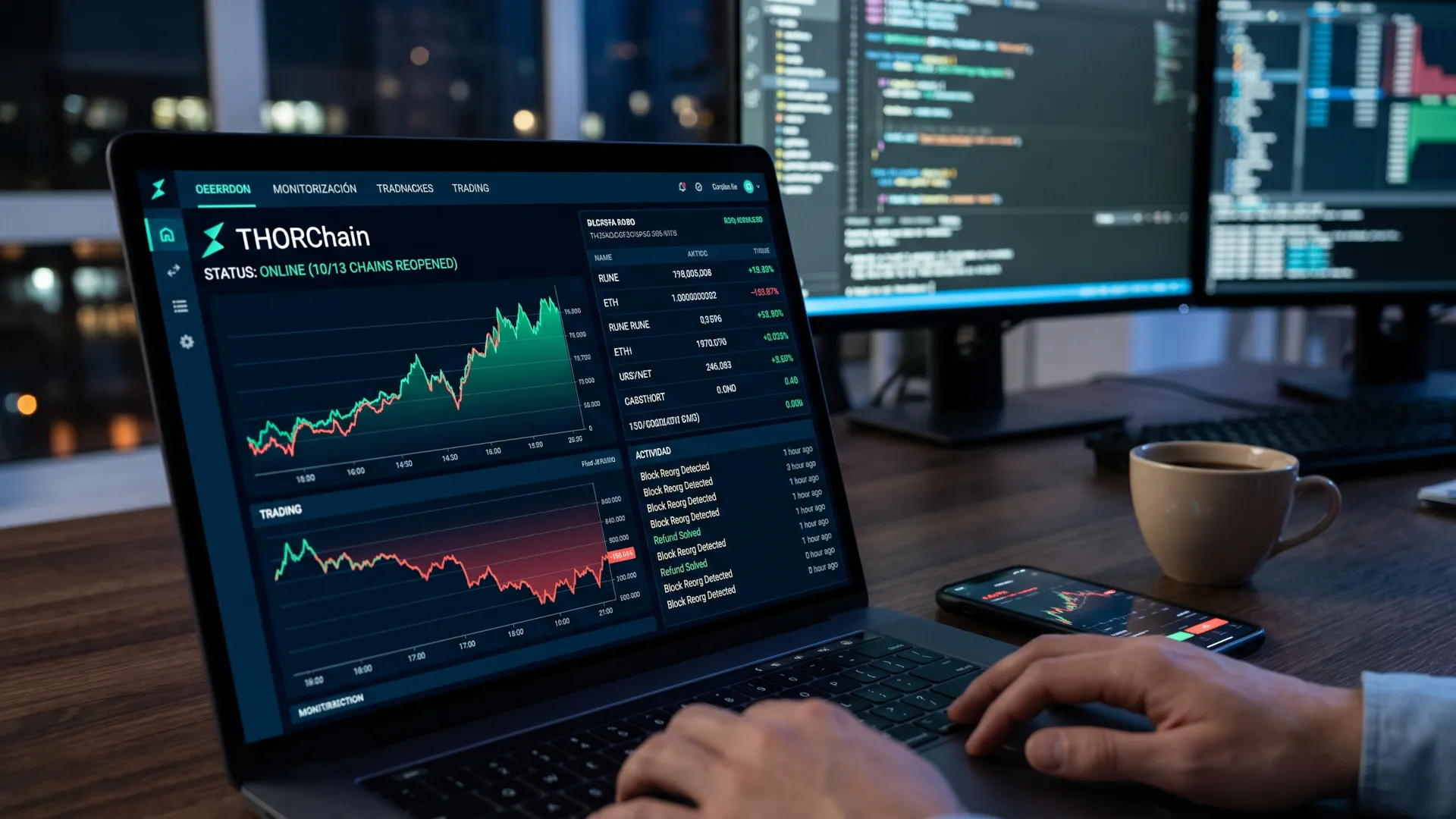
The protocol resumed trading on November 3 with version 3.21.1. The project's public data, which can be checked on its status pagethe same figures and the breakdown for each network are confirmed. Ten of the thirteen external networks resumed operations with trading and transaction signing active, while BNB Smart Chain, Cosmos Hub and Solana remained restricted.
The protocol's token, RUNE, rose about 15% in twenty-four hours to hover near $0.64, a move that says little about whether confidence has returned and a lot about how cheap it is to move the price of an asset with thin liquidity. What is interesting about the incident is not the price, but the failure: there was no theft, there was an accounting mismatch against the chain.
A reorganized block and a deposit that existed twice
The sequence described by the protocol is short and highly instructive. A deposit of 10 ETH reached THORChain's vault and the system credited it, but a single-block reorganization on Ethereum removed the transaction from the chain. The deposit was still credited on the protocol's ledger and no longer existed in reality, which is the worst possible state for a system that holds other people's funds.
The technical detail that matters is the order: the protocol acted on information that the chain could still undo. Any system that reads recent blocks lives with that window open for a few seconds.
The associated exchange did not reach the price limit the user had set, so the refund mechanism returned the funds. The problem is that it returned them twice: once against the credited deposit, which no longer existed, and once against the user's real deposit. The vault paid ten ethers it had never received, and the mismatch was detected by the solvency checker, not by a person.
A single-block reorganization is a rare event, but perfectly normal on Ethereum: two miners publish blocks almost simultaneously, the network picks one branch and the other is discarded. What is almost never tested is what an external system does when it has already read the discarded branch and acted accordingly. That was the hole.
The automatic brake that prevented something worse
THORChain's solvency checker exists precisely for this scenario. When the sum of what the protocol believes it owes users stops matching what is in the vaults, the system halts itself, without waiting for a human to notice. In this case it worked: the hole was ten ethers, not ten thousand.
The node operators, who are the ones sustaining the network, later decided to extend the halt to several chains while the developers looked at the code. That decision turned a small accounting incident into a global service interruption, and it is the part of the episode that will generate the most discussion: the automatic brake protected the funds, but the human reaction widened the reputational damage.
The user returned the ten ethers, according to the project's account, which closes the accounting hole and leaves the design question open. A system that depends on the beneficiary of an error returning it of their own free will does not have a recovery mechanism, it has a hope.
Ten chains open and three still closed
The reopening was not complete. Bitcoin, Ethereum, Bitcoin Cash, Dogecoin, Litecoin, Tron and Zcash came back with trading and signing active, including the routes the protocol uses for assets such as DogeOS and the RedStone-priced loan, and Avalanche, Base and XRP had already been operating since Monday. BNB Smart Chain, Cosmos Hub and Solana were still showing warnings on both functions, so anyone who needed to move value along those routes still could not do so.
The project's status table is the only public source that says which route works and which does not, and it changes several times a day without warning. Anyone operating with these routes has to check it before every move.
The distinction between trading and signing matters more than it seems. With trading active but signing halted, the protocol can accept a transaction and cannot settle it, which in practice is worse than a clean shutdown because it leaves funds in an intermediate state. THORChain kept the two functions aligned on every chain, which suggests that the reopening criteria were conservative.
Cosmos Hub and Solana were already restricted before the incident, according to historical node data, which changes the reading of the official statement. It is not that the bug closed three chains: it is that one chain was already closed for other reasons and the bug added the second.
The 14 nodes holding back performance
Of the 111 active nodes, 97 had upgraded to 3.21.1 at the time of the report and 14 were still on 3.21.0. The project itself linked the incomplete rollout to the exchange's performance problems, in a phrase that leaves no room for doubt: all active nodes must upgrade to fix performance.
The release notes add a detail that bears reading twice. 3.21.1 includes no consensus change and asks operators to install a private binary with additional security patches, with no coordinated upgrade height. A patch that cannot be audited and that each operator installs whenever they like is exactly the kind of process that produces half-upgraded networks for weeks.
The episode also comes at a time when the on-chain lending sector boasts of 175 million raised for lending, and a private patch sits badly with that narrative. When a large chain publishes a security update, the schedule is public and the version is verifiable; here the operator trusts a binary it cannot inspect.
The side effect nobody wanted to acknowledge
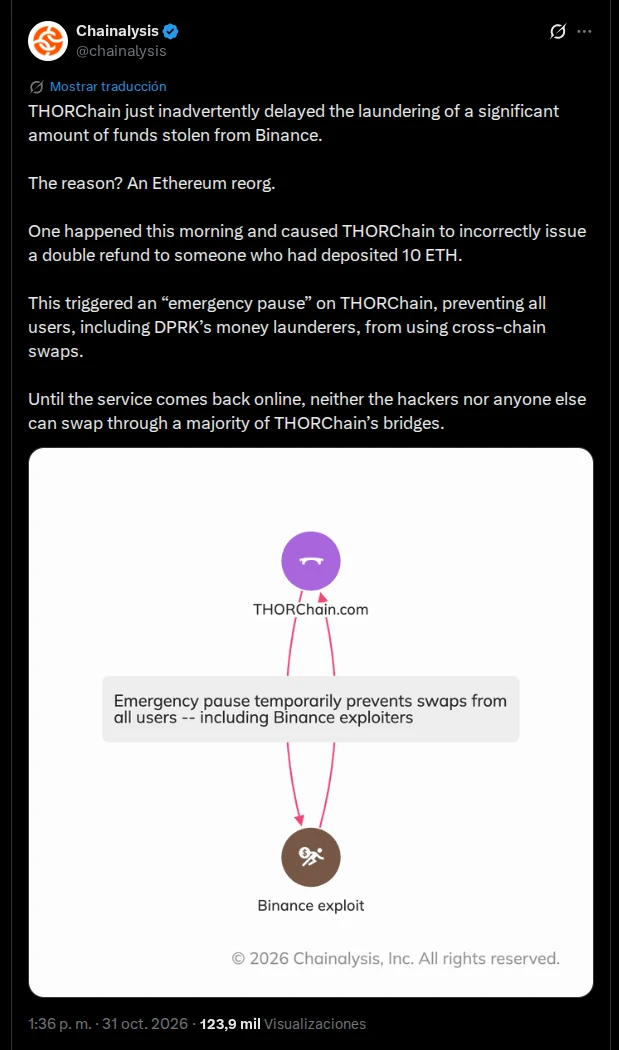
Chainalysis pointed out that the THORChain halt inadvertently delayed the laundering of the funds from the Binance hack, valued at 6.3 billion dollars. The firm's analytics maintain that the attackers used the protocol's routes to move part of the loot and that the shutdown forced them to look for alternative paths in the middle of the operation.
Chainalysis notes that the THORChain outage limited the laundering of assets from the Binance hack
That fact turns the incident into a debate the sector has been avoiding for years. A permissionless protocol that stops only because a number does not add up is, in fact, a censorship mechanism, and in this case the censorship worked in favor of the investigation. The operators who voted to reopen did so knowing that the routes were available again for those funds, as the founder of Pangolin Intelligence noted in Monday's discussions.
The debate is not new and there is no technical solution in sight either. Networks that present themselves as neutral have coexisted for years with lists of blocked addresses and with operators who decide on their own.
Neither position is comfortable. If the protocol can stop, someone decides when, and that someone has not been elected by anyone. The precedent of Arbitrum moving 8,425 ETH of the Binance loot without the key points in the same direction. If it cannot be stopped, the stolen money circulates freely through the very infrastructure that presents itself as neutral. THORChain has just shown that both things are true at the same time.
Reopening a chain without an owner
The question left open is not technical. The nodes decide to reopen each chain when they consider it safe, with no published date for the three restricted ones and no explicit criteria for what safe means. In a system that sells itself as decentralized, that criteria should be public before the incident, not after.
For the user the lesson is simpler and less kind. The ten ethers came back because whoever received them chose to return them, the exchange's yield depends on fourteen operators updating a private binary, and the routes to three chains remain closed with no deadline. The rest of the decentralized ecosystem is watching the case with interest, because the same reorganization pattern can repeat in any protocol that reads the chain and acts before the chain is confirmed.