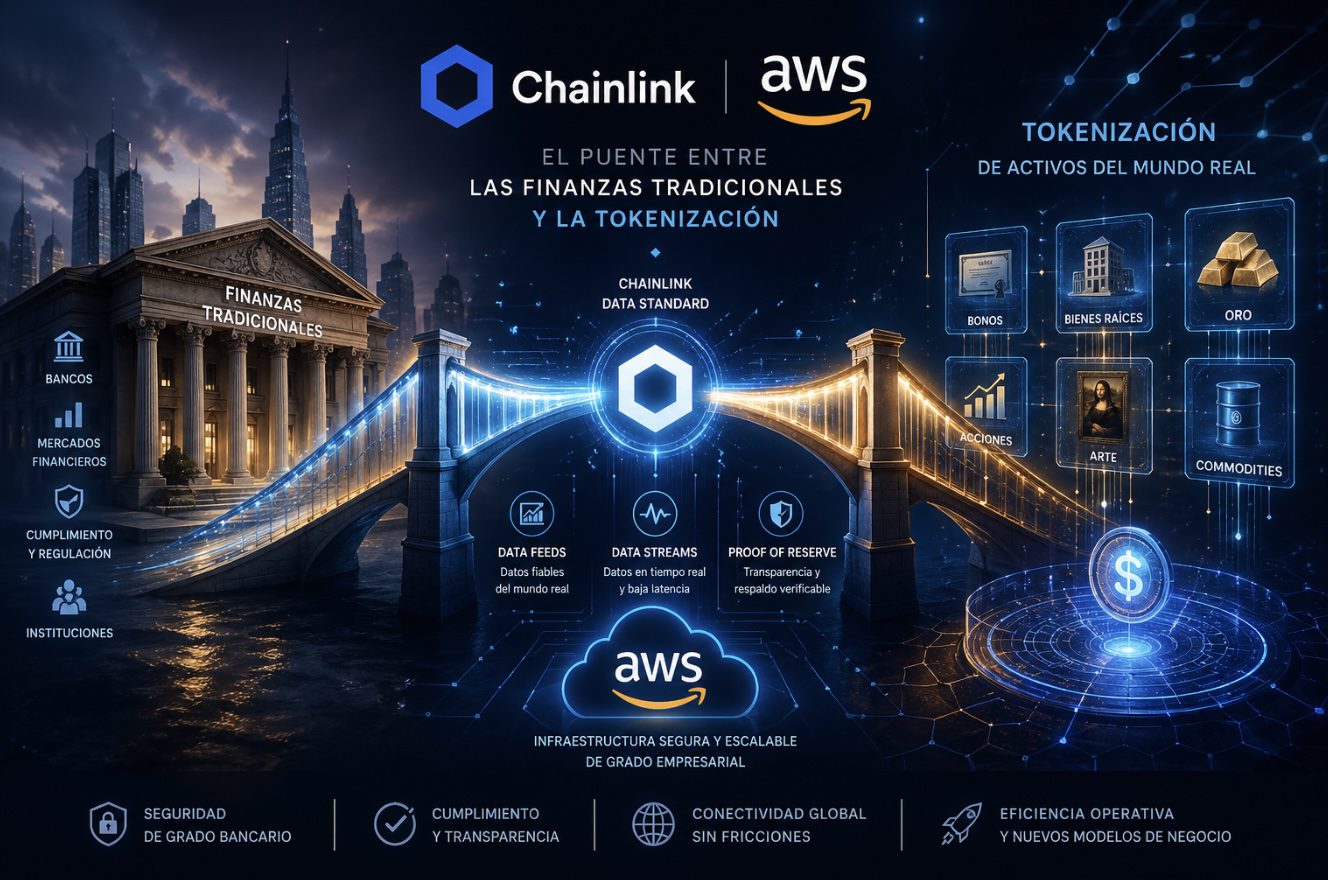
With the launch of the Chainlink Data Standard on AWS Marketplace, the boundary between traditional finance and the decentralized economy has definitively blurred. Financial institutions now have direct, standardized access to real-world data under Amazon Web Services' security infrastructure.
This integration makes essential services such as Chainlink Data Feeds, Data Streams and Proof of Reserve directly available to developers using Amazon Web Services (AWS). The news marks a turning point at which financial institutions can finally connect tokenized assets with real-world data under enterprise-grade security and compliance standards.
The connectivity challenge
One of the fundamental obstacles in developing cryptoasset solutions for institutions has been the so-called "oracle problem", or in other words: the inherent inability of blockchain networks to access external data securely.
For the tokenization of financial assets (RWA), this challenge is critical, since smart contracts require accurate information on prices, ownership records and compliance statuses that do not natively reside on-chain.
That is why Chainlink's decentralized oracle network (DON) infrastructure acts as a two-way bridge, connecting AWS computing and storage resources with smart contracts deployed on various networks.
This architecture allows financial entities to orchestrate complex workflows spanning both traditional systems and decentralized protocols, guaranteeing data integrity at every step of the process.
Pillars of the solution: Security, Compliance and Trust
The availability of these tools on the AWS marketplace not only simplifies technical procurement but also reinforces the trust standards needed for mass adoption. Developers of digital asset platforms can now benefit from:
- Proof of Reserve: Provides unprecedented transparency by autonomously and in real time verifying that issued tokens are backed by physical assets or bank deposits.
- Real-Time Data Management: Through Data Streams, platforms can access low-latency data essential for derivatives settlement and risk management in institutional markets.
- Bank-Grade Security: The integration uses services such as AWS Secrets Manager and AWS Key Management Service (KMS) to securely store the API credentials and private keys needed to sign on-chain transactions.
This structure significantly reduces operational friction, allowing institutions to focus on business logic and value creation rather than on managing the underlying infrastructure.
AWS and the digital asset ecosystem
By April 2026, AWS's role in the technology sector has evolved from a mere hosting provider to the predominant infrastructure partner for the digital economy. The leading hyperscalers, led by Amazon along with Microsoft and Google, are estimated to account for around 25% of total capital expenditure (Capex) in the US technology market in 2026, with figures exceeding 527,000 million dollars.
AWS's massive investment in data center infrastructure and high-performance computing has allowed on-chain stablecoin transaction volume to surpass 8.9 trillion dollars over the past year. Current examples include the migration of treasury infrastructures by giants such as MoneyGram and Western Union, which have moved toward hybrid models that use digital rails to improve their operational efficiency by up to 40%.
Toward institutionalized mass adoption
That is why standardizing data through Chainlink in a familiar environment such as AWS is a definitive step toward the sector's maturity. By normalizing data into consistent formats and automatically evaluating trading rules and risk thresholds, the foundations are being laid for a more efficient global financial infrastructure.
This hybrid model combines the best of both worlds: the speed and low cost of blockchain technology with the trust and regulatory compliance of regulated institutions.
As more institutions adopt these tools, the traditional banking paradigm shifts toward a model of atomic, programmable value transfer, eliminating the inefficiencies of legacy messaging systems such as traditional SWIFT. The Chainlink and AWS integration is not just a technical improvement; it is the validation that on-chain infrastructure is ready to support the load and demands of the global economy.