When the dust settled, Dashjr responded that BIP-110 "has not failed" and that miners were colluding against him; his Plan B, a hard fork that would change Bitcoin's proof of work to "fire the miners," was left on the table. This is the story of why a proposal presented as the defense of Bitcoin as money became the biggest governance debacle since the 2017 Blocksize War.
This is what Russia's cryptocurrency market will look like from September 1
What is BIP-110? A temporary soft fork against arbitrary data
The BIP-110, officially titled Reduced Data Temporary Softfork (RDTS), is a consensus rule change proposal published on December 3, 2025.
Its stated goal is to "temporarily limit the size of data fields at the consensus level, to correct the distorted incentives caused by the standardization of arbitrary data support and refocus priorities on improving Bitcoin as money," according to the official text.
The rules of BIP-110
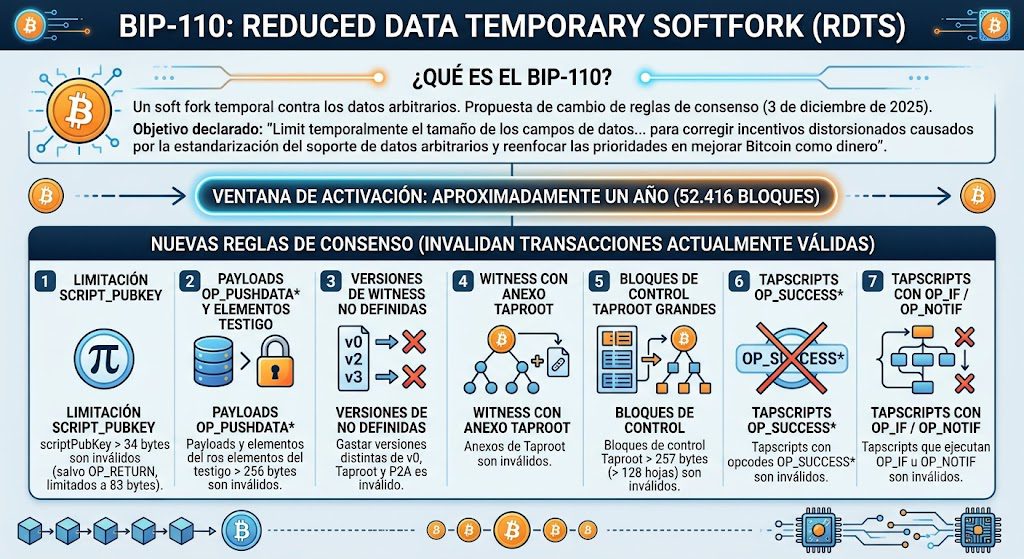
During an activation window of approximately one year (52,416 blocks), the BIP added seven consensus rules that invalidated currently valid transactions:
- New
scriptPubKey of more than 34 bytes are invalid, except for OP_RETURN, limited to 83 bytes.
- The payloads of
OP_PUSHDATA* and witness elements of more than 256 bytes are invalid.
- Spending undefined witness versions (other than v0, Taproot and P2A) is invalid.
- Witnesses with a Taproot annex are invalid.
- Taproot control blocks of more than 257 bytes (more than 128 leaves) are invalid.
- Tapscripts with
OP_SUCCESS* opcodes are invalid.
- Tapscripts that execute
OP_IF or OP_NOTIF are invalid.
Enforcement of the BIP
UTXOs created before activation were permanently exempt. The deployment used a modified version of BIP-9: signaling with bit 4 from December 1, 2025, an early lock-in threshold of 55% (1,109 of 2,016 blocks) and, if not reached, a "mandatory signaling" period from block 961,632 to 963,647 that forced lock-in at 963,648 and activation at 965,664 (~September 2026), with automatic expiration one year later.
In practice, the goal was to destroy the economic viability of Ordinals inscriptions (images and text embedded in the Taproot witness), BRC-20 tokens (a fungible token protocol launched in March 2023) and Runes. The proposal's official site sums it up: "since the inscriptions 'hack' in 2022, a trend emerged to embed arbitrary data in Bitcoin transactions."
Are NFTs back? Punk6529 reopens the debate and says they are not digital art, but network art
Dathon Ohm, the anonymous face behind BIP-110
The formal authorship of BIP-110 falls to a pseudonymous developer, Dathon Ohm, who presented the original draft on the bitcoin-dev mailing list on October 26, 2025. The BIP explicitly credits the "original draft and advice" to Luke Dashjr ("Original draft and advice: Luke-Jr"), the veteran developer, CTO of the Ocean Mining pool and maintainer of Bitcoin Knots, the alternative client from which the implementation emerges.
Ohm's identity has been the subject of speculation. Given his alignment with Knots and Dashjr's public support, many concluded that Dashjr was Ohm, but he has denied it, and his colleague Bitcoin Mechanic confirmed the denial while admitting that he knows Ohm's real identity. The developer Greg Maxwell went so far as to claim that "Ocean Mining wrote the proposal", something Ohm denies.
A new war in Bitcoin: OP_RETURN War
The context that explains the proposal is the OP_RETURN War. On October 10, 2025, Bitcoin Core 30.0 raised the default limit of -datacarriersize from 83 bytes to 100,000, effectively eliminating the historical cap on OP_RETURN outputs and allowing multiple data outputs per transaction.
The maintainers defended the change as an incentive correction (data migrates anyway to more harmful methods, such as fake public keys that bloat the UTXO set); but Dashjr and his circle read it as an invitation to spam and to legal exposure for node operators. In fact, Dashjr called the code "malicious" and warned that it "will kill Bitcoin almost immediately".
The original October 2025 draft added an even more controversial element: in addition to "proactive" activation (a flag day with a fixed height), it proposed a "reactive" method by which miners could activate the fork in the next block if they detected illegal content such as CSAM on the chain, an idea the text justified by citing "legal and moral risks" for node operators.
Lopp described it as "an underlying implication of using legal coercion," and the community read it as a threat of litigation against miners.
What problem was it trying to solve and who supported it?
For its promoters, BIP-110 was an urgent response to a real problem: since December 2022, Ordinals inscriptions and token protocols such as BRC-20 turned block space into a storage field for images and metadata, raising fees at the peaks of 2023 and 2024 and increasing the bandwidth and storage requirements of nodes.
The central thesis, contained in the BIP itself, is that "data storage competes unfairly with payments, unnecessarily makes Bitcoin transactions more expensive and fosters dependence on third-party payment processors, making payments easier to censor."
Minority support, lacking critical mass
Support was concentrated in the Bitcoin Knots ecosystem and among sovereign node operators. The official site listed one-click installs for Bitcoin Knots, Start9, Umbrel, myNode, Parmanode; myNode added "Bitcoin Knots + BIP110" as an option on February 6, 2026 and RaspiBlitz updated its installer on February 19.
Start9 published technical activation guides and its CEO, Matt Hill, had defended in 2025, in the talk Power to the Nodes, the "political power of running a Bitcoin node." In fact, on July 29, Start9's official account responded to its critics: "We know you're upset about this fork and think it's stupid, but closing your eyes and wishing it away, or shouting on X, won't work. That's not how Bitcoin works."
They were joined by figures of the Knots movement (Dashjr, Bitcoin Mechanic and Chris Guida), the trader Fred Krueger, the CAPTURE series by user hodlonaut (March and June 2026) and the report by researcher Melvin Carvalho (February 2026) on the removal of the OP_RETURN limit.
Supporters noted that nodes running BIP-110 software came to represent between 8% and 25% of visible nodes (there is no data on private nodes, which are a large majority) according to the counter. In mining, only Ocean, Dashjr's pool, and small operators (Roughnecks, SoV, Barefoot Mining, Sazmining and others) signaled support. BIP-110's failure was clear.
Visa Direct incorporates stablecoins to operate 24/7 with Zero Hash
Who opposed it?
Now, let us examine closely the opposite side of the story, those who frontally and publicly opposed this BIP-110. And it is no surprise to see on this list some of the voices with the most economic and technical weight in Bitcoin:
- Michael Saylor, executive chairman of Strategy, the largest corporate Bitcoin treasury, wrote on X: "There are 110 things more dangerous to Bitcoin than spam. BIP-110 turns a dispute over spam into a consensus change that would invalidate some currently valid transactions that pay fees. That precedent is the danger." In July he called it "Bitcoin Iatrogenic Proposal," published on July 18 "110 Reasons BIP-110 Is a Bad Idea" and asked its supporters to "stand down."
- Adam Back, co-founder of Blockstream and inventor of Hashcash, was the most consistent critic: "Bitcoin respectfully says no to what you want," he wrote, and "Bitcoin won't be joining it," while encouraging supporters to "get together and create a fork." In February 2026, he called it an attack on the reputation of digital gold and a "lynching," and after the August 9 split he declared the dispute "resolved.".
A laughingstock
- Jameson Lopp, CSO of Casa, argued in his February blog that BIP-110 would weaken two defining properties of Bitcoin: "Bitcoin's strength lies in its censorship resistance and its predictability. BIP-110 signals that the protocol can be altered to censor subjectively 'undesirable' transactions."
- Samson Mow, CEO of JAN3, outlined a "1% attack" (renting 1% of the hashrate for ~4.5 BTC a day to force changes) and published on July 22 a viral satire about a post-BIP-110 Bitcoin with only 83 users.
- David Bailey, CEO of Nakamoto, defined the soft fork as a Sybil attack: "Officially: BIP-110 became the most unpopular, most incoherent and most insignificant soft fork of all activation attempts."
- The majority mining pools never signaled; the founder of F2Pool, Chun Wang (@satofishi), mocked it publicly: "Every morning I wake up, open the X app, search 'BIP-110' and block a few people with the term in their name before breakfast." His most recent post on X is much clearer: "Luke (Dashjr), you have gone bankrupt not only financially, but also in terms of personal credibility. Feel free to change the PoW algorithm afterwards. That won't end well either."
10 reasons why BIP-110 has failed
And from here we can make a very clear list of the reasons why BIP-110 has failed. Among those reasons we highlight:
- Mining support never came close to the threshold. In the two periods before the split, signaling was 2.53% (51 of 2,016 blocks) and 2.64%, against the 55% required. Between May 1 and the end of June 2026, only 38 blocks out of more than 9,000 signaled (0.42%), and signaling even fell to 0%. The first 59 blocks of the mandatory window contained not a single bit 4. Here is a relevant point: Dashjr and company have devoted themselves at all times to attacking miners, forgetting that they are an integral part of the Bitcoin ecosystem itself. Attacking one part, thinking that nodes and their devs are more important, is simply a very bad idea if the success of your BIP depends on miners.
- The big pools said no, publicly and consistently. Foundry (~23–33% of hashrate) organized a hashrate-weighted vote with a default position of "No" and never crossed 51% "Yes" votes; AntPool remained silent; ViaBTC did not signal; F2Pool openly rejected it; MARA did not move either. Four pools concentrate more than 70% of hashrate. Only Ocean and small operators signaled. The position is no surprise, since Dashjr and those who supported BIP-110 even suggested they could take legal action against miners who did not join them (a textbook form of extortion).
Implementation without support
- Bitcoin Core never merged the implementation. The PR implementing BIP-110 in the reference client went unmerged. The only complete implementation was a fork of Bitcoin Knots, which deprived the proposal of the backing of the majority software.
- The activation mechanism violated the principle of rough consensus that has always prevailed in Bitcoin. BIP-110's 55% threshold was far from the usual threshold for a UASF: 90%. Basically, Dashjr lowered the difficulty to activate the BIP, and even so, he failed to reach the consensus to activate it. Jamesson Lopp called it "dogmatic bullying," and recalled that the 2017 UASF (BIP-148) actually never activated, because SegWit was imposed through the miners, and even so, support was above 90%
- Zero economic support. No major exchange, custodian, ETF issuer, wallet or payment network committed; ETF prospectuses (such as BlackRock's IBIT) permanently disclaim fork assets, and Saylor stressed that more than 99% of Bitcoin's economic weight was outside the proposal. The 2017 precedent worked because exchanges and businesses were already aligned with SegWit; here there was no one.
- The UASF produced a ghost chain. At block 961,632, nodes enforcing BIP-110 rejected AntPool's block and followed Roughnecks; the minority chain mined two blocks in eight hours and stopped. By inheriting the difficulty of 127.48 trillion with barely 1% of the hashrate, the next adjustment would take ~350 days.
Crypto celebrities 2026: AI agents land in Cantabria
A danger in every sense
- The replay risk turned the BIP-110 fork into a danger. Since both chains accept the same signed transactions, a buyer of the fork's coins could replicate the transaction on the main network and steal the seller's real BTC; the developer Kevin Loaec warned of this and CoinDesk published the warning "you could lose real BTC." This is an unacceptable technical flaw for a fork; no exchange would support such a situation, at the risk of its funds being drained. Despite the flaw's risk, Dashjr and company did not discuss or address the problem generated by their fork.
- The opposition included the largest treasuries and institutions. Saylor, Back, Lopp, Mow and Bailey concentrate the largest corporate treasury, the most veteran infrastructure and institutional adoption. Their public rejection left no room for the "social consensus" the BIP claimed.
- It did not solve the problem it claimed to solve. Peter Todd embedded the full text of the BIP inside a transaction compliant with the new rules, demonstrating that data storage would survive; the BIP itself admits that it makes storage "more expensive" rather than eliminating it, and Todd noted that if OP_RETURN were blocked, OpenTimestamps would move to fake public keys that bloat the UTXO set. Basically, the fork does not work, the problem it claims to solve is still there, and with a worse solution than the current one pursued by Core v30.
- The accumulated damage to process and credibility. Pseudonymous and disputed authorship, the initial threat of a "reactive" fork with legal consequences for CSAM, the accusations of inflating node counts and the threat of the "nuclear option" of changing the PoW ended up destroying the industry's trust. Ocean's own VP, Jason Hughes, estimated "less than a 5% chance of success… and I consider that generous."
Three reasons why BIP-110 did not solve the problems it claimed to solve
Now, let us examine more closely an embarrassing reality: "BIP-110 did not solve the problem it claimed to solve." And no, it is not just talk; the reality is quite clear and can be summed up in three reasons:
- It cannot prevent data storage, only make it more expensive. The specification concedes that the rules "raise the cost of data storage instead of eliminating it." Peter Todd's demonstration and the track record of alternative methods (fake public keys, scriptSig, Merkle trees, direct submission to miners) guarantee a cat-and-mouse game: data would migrate to formats that, in some cases, are worse for the UTXO set. The community understood it as a patch, not a cure, as it was sold.
Breaking the community's development
- It does not alter the real economic incentive. Block space has been allocated by fees from day one; inscriptions paid hundreds of millions of dollars in fees, and miners have no incentive to ban a source of income. Lopp summed it up: "Why would anyone in their right mind voluntarily accept a pay cut?" The underlying problem (how competing uses are balanced within a block market) is not touched; it only chooses which uses are "desirable." This is basic in a UASF whose goal is to change the economic relationship of transactions, especially if we understand that Bitcoin uses "Game Theory" to maintain a clear incentive system where all players obtain their respective gains according to their interests.
- It undermined the properties it claimed to protect. Changing consensus to censor subjectively "undesirable" transactions erodes neutrality and censorship resistance (Lopp's central argument), invalidates currently valid transactions (multisig with OP_IF, Miniscript, Tapleaves of more than 7 levels, BitVM) with a real risk of freezing funds, and demonstrates that a small group can attempt to impose rules by coercion. Saylor summed up the precedent as "the danger": the cure was worse than the disease. That is the underlying reason why the bitcoiner community, whose core value is the neutrality of the protocol, did not support it.
Debunking Dashjr: there was neither "community support" nor "miner collusion"
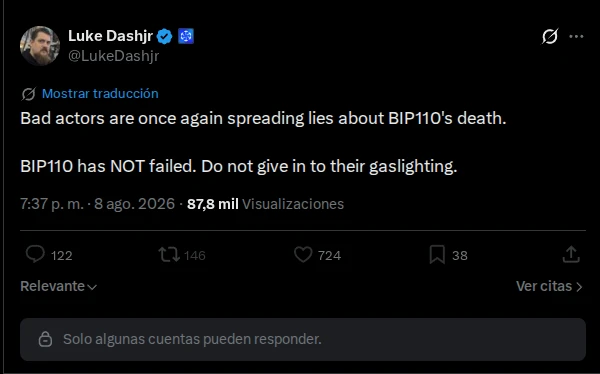
When the BIP-110 chain stopped, Dashjr turned to the conspiracy narrative: "Bad actors are again spreading lies about the death of BIP-110. BIP-110 has not failed. Don't fall for their manipulation," he wrote on August 8, and called AntPool's action "an attack on Bitcoin."
Dathon Ohm expanded the accusation: the big pools "collude" to turn Bitcoin "from money into a toxic data dump," and in fact, says that "Bitcoin miners have executed a secret hard fork on the Bitcoin network to achieve their goals and bring down BIP-110." Both claims collapse against the evidence, and turn out to be false; a hard fork in Bitcoin cannot be executed secretly, and there is no evidence of it whatsoever.
The "community support" that was not
The only indicator favorable to BIP-110 was the count of nodes running enforcement software, almost all Bitcoin Knots or its variants. But even in the most generous measurements, Knots was always a minority: Coin Dance placed it at ~22.65% of ~23,795 nodes in June 2026.
Dashjr claimed "more than 10% of all nodes" in February, and the aggregator bitdis.org showed in August 2026 Bitcoin Core with 74.32% of nodes against 25.41% for Knots, with only 19.26% signaling BIP-110.
Other estimates, based on reachable nodes, put Knots between 2% and 8%. In all measurements the majority ran Core, and a considerable portion of the "Knots nodes" did not even signal BIP-110.
Moreover, the reliability of those counts was questioned: CryptoSlate reported in March 2026 a "sudden spike in nodes that may be a single actor impersonating thousands," and Lopp called the mass signaling of nodes without economic weight a "Sybil attack."
And the decisive point: a node produces no blocks, no liquidity and no price. Bitcoin's consensus is not formed by node counts, but by coordination among miners, exchanges, custodians, merchants and users (who may or may not have nodes). "Community," in this context, was 74% Core, 99% of economic weight and 97% of hashrate not signaling.
Bitcoin Digital Objects: the standard Bitcoin was missing
The nonexistent "miner collusion"
This is another claim for which there is not a single piece of supporting data and, on the contrary, plenty of evidence to the contrary: the pools acted publicly, diversely and independently. Foundry did not align with anyone: it opened a vote among its clients with a default position of "No" and published a "neutral" resource guide with links to arguments from both sides.
EMCD did the same with a weighted vote. F2Pool publicly rejected it and mocked the supporters; AntPool simply kept using Core and the existing rules. If a cartel existed, there would have to be a secret agreement; but what exists is public and diverse rejection.
Analysts' explanation is simpler: signaling a contested change without consensus is risky for any pool (prisoner's dilemma), and banning data that generates fees is a voluntary pay cut.
The final blow to the conspiracy theory came from a member of its own side: Jason Hughes, vice president of Ocean Mining, published on July 17 the analysis BIP-110 On Track To Fail, in which he dismantled the proposal's "inevitability," recalled that "miners who do not support BIP-110 are not mining 'invalid' blocks just because an unadopted proposal exists" and concluded: "I estimate less than a 5% chance of success… and I consider that generous." When Ocean's own number two (below Dashjr himself) admits that there is no collusion, but a massive absence of support, the conspiracy narrative runs out of fuel.
Dashjr's Plan B: changing proof of work "to fire the miners"
With BIP-110 dead on the main chain, supporters did not sit idly by and activated their contingency plan: a hard fork that changes Bitcoin's proof-of-work algorithm. Its origin is the code that Luke Dashjr himself wrote in 2017, during the Blocksize War, which Chris Guida rebased onto the current version of Bitcoin Knots on August 1, 2026.
Guida presented it on August 4 as "just code we keep in our pocket in case miners betray Bitcoin, to activate at some later point," and clarified that there is no plan for immediate activation. Dashjr went further: he declared that a PoW change is "the only option" if BIP-110 fails and called Bitcoin Core "the scamcoin."
On August 9, after the stall, Dathon Ohm accused the pools of colluding and announced that supporters were working on a PoW proposal "to fire the miners."
Discord, the command center
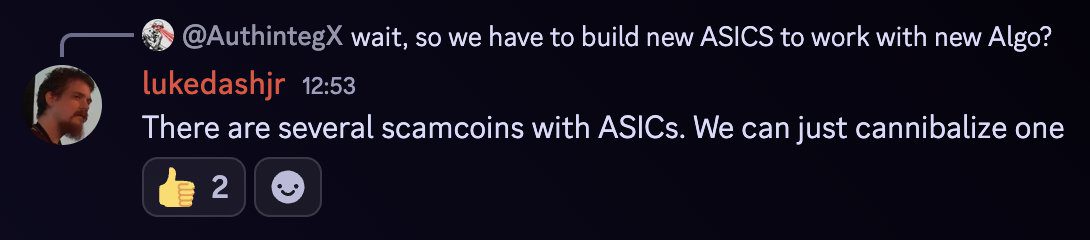
In the #strategic channel of the Bitcoin Knots Discord, the debate revolved around which algorithm to use: one participant summed up the motivation: "the reason to abandon SHA-256d is to fire the miners, not because it is broken," but Dashjr replied: "Bitcoin's PoW is also broken."
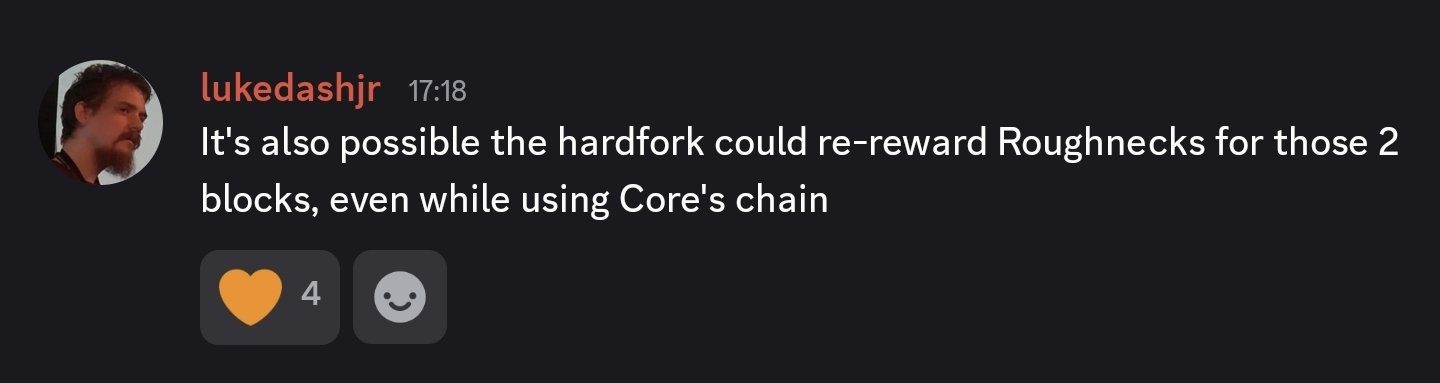
RandomX, KT256, BLAKE3, BLAKE2, Scrypt and Autolykos v2 were considered as options, with CPU/GPU mining. Dashjr proposed choosing the algorithm through a shortlist of candidates and "letting a deterministic random process make the final selection," to prevent hardware manufacturers from getting ahead.
In fact, in the Bitcoin Knots Discord, Dashjr himself talks about using an algorithm with relevant hashrate in an altcoin (scamcoins, as he calls them), in order to cannibalize it and use that computing power against Bitcoin and its current PoW. Ironic that he calls them "scamcoin," yet at the same time considers using them as a means to boost his own Bitcoin fork (which by its own definition is an altcoin or scamcoin).
Removing Luke Dashjr from Bitcoin Core development
In any case, the Bitcoin development list is already beginning to act. Since 2022, a case has been pursued against Luke Dashjr on the development list due to various problems and conflicts raised by his person. From toxicity, abusive use of his power as BIP editor, conflict of interest and now added to everything he is weighing in his actions against Core, the developer Murch has started a motion to remove Dashjr from his position in Core Dev.
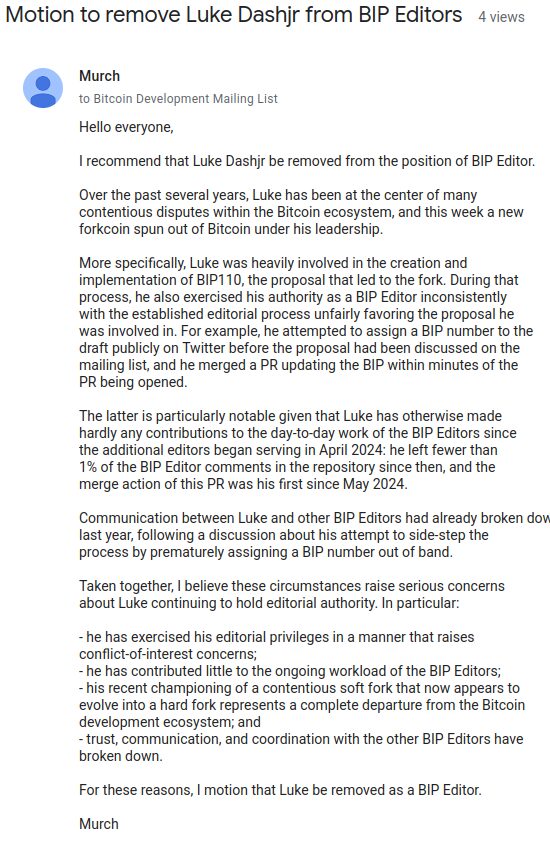
It sounds extreme, but it may be the healthiest thing in this situation. Above all, because part of Luke Dashjr's plan with the changes he intends to apply is to grant double rewards (changing Bitcoin's block generation) to any miner who supports him, something he could perfectly do by changing the PoW and the protocol's consensus rules. And no, that attribution is not false; Dashjr himself has shared it in the Bitcoin Knots Discord.
Why will the PoW hard fork fail miserably?
Here the terrain is completely delusional. Dashjr and the BIP-110 supporters began their career with the idea of cleaning up "spam on Bitcoin," but this Plan B is a totally different story: it is changing Bitcoin so that it bends to the guidelines of one person: Luke Dashjr.
Satoshi Nakamoto did very well to create Bitcoin, let it mature enough around a community and leave the project, letting it grow autonomously. Anyone can present ideas that, with the necessary support, can be applied to Bitcoin in general. In fact, BIP-110 itself is an example that this mechanism is still there and works, even when the means to do so are questionable. In the end it is the community as a whole that decides whether to support you or not, and in the case of BIP-110, the answer was a resounding no.
Saylor breaks the seams of maximalism: Strategy sells 1,638 bitcoins
Five reasons why it will fail
But this Plan B of Dashjr and company breaks with all of that: it is the centralization of Bitcoin around Dashjr and his entourage. If you do not follow his vision, you are out, period. And this is where powerful reasons arise to see absolute failure if that Plan B is finally carried out:
- It is a hard fork without the economy behind it. Unlike a soft fork, which miners can impose on existing nodes, a PoW change requires practically universal buy-in. The coalition pushing it is a minority of nodes (at most ~25% according to the most favorable counts) with ~0–2.6% of the hashrate. There are no exchanges, ETFs, custodians or merchants willing to follow them; ETF prospectuses permanently disclaim fork assets and no exchange signaled support.
- It would destroy the mining industry that finances the chain's value. Changing the algorithm would render obsolete billions of dollars in ASICs dedicated to SHA-256d (~940 EH/s). That industry simply will not accept it, and without its hashrate the new chain starts with practically zero security. The minority chain itself, with inherited difficulty, could not even produce three consecutive blocks: its liveness collapsed with 1% of the hashrate. A PoW change does not fix that: it only restarts the problem. In fact, here the problem is even more serious, because the only miners that supported BIP-110 were Ocean and a few other minority pools; changing the PoW algorithm would automatically make those pools lose their computing power, would send the value of their machines and investment to the trash, and that is something many miners will not accept, with a clear message: by stopping mining in Ocean or these pools, to support Bitcoin.
No coordination
- There is no possible coordination. At the moment, there is no chosen algorithm, no activation date, no software release and no network of miners, exchanges or users backing it. Dashjr's "deterministic random" selection is pure speculation about a mechanism never tested. As Guida said, it is "code in the pocket": without a date or consensus, it is not a plan, it is a threat.
- Changing the PoW does not solve the problem that originated BIP-110. Even if the minority chain started with a new algorithm, it would still have the arbitrary data that the BIP intended to eliminate and an irrelevant economic value. It would be a political punishment against miners, not an improvement to Bitcoin. History confirms it: the dozens of minority forks of 2017 died when speculation and infrastructure ran out. Does anyone remember BitcoinXT, Bitcoin Gold, BSV? They are all dead, and the same will happen with this plan of Dashjr's.
- Bitcoin's consensus is decided with money, not code. CoinDesk summed it up precisely: "the episode reveals that Bitcoin's governance is ultimately driven by economic coordination, not by overwhelming consensus." Knots nodes can decide which rules they accept in their own software, but they cannot force the economy to follow them. On August 9, the chain running BIP-110's rules had two blocks; the one following economic consensus had dozens more. The lesson the experiment leaves is the one summed up by analyst Ishi when studying Start9's alignment: "Your node gives you sovereignty. It does not automatically give you consensus."
The war continues
Be that as it may, Luke Dashjr and his entourage will keep pushing their idea of imposing, at whatever cost, their vision of Bitcoin. Meanwhile, on the other side, the broader Bitcoin community goes on with its life and makes decisions based on the elements that have made Bitcoin grow to where it is today. The two visions are antagonistic, irreconcilable, and as Dashjr's Plan B takes even more shape, that friction will only keep growing.
All that remains is to see how these events unfold, and how the Bitcoiner ecosystem and community will change, but one thing is certain: BIP-110 died before it was born, and all the elements point to the Bitcoin PoW hard fork having the same fate.
Coinkite warns of a flaw in Coldcard after a mysterious theft of 594 bitcoins