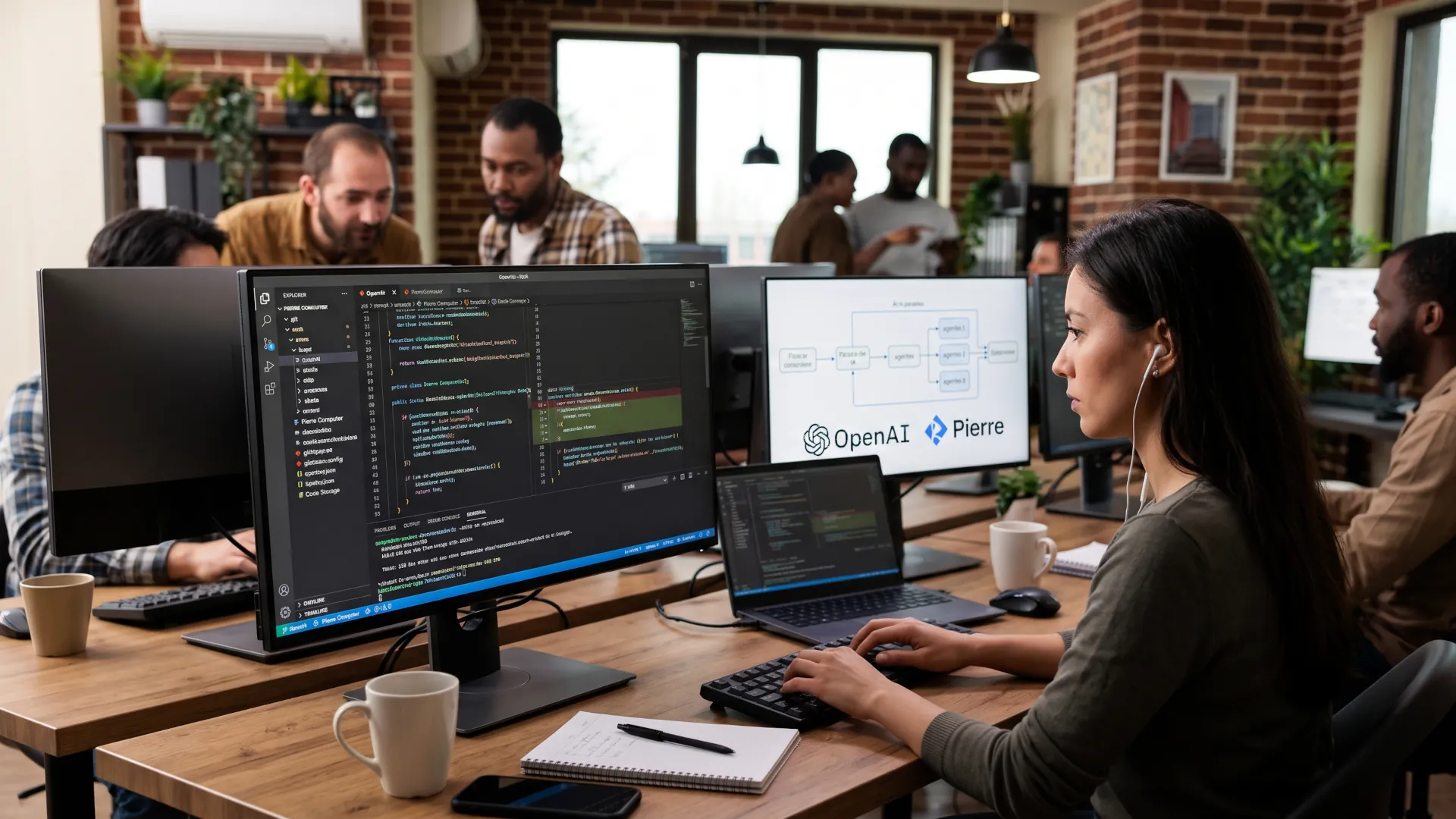
OpenAI announced the purchase of Pierre Computer Company, the company behind Code Storage and a handful of open source tools that already run inside the Codex application. The deal brings no new model and no computing capacity: it brings the layer where code lives, which is where it is decided whether an agent can work in parallel with ten others without the repository turning into a battlefield.
The company's official announcement is explicit about the reason. Pierre's libraries, Trees and Diffs, are already used in Codex to navigate a project's files and see what has changed; the next step is to bring Code Storage, the service that stores code and its history using Git, inside the product. OpenAI wants its agent not only to write the change, but to place it on the right branch.
The reading from Axios,which broke the deal, adds the competitive context: OpenAI enters the territory of Microsoft, owner of GitHub, at a time when code agents are taking on an increasing share of development work. The price has not been disclosed and the closing is subject to the usual regulatory approvals.
Pierre Computer and why it was already inside Codex
Pierre Computer is no stranger to anyone who has used Codex. Trees handles navigation through a project's files at the speed an editor demands, and Diffs shows changes in a view that lets you fix a line without leaving the comparison. They are two pieces that look minor and that determine whether reviewing an agent's work takes two minutes or twenty.
The third piece is Highlights, a syntax highlighter that updates while a developer types or while an agent streams code. In a flow where the agent produces text incrementally, a highlighter that waits for the end of the block makes the interface look broken even when the code is correct.
The fourth is Code Storage, the service that lets an application store code and track its history with Git. That is the piece OpenAI wants to integrate and the one that turns the purchase into something more than an interface upgrade: it is the infrastructure on which decisions about what is stored, when and by whom rest.
The purchase is more about integration than about acquiring talent, although it is that too. None of the four pieces is a product that sells on its own; together they are the interface between an agent and a repository.
Pando, the in-house backend that already existed
The purchase does not come out of nowhere. That same week OpenAI explained how it is scaling Git internally with Pando, its own version control backend designed for engineers and for agents. That detail turns the deal into the second piece of a strategy already under way: first the store is built, then the interface that makes it usable is bought.
The problem that combination solves is real and familiar to anyone who has used a code agent in a large repository. Git is designed for a human making a change every few hours, not for ten agents opening simultaneous branches and merging them in parallel. Locking, conflicts and indexing times multiply once the number of writers stops being human.
The Pierre purchase also solves a product problem that is not visible from the outside. If the agent lives in its own application, the user expects the code to reach the repository without opening a terminal. Integrating the store and the review into the same tool is what separates an assistant that suggests changes from a system that delivers them.
The tug of war with GitHub over the agent workflow
The ground where the competition is fought is not the editor or the model, but the shared history a team consults when something breaks at three in the morning and you need to know what changed and who approved it.
GitHub is not just a repository: it is the place where changes are reviewed, discussed and approved. That position gives Microsoft an advantage that a better model cannot buy, because a team's workflow lives in the pull requests, in the comments and in the decision history that nobody wants to migrate.
OpenAI is not trying to replace GitHub overnight. What it seeks, according to the announcement, is for Codex to connect the code a company publishes with the decisions its people make, and that is achieved by making the agent take part in the same history as humans. If the agent writes to the same Git, the review happens where it already happened.
The open question is whether teams accept that their code history lives on the infrastructure of a model provider. The answer will depend less on product quality than on company policy, and there GitHub has a fifteen-year head start in building trust.
What remains open: price and regulatory approval?
The announcement leaves three things unresolved. The first is the price, which has not been disclosed and in deals of this kind usually appears weeks later in regulatory filings. The second is the timetable: the closing is subject to the usual conditions and to regulatory approvals, with no date.
The third is what happens to Code Storage as a standalone product. OpenAI says customers will be able to keep using it while its functions are integrated into Codex, and that Pierre's open source projects will remain open. It is the standard formula for reassuring existing customers, and also the one that breaks most easily once the integrated product becomes the priority.
For teams that already use Pierre's libraries in their own tools, the real risk is maintenance. An open source project that comes to depend on a company with a commercial product gets more resources and less attention to edge cases, and that balance shows two years down the line.
What does it mean for a team with agents in its CI?
For anyone who already has agents in their continuous integration, the purchase changes nothing this week and does point to a direction. The software that measures how much code AI adds points to the same bottleneck. The sandboxes that isolate agents solve the other half: the problem is no longer that the agent writes badly, it is that it writes so much that nobody can review it.
The practical consequence is that version control becomes an architecture decision. A team that wants ten agents working in parallel needs short branches, frequent integration and a review that does not depend on a human reading every line. That is what OpenAI is buying, and it is what GitHub will have to show it already has.
The orchestration of agents in Kubernetes shows the same pattern from the other side: once the agent stops being a personal tool and becomes just another process in the infrastructure, what matters is where it writes and who authorizes it.
The bottleneck nobody looks at
For two years the conversation about code agents revolved around model quality, and the Pierre purchase suggests that stage is closing. If the model writes reasonable code almost always, the limit stops being generation and becomes review, traceability and conflict between simultaneous changes.
That shift has an uncomfortable consequence for model providers. The work that remains is infrastructure, and infrastructure is built slowly, bought expensively and defended with integrations, not with a demo. OpenAI has just paid for one part of that work; Microsoft has been charging for it for fifteen years.