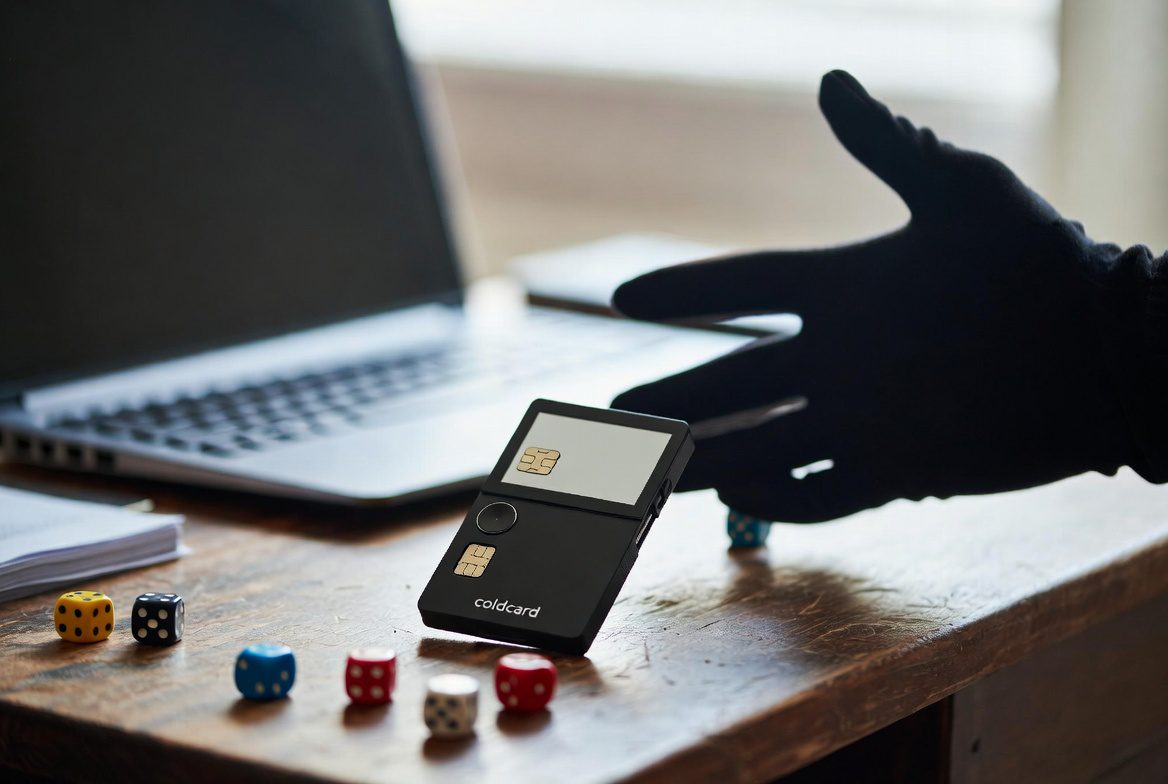
The vulnerability affects the Coldcard Mk3, a model that is no longer manufactured, with particular severity. According to the company, all seeds generated on this device with firmware 4.0.1, published in March 2021, or with any later version may be at risk. The problem is also present in seeds generated with Coldcard Mk4 and Mk5 before version 5.6.0, as well as in those created with Coldcard Q before version 1.5.0Q.
Less randomness than expected
A seed phrase is the set of words that allows the private keys of a bitcoin wallet to be reconstructed. Its security depends, among other factors, on it being generated using sufficient randomness, known as cryptographic entropy. Coinkite expected its devices to produce seeds with approximately 128 bits of entropy. However, the company's preliminary investigation indicates that the seeds generated on the affected Mk4, Mk5 and Q models had around 72 bits of entropy.
This does not mean that all those seeds can be discovered immediately or that all funds have been stolen. It means that the universe of possible combinations is much smaller than expected and that, under certain circumstances, an attacker with technical and computational capability could have a greater chance of reconstructing a seed.
The impact on Mk4, Mk5 and Q is less severe than on Mk3, but Coinkite considers it still serious enough to recommend migrating funds.
The company has not yet published the full technical report. Its notice contains a preliminary analysis and states that the investigation remains open.
Updating the firmware does not repair previous seeds
One of the most important aspects of the alert is that installing the new firmware only fixes the generation of future seeds. The update does not increase the entropy of a previously created seed phrase or modify the private keys derived from it. Therefore, a user who generated their wallet with an affected version must create a new seed, using a device with the corrected firmware, and transfer their funds to the new addresses.
It is not enough to update the Coldcard and continue using the same seed phrase. Before generating the replacement wallet, Mk4 and Mk5 users must check that they have installed version 5.6.0 or later. Q owners must verify that they have version 1.5.0Q or later.
Coinkite recommends carefully recording and checking the backup of the new seed, verifying the receiving address on the device screen and first carrying out a small test transaction. Only after confirming that the new wallet works correctly should the remaining funds be transferred.
The company also advises temporarily keeping the old backup until the migration has been completed and all operations have been confirmed.
Dice may have protected some seeds
The flaw lies in the entropy produced by the device itself, but it does not eliminate the independent randomness that the user may have added by rolling dice.
Coldcard allows the creation of a seed to be reinforced by manually entering the results of rolls of a six-sided die. In the affected firmware versions, the device combined, through a hash function, the internally produced seed with each result entered by the user. According to Coinkite, between 50 and 98 independent, private rolls made with a balanced die provide at least 128 bits of entropy on their own. With 99 rolls or more, the contribution approaches 256 bits.
For this reason, the company does not consider a seed to be at risk solely because of this flaw when the user entered a minimum of 50 fair, independent and private rolls, provided the results were not recorded, photographed, digitized or exposed.
The exception refers to the final words displayed after adding the dice. If the user does not remember how many rolls they made, is unsure which words they used or does not know whether the results remained private, the recommendation is to migrate to a new seed.
A BIP-39 passphrase adds a barrier, but does not eliminate the problem
Users who protected the affected seed with a BIP-39 passphrase or passphrase have an additional, independent layer of security. However, its effectiveness depends on the quality of that passphrase. A short, common, repetitive expression, reused, taken from a quote or based on well-known names may be relatively easy to guess.
Coinkite stresses that the BIP-39 passphrase is not the PIN used to unlock the device. They are different elements: the PIN protects physical access to the Coldcard, while the passphrase transforms the same seed phrase into a different wallet. Even when the passphrase is long, random, unique and remains secret, the company recommends moving funds to a new seed generated with the corrected firmware.
Alternatives for Mk3 owners
The situation of the Coldcard Mk3 is more complicated because the model has been discontinued and does not yet have a corrective update. Coinkite is studying the possibility of publishing a final firmware version for this device. However, the age of the platform means that an update could render some units unusable. The company will only publish it if it manages to validate a sufficiently secure procedure.
In any case, affected users should not wait for that possible update. New firmware cannot repair a private key previously created with an insufficient source of entropy.
When an Mk3 is the only device available, Coinkite proposes as a temporary measure creating a wallet protected with a long, random and unique BIP-39 passphrase, checking its master fingerprint —known as the XFP— and transferring the funds from the original wallet.
The company warns that each passphrase, even one containing a simple typo, generates a different and perfectly valid wallet. Therefore, the user must verify the same XFP every time they enter the passphrase and before sending funds. This solution should be considered temporary until it is possible to create a new secure seed on an updated device.
The advanced option of generating a seed using only dice
Coinkite also describes an advanced procedure for those who only have an Mk3 and want to completely exclude the device's random number generator.
On an empty Mk3 with version 4.1.9, the user can access the Import Existing > Dice Rolls option and enter at least 99 independent results from a fair six-sided die.
This route applies a hash function directly to the sequence of rolls and does not use the affected entropy generator. The company stresses that the normal new-wallet creation process should not be used if the goal is to dispense entirely with the internal generator.
The procedure requires advanced knowledge. The user must verify the backups and fingerprints of the wallets, check a receiving address, then restore the original wallet and make a small test transfer before moving the full balance.
The dice sequence must be treated as secret information. It must not be photographed, stored in digital format or entered into a computer or phone connected to the internet.
Tapsigner, Opendime and Satscard are not affected
The problem is limited to the code used to generate seeds on certain Coldcard models. Coinkite assures that Tapsigner, Opendime and Satscard are not affected, since these products use different codebases.
Coldcard is a family of hardware wallets designed exclusively for Bitcoin. The devices store private keys offline and allow transactions to be signed without exposing those keys to a computer connected to the internet.
Coinkite, founded in Canada in 2012, has manufactured Coldcard since 2017 and also sells other self-custody products, such as Opendime, Tapsigner and Satscard. Its exclusive specialization in Bitcoin and the possibility of using Coldcard without a direct connection to a computer have made the brand a reference among advanced users.
The link to the movement of 594 BTC is not confirmed
The alert has coincided with reports of the unauthorized movement of approximately 594 BTC from hundreds of addresses. This episode helped direct attention toward the security of certain old wallets. However, Coinkite has so far not demonstrated that the entropy generation flaw is the direct cause of the theft of those bitcoins.
Therefore, it cannot be stated that Coldcard caused the theft of 594 BTC or that all the addresses involved had been created with the company's devices.
What is confirmed is that Coinkite has identified a defect in seed generation, has published corrective firmware for Mk4, Mk5 and Q and has asked affected users to migrate their funds. The technical link between that defect and the 594 BTC remains under investigation.
A delicate flaw for self-custody
The incident is relevant because it affects the foundation on which the security of a wallet is built: the randomness used to generate its keys. A hardware wallet can keep keys disconnected from the internet, incorporate security chips and allow transactions to be signed in isolation. But if the initial seed is generated with less entropy than expected, the resulting keys may offer less resistance than intended.
The alert also shows that updating a wallet's software does not always fully resolve a vulnerability. When the defect affects the moment the private key was generated, the real solution is to create a new cryptographic identity and transfer the funds.
Coinkite asks users to act calmly. A hasty migration, a misrecorded passphrase, an unverified address or the loss of a backup can create a more immediate danger than the vulnerability itself.
The priority is to check the model used, identify which firmware the seed was created with and determine whether enough private dice rolls were added. When in doubt, the manufacturer's recommendation is to generate a new seed with an updated Mk4, Mk5 or Q, verify it carefully and move the bitcoins through a first test transaction. The headline avoids attributing the 594 BTC to the flaw while there is no technical conclusion proving it.
FATF warns of the industrialization of illicit use of cryptoassets