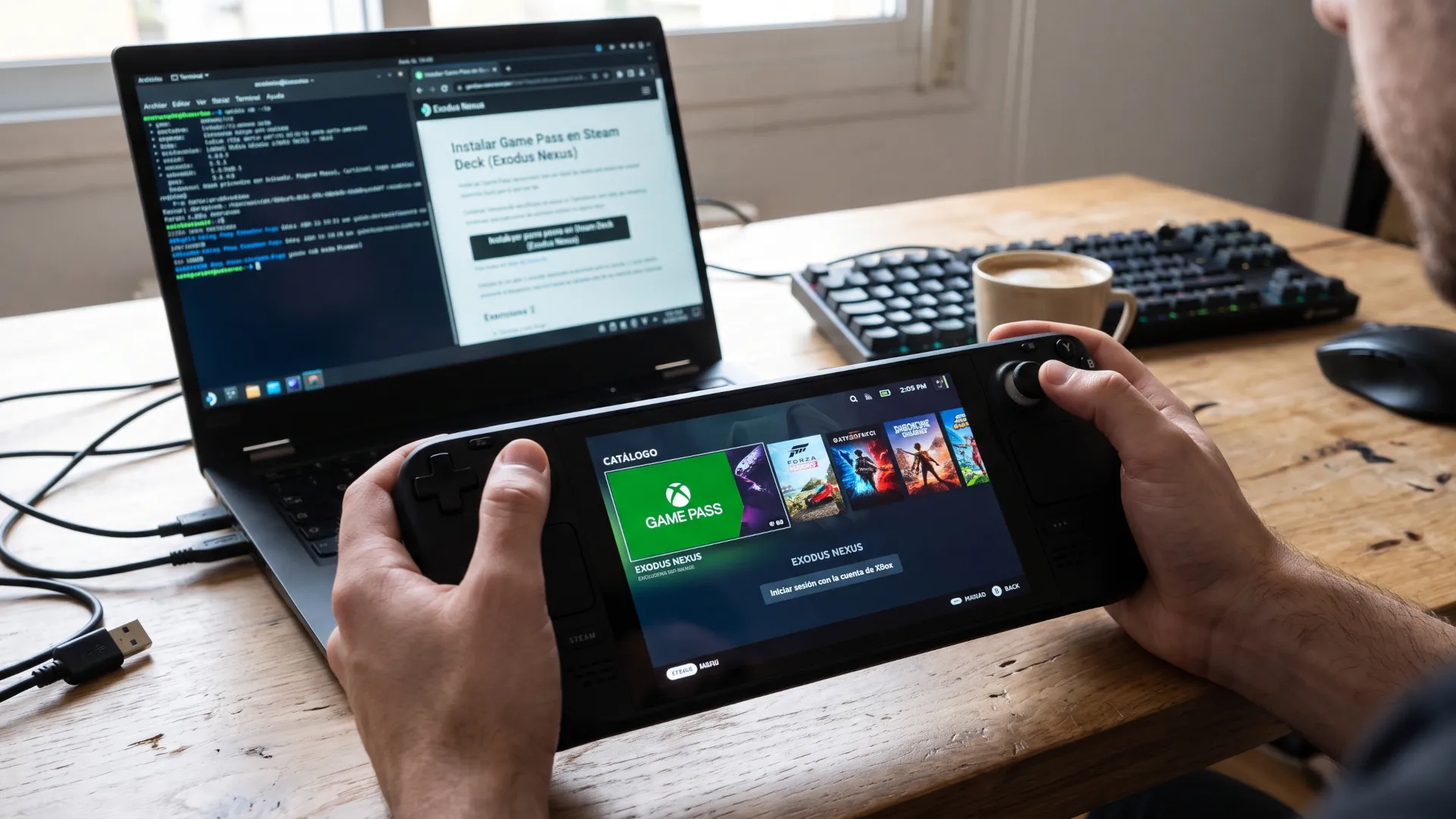
There is a scene that repeats itself on every handheld with Intel graphics. The game offers XeSS, you enable it, and the image improves less than it should because the upscaling is taking the slow path. That path has a technical name and for a few days now it also has a remedy in the form of patches. Damian Tomczak, an Intel engineer, opened a series of four pull requests on October 19, 2026 so that XeSS can take advantage of the XMX cores inside Proton, the Steam Play compatibility layer.
It is worth clarifying what is at stake here. Proton lets you run Windows games on Linux, and the upscaling libraries those games ship with are written for Windows. XeSS works with two engines: a generic one that runs on GPUs from almost any brand and another that uses the matrix acceleration built into Intel GPUs, considerably faster. Under Linux, even with an Arc installed, XeSS stayed on the generic path and left the matrix cores unused.
The detail matters because upscaling has become the tool with which low-power handhelds try to hold 60 frames. Intel announced its Arc G-Series processors for laptops on May 28, 2026, with Xe3 graphics and XeSS 3, and those machines reach the market with Windows 11, according to the company's press release. If Proton learns to use XMX, those users could switch systems without giving up the best upscaler for their hardware. It is not a feature yet: these are four open, unreviewed PRs.
Four patches that only work in order
The series is signed by an Intel engineer and consists of four pieces that do not work separately. Each link lives in a different repository and, without the last one, the other three do not reach SteamOS or Bazzite.
PR 369 in ValveSoftware/wine adds a bundled libxess.dll that forwards XeSS's D3D12 calls to the native Linux library, libxess.so, so that the game believes it is talking to the Windows runtime and ends up running the Linux one. D3D12 objects are converted to Vulkan through the vkd3d-proton interoperability interface, PR 3379 enables the Vulkan extensions XeSS needs and PR 5992 in DXVK stops hiding the Intel GPU brand when Proton handles the upscaling. PR 10289 in Proton bumps the three previous submodules, so it has to go in last.
The PR text describes a condition that makes this a patch rather than a switch. The bundled DLL is only used when Proton finds a libxess.so, first in its contrib directory and then in the system library path, and that path can be forced with the XESS_LIB_OVERRIDE variable. If there is no native library, the game keeps loading its own Windows libxess.dll, with the usual slow path.
PR 369 in ValveSoftware/wine was opened on October 19, 2026 and remains open, with a single coordination comment for the series and no approved review. In a repository like that, a series can take weeks to be looked at.
Therein lies the boundary between a feature and a promise. Proton cannot include Intel's binary on its own, because someone has to supply the native library, and the XeSS SDK is distributed with closed binaries. The open part is the integration, not the upscaler.
Three upscalers with three different owners
Each manufacturer has solved the problem its own way within Proton, and the three solutions have different ages and requirements. NVIDIA goes through DXVK-NVAPI, the piece that exposes NVAPI under Linux and that Proton has enabled by default since version 9.0, according to the project's documentation. It works for DLSS, although DLSS 4 still lacks support in that layer.
AMD got there earlier through the official route. VKD3D-Proton 3.0, released on November 17, 2025, added FSR 4 through the cooperative matrix and 8-bit floating point extensions, with a native path for RDNA 4 and an emulation on int8 and fp16 that the changelog itself describes as hacky and that does not make it into official builds. In June 2026 Valve brought FSR 4 to discrete RDNA 3 GPUs with Proton Experimental.
Intel arrives last and with a fundamental difference. Its upscaler does not need a competitor's GPU, but its own library and its own matrix cores. That dependency explains why the patch has to come from Intel and not from a community volunteer.
| Upscaler |
What it requires under Linux |
Status in Proton |
| NVIDIA's DLSS |
RTX GPU and DXVK-NVAPI enabled |
DLSS 4 unsupported in VKD3D-Proton |
| AMD's FSR 4 |
RDNA 4, or hand-compiled emulation |
VKD3D-Proton 3.0 and Proton Experimental |
| XeSS with XMX |
Intel GPU with matrix cores and libxess.so |
Four open PRs, unreviewed |
What each user gains and does not gain
For anyone with an Arc in a machine running SteamOS or Bazzite, the change is the most noticeable and the least quantifiable. Moving from the DP4a path to XMX means using the matrix units Intel put into its GPUs precisely for this task, with better image per frame and lower cost. None of the four pieces includes figures, so any percentage circulating is an extrapolation from tests done on Windows.
On Steam Deck nothing changes. Valve's console uses an APU with RDNA 2 graphics, without matrix cores and below the RDNA 4 cutoff that FSR 4 requires on the official path. Its owners will keep depending on whatever upscaling the game ships or on the FSR 4 emulation that requires compiling VKD3D-Proton by hand.
There is a limit worth keeping in mind. Proton does not add XeSS to a game that does not have it nor change the version of the upscaler the studio chose: it only makes the library the game already loads find the fast path instead of the slow one.
On Bazzite, a distribution aimed at handhelds and living-room machines, the change will arrive the same way as on SteamOS: updates to Proton and its submodules, not a package specific to the distribution. That is the advantage of doing the work in common.
Why Valve lets a manufacturer touch its layer
SteamOS was born tied to AMD and update 3.8 arrived in March 2026 as a preview version with changes aimed at Steam Machine and at third-party hardware.
The underlying reason is commercial. Each manufacturer that enters that circle expands the catalog of machines capable of running Valve's store, places among the year's improvements compatibility with recent AMD and Intel platforms.
Valve's model consists of accepting code from manufacturers in shared projects, not of opening private forks. VKD3D-Proton, DXVK and Wine receive contributions from Intel, AMD and NVIDIA, and Valve keeps the final say on what goes in. The clearest precedent is FSR 4 itself, because Proton Experimental added an upgrade path for games with FSR 3.1 that only works on AMD GPUs and did so with the company's blessing.
The risk is real. Each accelerated path adds a manufacturer's binary to the dependency tree, and that binary can change license, version or behavior without warning the rest. Valve accepts that debt because the alternative is for its Arc users to play with the worse upscaler.
The Arc handheld still boots Windows
Intel presented its Arc G-Series processors for laptops on May 28, 2026, with Xe3 architecture and up to Arc B390 graphics, and the first machines, among them the MSI Claw 8 EX AI+, arrive with Windows 11 from June. Those processors debut XeSS 3 with multi-frame generation, and the feature later came down to Alchemist and Battlemage with driver 32.0.101.8509.
The irony is that Intel's best upscaler on an Intel handheld still depends on an operating system that is not Valve's. If the four PRs are merged, SteamOS will take a real step toward parity with Windows on Arc hardware; if they stay in review, the GPU will keep performing better outside SteamOS through the driver.
It is worth following the merge and not the announcement. When PR 10289 goes in, the question will stop being who accelerates XeSS and become who packages libxess.so, under what license and from what date.