Flathub, the Linux App Store that has now surpassed 4 billion downloads
If you install a program on Linux, there is a very high chance you do it through Flathub, even if you don't know it. This central repository of applications in Flatpak format surpassed in 2026 the 4 billion cumulative downloads and the 3,500 applications, and in 2025 it recorded its best year with more than 435 million downloads, 21% more than the previous year. Behind that growth is a simple but powerful story. Flathub has become the "Linux App Store," the most convenient way to install and update software on almost any distribution, just as the App Store is on Apple or Google Play on Android.
What is Flathub? The universe of Flatpak applications
Flathub is the central store for Flatpak applications. In turn, Flatpak is a universal packaging format for Linux desktop applications. This means the developer builds a single package that works on practically any distribution, without needing to adapt it to Debian, Fedora, Arch or openSUSE separately.
The idea is not new, projects like .deb or .rpm have been around for decades, but Flatpak introduces two key differences:
Universality. An application is published once and runs on all distributions. This solves Linux's historical fragmentation, where each distro had its own format and its own update schedule.
Isolation (sandbox). Each application runs in an environment isolated from the rest of the system, with explicit permissions to access files, network or devices. That isolation gives more control over dependencies and reduces the risk of an app altering the system.
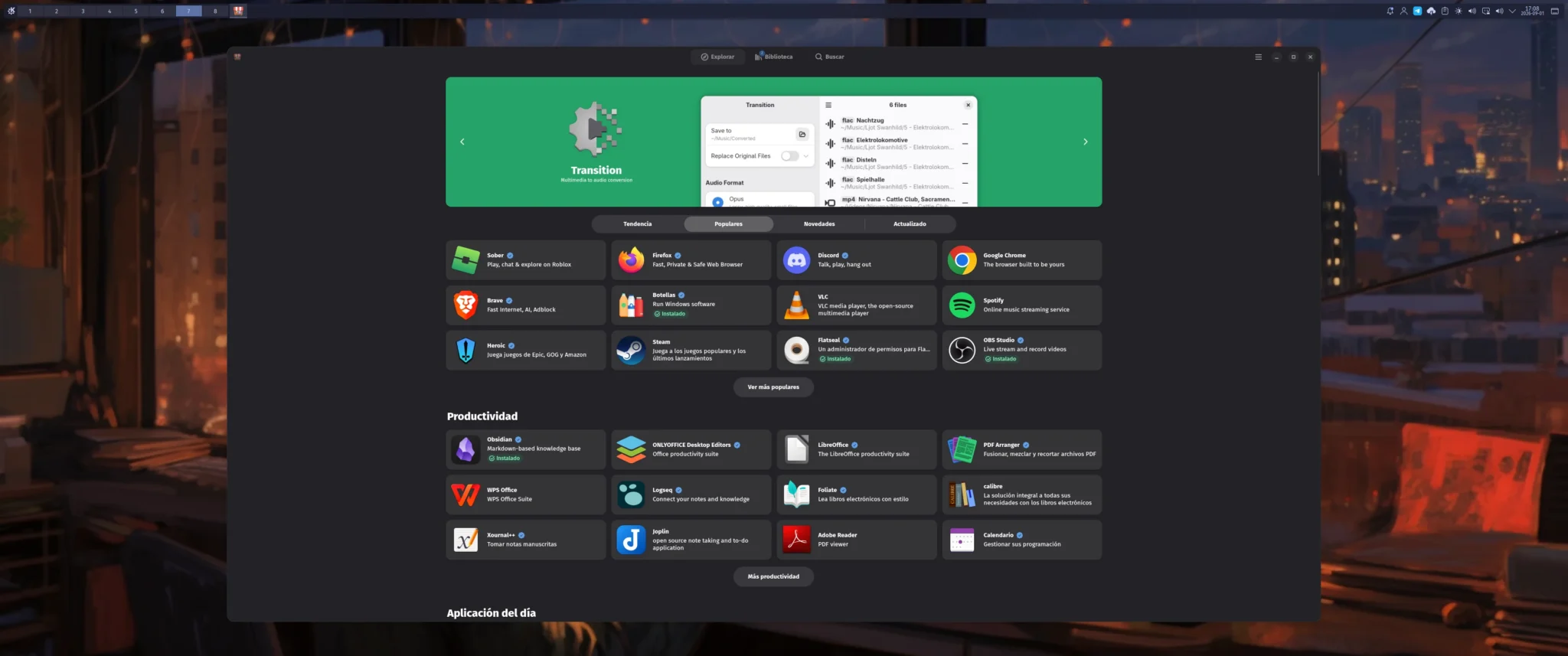
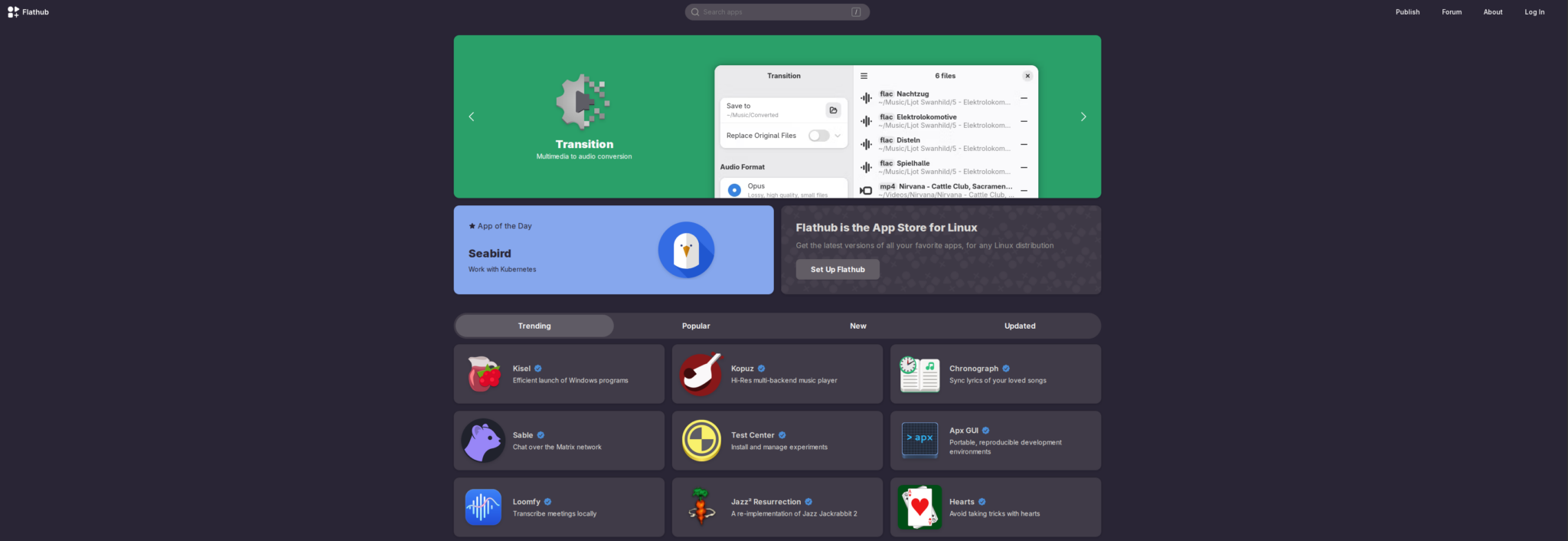
Flathub provides the "storefront" layer, a central place to search, install and update applications, with pages, screenshots, descriptions and an install button. The official documentation sums it up as the main repository for publishing and hosting Flatpak applications, integrated by default with native software stores such as GNOME Software and KDE Discover.
Why has Flathub become so important now?
Flathub's success is not the result of a single factor, but of the convergence of several in recent years. The numbers tell the story. On the one hand, annual downloads went from 27.3 million in 2020 to 435 million in 2025, a growth of more than fifteen times in five years, according to Flathub's 2025 annual summary. The catalog grew from 914 applications in 2020 to more than 3,500 in 2026, and it already has more than 2,000 verified applications and millions of monthly active users.
Behind all this success there are four main drivers:
Adoption by the distributions. Flathub comes preinstalled and enabled by default on Fedora, Linux Mint, elementary OS, Endless OS, KDE Neon, Pop!_OS, Zorin OS and others, and is easy to add on Ubuntu or Arch. When an app store comes preinstalled, the average user doesn't even need to know that Flatpak exists. They simply install programs from the usual interface. Since Fedora 38, moreover, Flathub is fully available when third-party software sources are enabled.
The Steam Deck and the Valve ecosystem. The launch of the Steam Deck in 2022, which runs SteamOS (a distribution based on Arch), turned Flathub into the default source of applications for its desktop mode. Millions of devices put Flatpak in the hands of users who had never thought about packaging formats. With the new Steam Frame and Steam Machine arriving in 2026 with the same SteamOS, the trend will accelerate. It is no coincidence that Flathub's most popular category is video games, with emulators such as RetroArch and Dolphin and launchers such as Heroic or Steam.
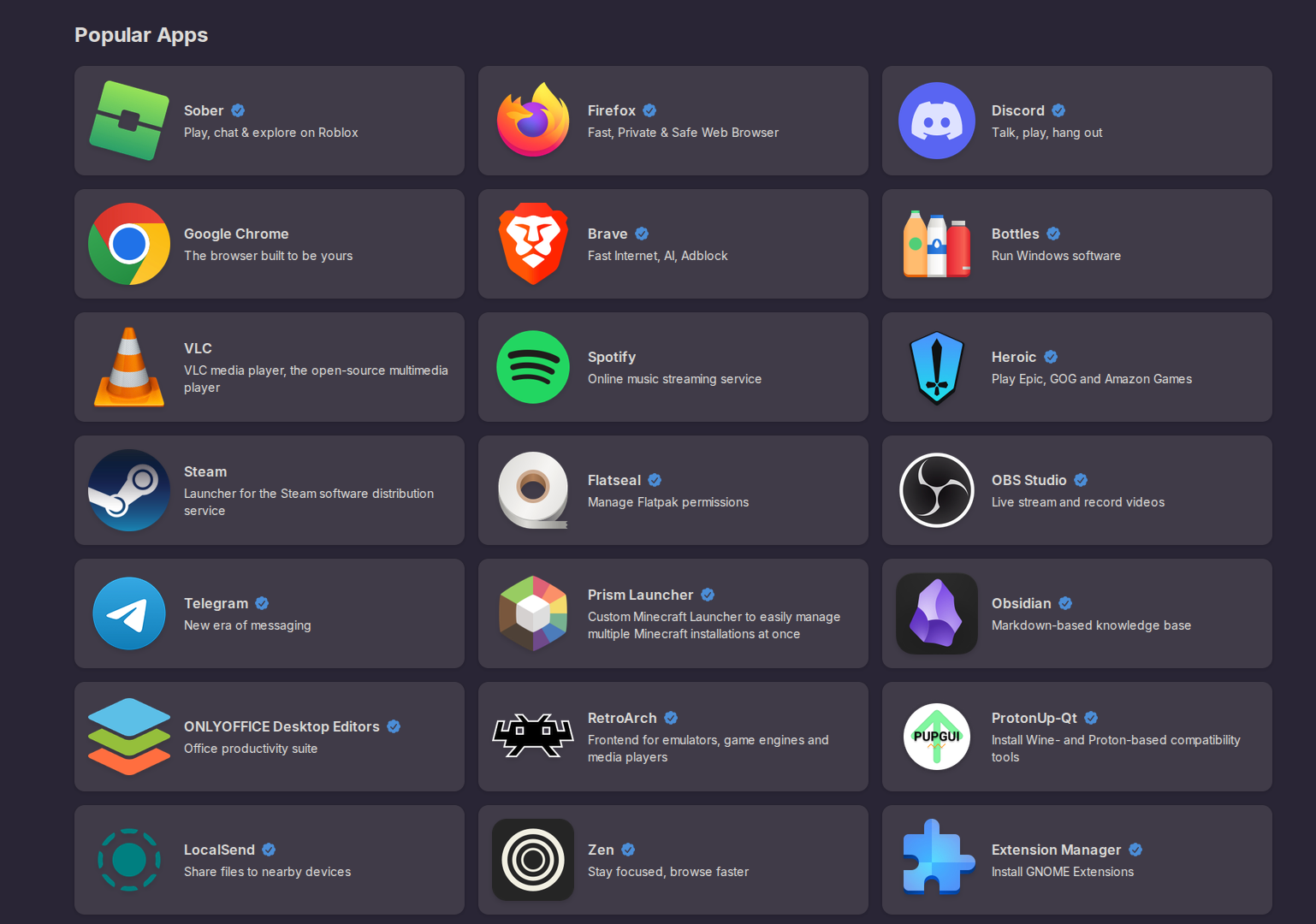
The applications people expect. Flathub today hosts practically all the popular software a Windows or macOS user would expect: Firefox, Google Chrome, Discord, Spotify, VLC, Telegram, Microsoft Edge, Steam, OBS Studio, Zoom, Thunderbird, LibreOffice and GIMP, among others. An important app arriving on Flathub makes both Flathub and Linux more attractive to those new to the desktop. Hundreds of independent and open source applications are also added every year.
The victory in the "packaging war". For years Flatpak, Snap (from Canonical) and AppImage competed. With the adoption of Flathub by Fedora, Mint, elementary and the Steam Deck, and with its distribution-neutral character (unlike Snap, closely tied to Ubuntu), the community has de facto chosen Flatpak as the standard. That way, Linux's "packaging war" ended without a treaty, but with a market that has made its decision.
Popular applications available on Flathub
How to use Flathub?
For most users, the simplest way to use Flathub is through their distribution's software store. If you use GNOME, open Software (GNOME Software); if you use KDE, open Discover. Both integrate Flathub by default.
If your distribution already has Flathub enabled (Fedora, Mint, elementary, Pop!_OS, etc.), you just have to search for the application and click "Install".
If you use Ubuntu, Debian or another distro that doesn't come with it out of the box, you first have to install Flatpak and add the repository, and on GNOME also install the corresponding plugin. The official Flathub installation page explains the process by distribution.
You can also visit flathub.org from your browser, search for an application and click the "Install" button: it will download a .flatpakref file that, when opened, installs the application directly from your software store.
Each application is identified by a unique three-part ID, such as org.gimp.GIMP, org.mozilla.firefox or com.spotify.Client. To see what is available in the repository, you can use flatpak remote-ls flathub --app.
Security and trust: verified applications
With thousands of applications, trust is key. Flathub uses a system of verified applications: a badge indicating that the application is published by its original developer and that the Flathub team has confirmed the identity. Verification reassures the user that a given application really comes from its author, and not from a third party redistributing it.
In addition, Flathub has an AI policy for applications that requires accountability and human review of permissions, isolation and security. The goal is for installing an application from Flathub to imply the confidence that someone has reviewed that the software does what it says.
A promising future for Linux apps
Flathub is not just a download store: it is in the midst of a transition toward a mature and independent platform. The GNOME Foundation, together with KDE e.V., is driving Flathub LLC as its own self-sustaining entity, with its own governance and independent funding. Although the plans have been delayed, in September 2025 the GNOME Foundation confirmed that they were moving forward with hiring legal services. That step is important because Flathub has relied heavily on funding from donors such as Endless and on GNOME's infrastructure.
On the immediate horizon there are three relevant developments:
Payments and donations. Flathub plans to allow developers to sell applications or receive donations within the platform, with a 30% fee for proprietary applications and 10% for open source ones, which are cross-subsidized. This would open the door for free software developers to make money directly from their work.
More software and better integration. As more projects choose Flathub as their main channel, the catalog grows and so does integration with GNOME Software and KDE Discover: better verified listings, clearer permission notices and faster updates.
Architecture support. One of the pending tasks is to expand support to ARM64, since not all applications work on ARM processors, something relevant for the new laptop devices and Linux-based handheld consoles.
Not everything is a bed of roses. Flathub faces real challenges: a small maintenance team up against the moderation of thousands of applications, the deprecation of old runtimes (in 2025, nearly a thousand applications still depended on runtimes at the end of their useful life) and the disk space cost of packaged applications. There is also debate over whether distributions like Fedora should enable Flathub by default, a decision that pits the convenience of new users against the control and security of the distributions.
But the trajectory is unmistakable. What began as a solution to Linux packaging fragmentation has become the de facto app store of the Linux desktop, backed by thousands of applications, billions of downloads and an ecosystem of developers that increasingly chooses it as their main channel. For the Linux user, that means a more predictable and consistent experience: finding, installing and updating software easily, on any distribution.