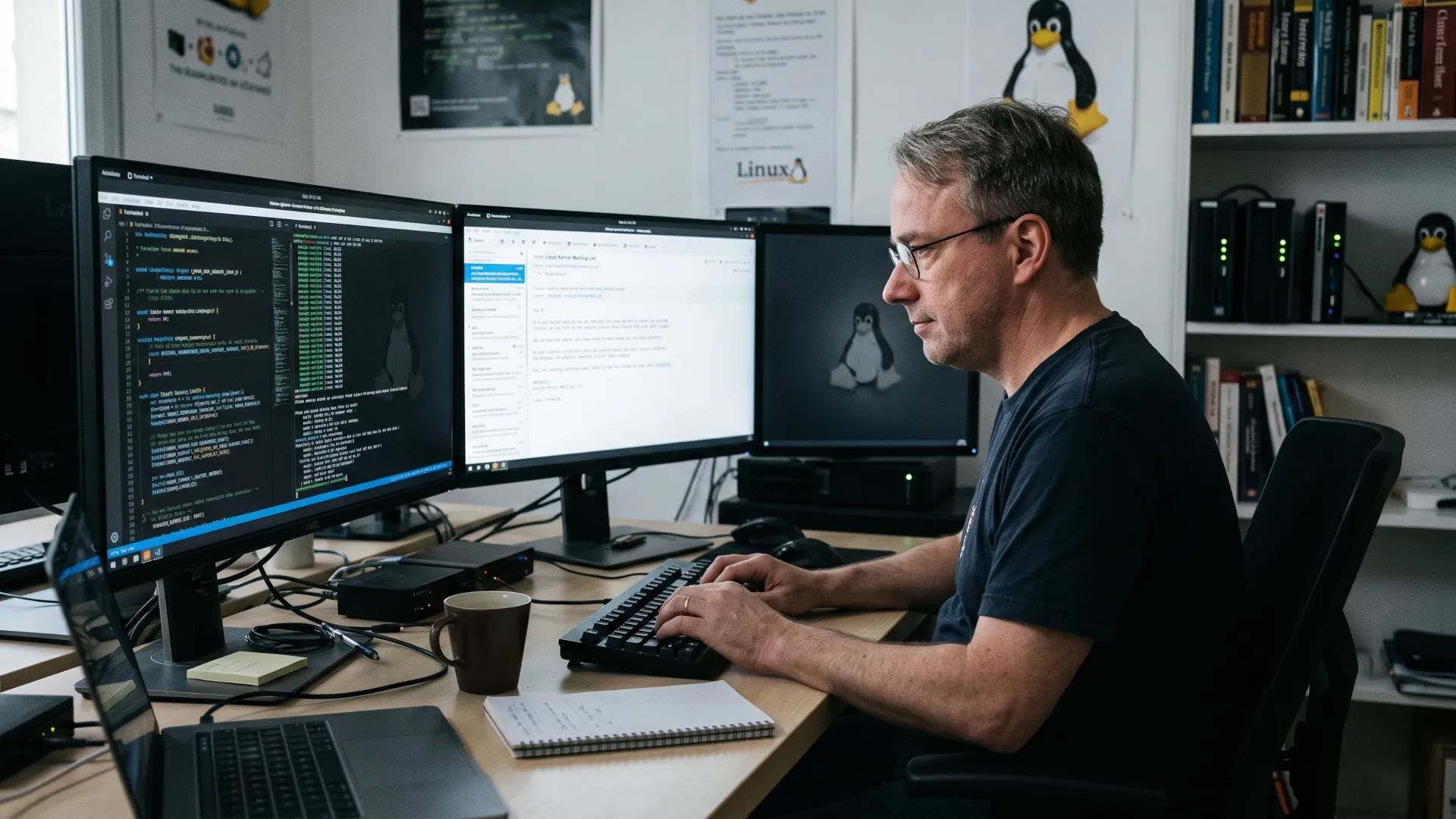
Linus Torvalds published the announcement for version 7.4-rc2 of the Linux kernel on November 8, 2026 and, among the routine paragraphs, left a sentence that changes the tone of the conversation: a good part of the maintenance work in recent weeks was artificial intelligence-assisted fixes and he plans to stop repeating it in every email. In the official project archive, 7.4-rc2 has been the mainline since November 9, with 7.3.4 already released as stable.
The data behind that shift in tone is not his. Alexei Starovoitov, maintainer of BPF, the programmable filter mechanism the kernel uses to inspect traffic and system calls, reported that the pace of fixes in that area now exceeds that of new bug reports. If the ratio holds, that team stops merely plugging what comes in and starts emptying the old backlog.
The finding is modest and Torvalds himself plays it down: most other areas of the kernel have not reached that point and, at best, it is a sign that the tide may be turning. What is interesting is not the headline about machines that program, but that a fix closing an old bug genuinely reduces accumulated risk, while the announcement that he will stop mentioning it opens an uncomfortable question about auditing.
What did Torvalds say and what did he leave out?
The email dated November 8, 2026 arrives after a high-volume cycle. Torvalds describes 7.4-rc2 as a large candidate and compares it with the previous rc1, which he calls, without qualification, the largest in kernel history.
Much of that size had a mechanical origin: automatic Coccinelle updates, the tool that rewrites code patterns en masse and has been moving thousands of lines per cycle for years. That inflates the patch count without a new feature behind each one, a detail worth keeping in mind before reading the figures as a sudden surge in human activity or assisted activity.
In the 7.4-rc2 announcement the key phrase is a concession of ground. Torvalds writes that much of the recent maintenance was AI-assisted fixes and that he will stop repeating it because, at this point, it can be taken for granted. There is no list of tools or patch count. Nor do the touched files appear.
That absence of detail is not an editorial oversight, nor a minor omission: without a public inventory, no one can measure what share of the accepted code came from a model or in which areas it is concentrated.
What is clear is the limit of the message. It does not claim that the kernel is written with AI, it offers no percentages and it does not suggest that generated code is accepted without the usual review. An assisted patch still goes through the same hands and the same tests, and that is the only guarantee the process can offer today. The changes in 7.4-rc2 went through that same filter, like any other candidate.
Why does a fix weigh more than a new patch?
A bug that has been in the tree for months is a risk paid for daily: every stable release inherits it and every distribution drags it onto servers, phones and routers. A fix removes that risk at a stroke, whereas a new feature adds surface area and forces more code to be reviewed than before.
That is why the indicator that matters is not how many patches go in, but whether the team handling an area manages to close more than it receives. In queue terms, fixing the old and fixing the new look little alike: the former pays down debt, the latter keeps it stable. That distinction explains why a one-line note in a release email can be worth more than a performance milestone.
7.4 has also touched the inventory of features the project considered dangerous and that Torvalds decided remove from the tree, another cleanup that reduces the attack surface without adding new capability.
Accumulated risk is not the same as severity, and an area's ratio does not distinguish between the two either: a hundred minor fixes can be closed in a month while a critical bug that has been open for two years is still dragging on.
That is why the notice is more informative for what it restricts than for what it celebrates. The message itself notes that most of the other areas have not reached that point, so BPF's success works as a visible exception rather than a general trend across the tree. A maintainer who empties their queue does not prove that the rest can do the same.
The BPF figure in context
It is worth separating what each signal measures from what it suggests, because the announcement mixes three different things in a few paragraphs and only one of them has numbers behind it: the state of a specific queue, at a specific point in the cycle.
| Signal in the announcement |
What it measures |
What it leaves out |
| AI-assisted fixes |
recent maintenance volume, no figure given |
which tools and which specific patches |
| Pace of fixes in BPF |
inputs versus outputs of an area's queue |
severity, latency of the fixes and regressions |
| large 7.4-rc1 and rc2 |
size of the merge window |
how much of that volume is automatic |
| Rest of the kernel |
the acknowledgement that it does not reach that point |
which areas are lagging behind and why |
| Review process |
that no changes were announced |
traceability of the origin of each patch |
The useful reading of the table is the second row. The BPF ratio compares arrivals with departures in a specific area; it does not measure the quality or age of what was fixed, nor does it say whether a person or a model found the fix. A falling queue is good operational news, and at the same time it can hide the fact that the easy items are closed before the difficult ones.
Nor are there public figures behind Starovoitov's observation: without counts of reports and fixes per week, the ratio works as the impression of the person who has led the area, which is worth a lot, but not as a measurement that someone else can replicate.
The calendar orders the rest. The second part of the review of the 7.4 merge window was published on November 2, and by November 10 the stable branch was already at 7.3.4, with 7.2.15 marked as end of life from day one. Anyone who wants to see the effect of these fixes on their own machine has the option of compiling their own kernel, which remains the most direct way to check which patches land and which do not.
Maintenance that becomes normalized with no public trace
At this point, the question is no longer whether AI helps maintain the kernel, but whether the trace of that help survives the next release candidate. The more automated maintenance there is, the more necessary it becomes to know where each patch that touches memory or networking on someone else's server comes from, and the November 8 announcement leaves that part out of the email.
The least-cited part of the announcement is the one that should matter most in the medium term. If assisted maintenance stops being flagged, the origin of patches ceases to be a public record, and with it disappears the possibility of discussing which classes of bug the models find and which ones they miss. There is no need to distrust the process to miss a log that until recently was considered part of the announcement.
An identifier in the patch, of the kind already used to recognize co-authorships and reviews, would solve traceability without touching the review. It costs one line per submission and returns something no release email can give: the ability to count. Without that, normalization advances and the evidence stays at the door.