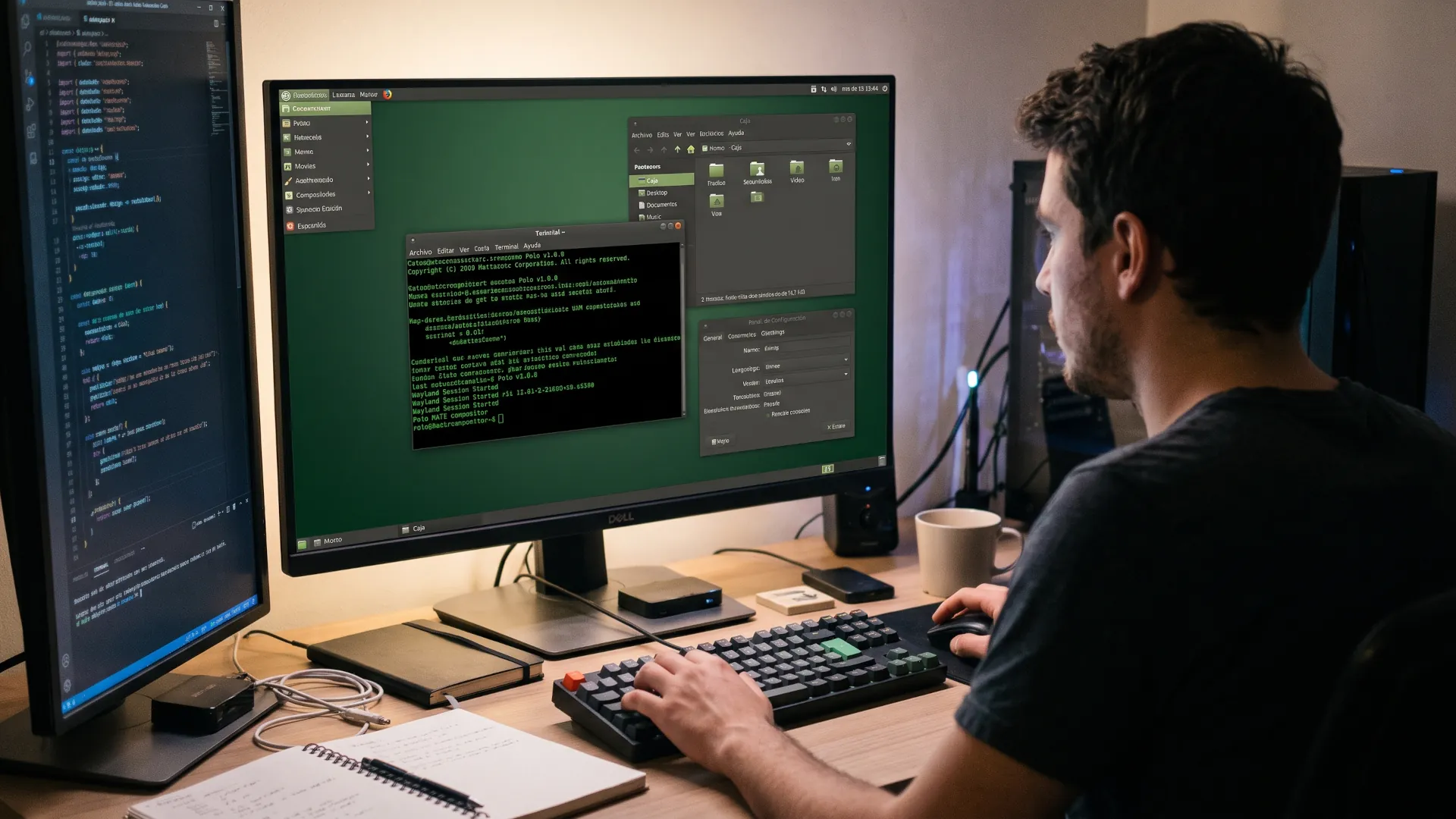
Since this week, MATE has its own path to Wayland that does not involve adapting the desktop to someone else's compositor. The Polo repository dates version 1.0.0 to November 11, 2026, and the first posts about the release came on the 12th, with a project written in C and Vala on libweston 16 that combines compositor, window manager and session manager in a single package. Its author is Kerem Söke, a MATE user, and he presents it as a port of the behavior of Marco, the desktop's classic window manager, to the new architecture.
The difference from what came before is not cosmetic. MATE already had an experimental Wayland session built on Wayfire, a generic compositor that is adapted with plugins, patches and startup scripts. Polo reverses the direction: it starts from MATE, from its GSettings keys, its session API and its window rules, and builds the Wayland layer underneath. The author says it plainly in the repository: Wayfire was not designed for MATE and for years they have been trying to make the desktop fit through add-ons and compromises.
That shift in approach explains the interest in version 1.0, which remains an independent project and not the desktop's official solution. Even so, its scope is greater than that of an experiment.
A compositor written for MATE, not the other way around
Polo is not a Wayfire fork or a plugin: it is a Wayland compositor with a window manager and session authority, and that fusion is what allows it to read the preferences MATE already had stored. Marco's window rules, themes and shortcuts reach the new desktop through `org.mate.Marco.*`, so anyone who has the desktop configured to their liking does not start from scratch. In practice, the session behaves like the X11 one for applications and for the settings the user had already changed.
The session part is included as well. Polo implements the D-Bus API of mate-session-manager 1.28, so the panel and Caja keep talking to the same counterpart as in X11, as do the power manager and GTK applications. Phased startup, inhibitors, presence, countdown shutdown dialogs and sessions saved in `~/.config/mate-session/saved-session` work without touching the desktop configuration.
The price of that integration lies in maintenance. When a project absorbs three pieces that were previously handled by different teams, any change in MATE forces a review of the whole, and the author admits that the work remains open: the stated goal is to absorb the rest of window management and the X11-specific integration without the desktop ceasing to feel the same.
There is a calendar nuance worth noting. The repository tags 1.0.0 on November 11, while public dissemination came on the 12th, and that one-day difference changes nothing technical, but it does help in reading the first coverage.
What can you do and what is still tied to XWayland?
The inventory of what works is extensive for a first version, and the list of what is missing is short but important. The following table summarizes the pieces a MATE user notices when entering the new session and the status of each one.
| Component |
How it works in Polo |
What remains pending |
| Window management |
Marco policies, themes and shortcuts on Wayland |
Nothing essential |
| Panel (mate-panel) |
Works with layer-shell |
Fedora builds it only for X11 |
| Session |
D-Bus API of mate-session-manager 1.28 |
Nothing essential |
| Desktop settings |
mate-settings-daemon on XWayland |
Keyboard, mouse, background and xrandr disabled |
| Screenshots and screen sharing |
xdg-desktop-portal with its own picker |
Outside the compositor core |
| X11 applications |
XWayland |
Nothing relevant |
The most striking piece is the fourth row. mate-settings-daemon still runs through XWayland because it has no Wayland support, and in the new session the plugins that cannot work there are disabled: keyboard and mouse, multimedia keys and the wallpaper, along with xrandr and accessibility. The desktop starts, but part of the fine-grained configuration is left in the compositor's hands.
Builds matter too. Several MATE packages distributed by Fedora, among them mate-panel, are built only for X11 and need versions with Wayland support to integrate fully, something the developer himself flags as a pending task for the distribution.
Alt+Tab, tiling and the GNOME 2 cube
The window functions are the usual ones, which is exactly what is being aimed for. Polo brings Alt+Tab with preview, tiling by keyboard or by dragging, multiple workspaces, window menus and on-screen notifications that are announced to screen readers, an accessibility detail that many new compositors leave for later. Monitor management includes hot-plugging, saved layouts, gamma and output zoom.
The visual section brings back the effects that defined GNOME 2 and that MATE preserved: the desktop cube, windows that wobble when moved and the animations when minimizing and maximizing. They are pure cosmetics and do not fix any productivity problem, but they work as a sign of continuity for anyone who has had the same desktop layout for fifteen years, and that continuity is precisely what other migrations to Wayland have broken.
The obligatory reference here is the desktop's own history. The review of fifteen years of Dolphin's column view shows how a specific feature can survive three rewrites if the project decides to keep it, and MATE has made that stubbornness its identity.
Nostalgia does not pay the bills, and that is where the risk lies. An effect that nobody maintains breaks with the next version of libweston and drags down trust in the rest of the compositor with it.
Compiling on Fedora 44 and Ubuntu 26.04
Anyone who wants to try it has to compile it. The repository publishes instructions for Fedora 44 and 45, Debian 14, and Ubuntu 26.04 and 26.10, with libweston 16 as the base and the minimums set by the project: Vala 0.56 and GLib 2.80 among others. There are no official packages in the distributions' repositories, so the first contact is a terminal and a list of development dependencies.
The preliminary step makes sense for a project of this size. Packaging for six versions across three distributions requires infrastructure that a single developer cannot sustain, and the compilation instructions for Fedora 44 and Debian 14 make it clear that the goal now is for the code to work, not for it to be easy to install.
Once installed, the session appears as MATE (Polo) in the LightDM selector and starts like any other. Compiling a desktop from source code is not unusual in the Linux ecosystem, and the method for cooking your own kernel follows the same principle: you control the version, you pay the maintenance. For a distribution that wants to include it, the usual path is packaging, as happened when CachyOS brought its desktop to WSL and had to resolve the dependencies outside its natural environment.
With six version combinations in the documentation and none in the official repositories, the project is at the stage where the technical side already works and the logistical side does not yet, which is where almost all alternative compositors end up.
A one-person project against MATE's pace
The detail that orders everything else is scale. The list of pieces that remain on X11 confirms that Polo is an independent project and not a replacement adopted by the desktop. The repository backs this up: GPL-3.0 license, 329 commits and 19 stars, with a single person behind it. With those numbers, the comparison with the MATE team is not fair in either direction.
The useful question is not whether Polo will be MATE's official Wayland, but whether the desktop can afford to keep waiting. An external development that moves faster than the organization has a known cost: when the author gets tired, the code is left orphaned and whoever adopted it goes back to X11 or switches to another environment. The good part is that the GPL and MATE's standard interfaces leave the door open for the work to be absorbed.
While that happens, 1.0 is a testing ground for a reasonable idea: that a classic desktop's migration to Wayland is done from within that desktop, not from a compositor that has to be convinced.