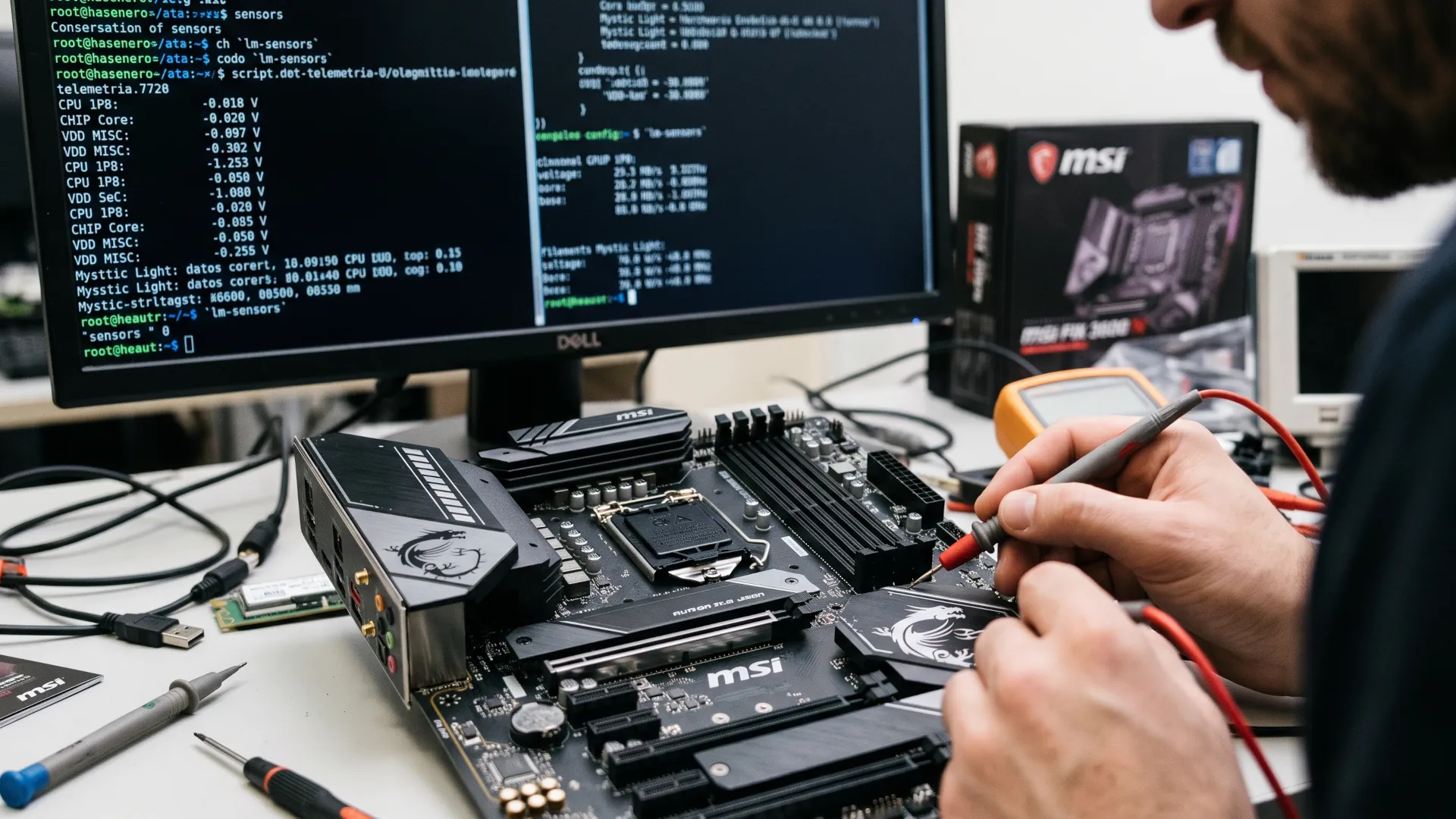
MSI sells its latest AM5 boards with Mystic Light, an RGB lighting system that can only be controlled from Windows with MSI Center. This weekend, an independent developer, Tomasz Bojanowski, sent a series of patches to the kernel mailing list to bring that controller to Linux. The interesting part is not the color of the lights: it is that the USB microcontroller that manages the RGB turns out to also be the only component on the board that measures three voltage rails that the Super I/O chip ignores.
The finding turns a hobbyist project into something with real utility for anyone diagnosing an MSI board with AMD 800. The rails in question are CPU 1P8, CHIP Core and VDD MISC, and on the boards tested they are not monitored by the Super I/O, which is the chip to which the system's voltage and temperature sensors are traditionally connected. If the driver makes it into the kernel, `lm-sensors` and monitoring tools will be able to read them for the first time.
The news has two readings and it is best not to mix them. The first is the usual one, that of consumer hardware that depends on proprietary software for basic functions. The second is less obvious: on modern boards, part of the telemetry has shifted to microcontrollers that the operating system does not know about, and recovering it requires reverse engineering protocols that nobody documents. RGB was the entry point, not the goal of the work.
A microcontroller with more functions than the box advertises
The Mystic Light controller communicates over USB and in Windows it serves for little more than changing colors and effects. In the kernel submission, the focus is on exposing the voltage sensors that the same chip collects. It is a reasonable scope decision: a driver that starts by reading telemetry registers is easier to review and accept than one that writes commands to each board's lighting firmware.
Bojanowski's patches for MSI Mystic Light were published this weekend and are still under review. The kernel community usually takes months to accept a new driver, especially one that touches consumer hardware with scarce documentation. Nothing guarantees it will reach the main tree, although the fact that the author found a useful function beyond RGB improves its chances.
There is a detail that explains why this matters on a home server or a technical workstation. When a machine boots badly, with random hangs or reboots, the first question is always the same: is the power where it should be? Without sensors, the answer requires a multimeter and time. With them, a single command is enough.
Reverse engineering as a weekend job
The road to get here was not short. Another developer, who goes by the alias Picachuchu69, published a Python script days ago that controls the RGB of the B860 and X870 boards from Linux without going through Windows. He did it by capturing the real USB traffic of MSI Center inside a Windows virtual machine and analyzing it with usbmon and Wireshark, and he documented the full protocol: a 290-byte HID report, mode at offset 273, a four-color palette after that, a byte of parameters packed with speed, brightness, direction and animation.
That work is what makes the driver possible. The protocol documentation, published in an open repository, allows others to write C code for the kernel instead of repeating the capture. It also reveals a design detail that says a lot about the industry: MSI Center's temperature mode is not firmware, it is software that sends static commands calculating the color from the sensor readings. The board does not think, the application decorates.
The story fits a trend that repeats itself in consumer hardware. The manufacturer uses a cheap microcontroller for several functions, documents only the one it sells and leaves the rest in the hands of the community. When someone looks inside, they find capabilities that were never announced and that are sometimes more valuable than the original function.
There is a precedent that helps gauge the value of what has been achieved. Board sensors usually reach the operating system through the Super I/O chip and the drivers that the community maintains in the lm-sensors project.
What is missing for it to be of any use?
A driver under review is not an available driver. Users of stable distributions will take a while to see it, and those who want it sooner will have to compile the kernel or apply the patches by hand, which on a work board is not a trivial decision. It is also unclear which models will be covered: the work was done on boards with the AMD 800 chipset and controller support may vary between revisions of the same model and its management circuitry. The same community work that brought ROCm to FreeBSD applies here, only the prize is smaller.
Kernel review is slow by design. Each submission goes through maintainers who read the code, ask about edge cases and demand that the driver not break anything on similar boards. A consumer hardware submission without manufacturer documentation usually needs several iterations before getting the green light.
RGB, curiously, is the last thing to arrive. The current submission focuses on voltages, and lighting control would need a second round of patches that does not exist yet. Anyone hoping to turn off the lights on their tower from Linux will have to keep waiting or fall back on the Python script, which already works even though it writes directly to the HID device.
For everyone else, the immediate utility is more sober. A home server with an MSI board can gain three sensors it did not have until now, and that improves power failure diagnosis without buying additional hardware. On a machine that stays on for years, knowing whether the 1.8-volt rail is drifting is information worth more than any breathing effect.
The path to the usual monitoring tools still has steps ahead. A driver in the kernel tree does not expose the sensors on its own: the lm-sensors project needs to add the chip definition and distributions need to update the package so that a user can read the values with the sensors command, something that usually takes one or two releases.
When a rail does not reach the operating system through the usual route, the only way to read it is to find the component that does measure it and write code to talk to it.
RGB as a side effect
The episode leaves a lesson about how free hardware support gets written. Manufacturers do not usually document what they do not consider a feature, and developers find value where there was none. A chip that exists to sell lights ends up being a source of telemetry because someone took the trouble to capture its traffic and publish it. These are improvements that arrive late and through the back door, like KDE Dolphin's Miller columns, which returned fifteen years later.
It remains to be seen whether the driver makes it into the kernel and whether MSI responds with documentation or with silence. Both things have happened before in this industry, and the difference is usually measured in years. In the meantime, the work is on the public list, reviewable line by line, which is exactly where it belongs.