Why has Apple decided that you shouldn't buy its hardware?
First, Apple did not present its Apple Upgrade program as a financial curiosity, but put it at the center of its store. Since July 28, 2026, in the United States, the Apple Upgrade program replaces the iPhone Upgrade Program and iPhone Payments for new customers and extends the model to almost the entire catalog. You no longer finance the purchase; instead, you rent the device for a "convenient" monthly fee.
This mechanism breaks fifteen years of habit. You choose an iPhone or Apple Watch for 12 or 24 months, or a Mac and iPad for 24 or 36 months. You pay each month and Klarna charges in its app after a soft check and retains ownership. At the end you have three options: return it and walk away, hand it in to start another lease with a newer model, or pay a one-time purchase fee to keep it. That simple.
Apple's FAQ leaves no room for doubt: you are not the owner at the end of the term unless you pay that fee.
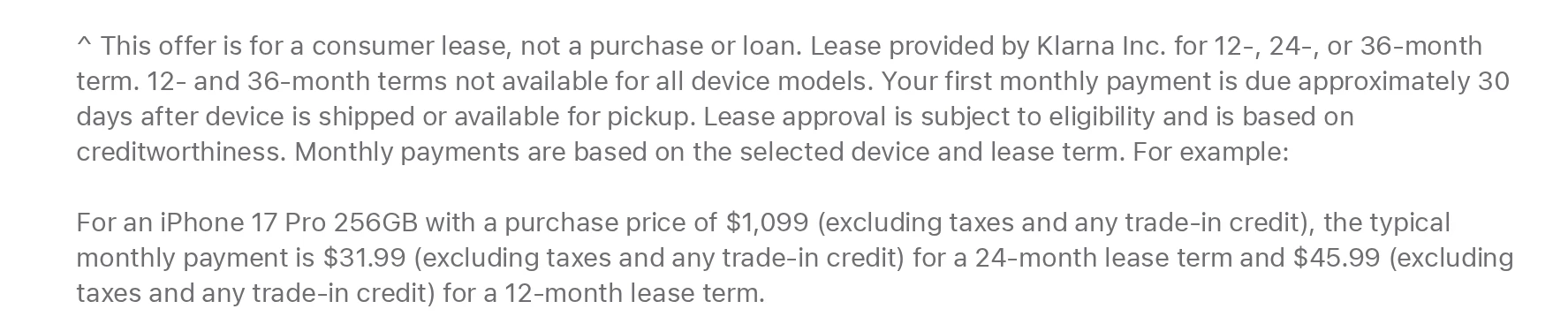
Starting prices set the tone: iPhone from $17.99 a month, Apple Watch and iPad from $11.99 and Mac from $24.99, before taxes and not counting trade-in. Real examples climb quickly. A 256 GB iPhone 17 Pro with a list price of $1,099 comes out at $31.99 a month over 24 months or $45.99 over 12 months. That means $767.76 paid over two years to use a phone you then return, 70% of the price without keeping anything, and if you want to keep it you pay another $331.24 as a purchase fee, as the fine print details.
| Via |
What you pay for an iPhone 17 Pro $1,099 |
What you have at the end |
How you exit early |
| Apple Upgrade 24 months |
$767.76 and you return it |
Nothing, or you pay $331.24 extra and buy it |
You pay all remaining installments |
| Apple Card Monthly Installments 24 months |
$1,099 in 0% installments |
The phone is yours from day one |
You pay the remaining balance |
| Direct purchase |
$1,099 upfront |
Yours |
Not applicable |
| Refurbished and keep |
Discounted price + repairs |
Yours and resellable |
Yours |
Making a difference
The difference is not just accounting. The previous iPhone Upgrade Program, financed by Citizens Bank, was an interest-free loan that included AppleCare+ and ended in ownership after 24 payments, with the option to switch at 12. Apple Upgrade is a pure rental with AppleCare as a paid add-on. If you change your mind after the first 14 days, Apple acknowledges that early termination obliges you to pay all remaining monthly payments. Switching before completing all installments to get a newer model costs the same: all outstanding installments plus possible damage charges if the device is not in the required condition.
The shift does not come from marketing alone. It was driven by the global memory shortage. Tim Cook warned in June that price increases were inevitable. The cost of DRAM and NAND has nearly quadrupled in a year due to demand from AI data centers, which the press calls RAMageddon. In statements to the Wall Street Journal reported by Reuters, Cook said Apple had tried to absorb the blow, but that the situation had become unsustainable. TechInsights calculated that Apple would need to add about $270 to the next iPhone Pro to maintain margin, starting from the current $1,099, and several leaks put the iPhone 18 Pro close to $1,399.
Rental softens the initial blow. With price tags above $1,500, paying $31.99 a month hurts less than $1,099 upfront. The key is who benefits from the residual value. When you buy and resell, that value is yours. When you rent, the device goes back to Apple and so does the margin. In fact, refurbishing at this point is simple: Apple can just "clean up" the iPhone and put it back up for rental at a lower rate, the contract does the rest, and Apple comes out ahead.
For those who upgrade every year, the toll looks similar to before. For those who keep the same phone for three or four years, WIRED and Gizmodo agree, buying and keeping is cheaper and leaves you an asset you can sell or keep as a backup.
Revolut gets green light to create a stablecoin bank in the US
Sony and its "buying is not owning"
Almost at the same time as Apple was shifting its store, Sony was defending in a California court the opposite of what its store suggests. The story begins on June 18, 2026, when four users sued Sony Interactive Entertainment in the Northern District of California. They allege that PlayStation Store misleads by using buttons such as Buy Now and Confirm Purchase without clearly and separately warning that no ownership is transferred, but rather a limited and revocable license subject to the Software Product License Agreement. The lawsuit invokes California law AB 2426, which since January 1, 2025 prohibits advertising digital goods with terms that a reasonable person would understand as unlimited ownership, unless there is a separate affirmative acknowledgment or a clear and visible notice that it is a license with a link to the terms.
Sony responded on August 21. Its filing, reported by VGC and expanded by Game File, argues that "reasonable consumers already know they do not obtain ownership, that the checkout warns that the purchase amounts to a license and that the SPLA says software is licensed to you, not sold". To illustrate this, Sony's lawyers argue that, if buying digital were real ownership, a plaintiff could not have acquired Resident Evil Requiem on February 25 for $69.99 after someone else bought the same game on February 14, because ownership would no longer be in Sony's hands to resell it.
The problem is that practice contradicts the theory. And it is not abstract theory.
Sony has already used that architecture to erase libraries paid for at full price. In December 2023, Sony announced that on the 31st of that month it would remove 1,318 seasons of Discovery programs due to changes in its licensing agreements, without refunds, as documented by Ars Technica. After the outcry, it renegotiated and kept access for at least 30 more months, but it made the principle clear: all content is delivered on a non-exclusive and revocable basis. It was not an isolated case; in 2022, Sony withdrew purchases in Germany and Austria for the same reason.
But the current situation aggravates the clash. Sony has recently announced its plan to stop manufacturing physical discs for PlayStation starting in January 2028, according to Push Square. If the physical format disappears and the only route is a personal, limited and non-transferable license, consumers' libraries are left at the mercy of future third-party decisions. Steam, after AB 2426, began showing an explicit revocable license notice in its cart, an example the plaintiffs cite as clear compliance that PlayStation does not match. Sony did send emails in late August reminding users that creating an account meant accepting the license, but without separating that notice from the rest of the terms, exactly what the law requires.
The reaction in forums sums up the mood. A new slogan has been born: If buying is not owning, then pirating is not stealing. That is what thousands of messages have repeated since the filing became known. Techdirt's analysis recalls that the FTC publishes guidelines because many people do believe they own digital content, and that some purchases do confer permanent ownership when they allow offline download without revocation, an exception that AB 2426 itself contemplates.
The same pattern everywhere, or how rental became the model
But in all this, Apple and Sony are not alone. What is troubling is the synchronization. Adobe abandoned the perpetual license for Photoshop CS6. Today Creative Cloud requires at least $60 a month and if you stop paying, you lose the ability to use what you created. HP turned purchased printers into hostages of an ink subscription, disabling cartridges with ink via firmware, even if you canceled Instant Ink. The case ended in a class action and a settlement of more than $1.3 million.
Tesla disabled Enhanced Autopilot features in used cars sold as equipped, and BMW charged to enable seat heating, even when the seats were already installed. Each example examined by Glofiish shares the same mold: lower initial cost in exchange for a monthly obligation and the seller's ability to change terms.
The financial logic, for its part, is impeccable. Recurring revenue is predictable and builds loyalty. Apple designs leasing for a permanent monthly relationship instead of a purchase every 42 months, the actual average upgrade cycle in the US according to IDC. Each rental returns a one-year-old iPhone with high residual value that feeds the refurbished market, and where Apple can keep making money.
For those who upgrade every twelve months, the total cost is around that of buying and reselling, according to Creative Strategies calculations cited by TechCrunch. For those who stretch it out, the perpetual subscription gets expensive.
The line from Kyle Wiens, of iFixit, to WIRED sums it up: Apple uses its cash pile to turn us into tenants instead of owners. If you don't own it, you don't choose who repairs it. A rented phone belongs to Apple and its inspection at return decides the surcharge. Independent repair, cheaper on a device you own, becomes easier to block on a rented one, because maintaining a repair monopoly over a rented good does not violate the same protections as over a sold one.
| What you think you buy |
What you sign |
What you can do without permission |
| iPhone on Apple Upgrade |
Temporary use of the hardware |
Return it in good condition or pay |
| Digital game on PlayStation |
Non-transferable personal license |
Play while Sony retains rights |
| Photoshop on Creative Cloud |
Access while you pay |
Edit, but not use without a subscription |
| Digital movie or book |
Revocable license unless offline download |
Watch while the platform allows it |
That table is the new social contract of technology consumption. You don't buy things. You enter relationships that the other party can redefine.
Trump takes sides with OpenAI in the copyright battle against the New York Times
And if you don't want to rent, what's left
Leasing is not inevitable, at least today. Direct purchase still exists, Apple Card Monthly Installments at 0% and the refurbished market where Apple wants your rentals to end up. The choice depends on your actual pattern. If you upgrade every year and value predictability, rental suits you. You accept paying 70% of the price every two years to use and return, plus insurance if you don't want surprises, and you get the latest model without friction.
If your phone is a tool and not a showpiece, the arithmetic changes. An independent repair shop sums it up without romanticism: the most common failure of a three-year-old iPhone is still the battery, between $69 and $89, one or two months of the fee, and what extends a Mac's life is an SSD at $279 to $399. Against that, 36 months at $31.99 a month is $1,151 paid and back to square one. Buying refurbished, keeping and repairing remains, in iFixit's words, the best deal.
Regulation pushes in favor of the owner. The European Union and several US states require offering parts, manuals and not blocking repairs with software locks. They are imperfect, but they distinguish between selling and renting. On what is sold, the manufacturer has fewer and fewer excuses to prevent you from choosing a repair shop. On what is rented, its control is greater by definition.
That is why labeling matters. California tried to close the gap with AB 2426. It does not prohibit licensing, it prohibits confusing. If you use "buy," you must say it is a license in plain language before charging, with a link, or request a separate acknowledgment. Steam already applies it. The lawsuit against Sony will test whether a buried paragraph and a Confirm Purchase without a separate tick meet that standard.
When paying is no longer owning
The honest thing would be to call each thing by its name. Apple has been transparent on one point: this is a rental, not an installment purchase. That is more honest than selling without the advantages of ownership. Sony, on the other hand, keeps the verb "buy" in the storefront to argue in court that no reasonable person understands buying as owning. It is deceptive and sneaky.
But the two positions converge on the same thing: ownership shifts from the customer to the platform, you no longer really own anything. Hardware as a service and licensing share the same incentive: that you pay indefinitely and that the residual value stays with the company. It works as long as direct purchase remains on the shelf. The risk, as IMFounderwarned, is that optional stops being optional when buying becomes more expensive or becomes residual.
What is needed is labeling that does not deceive, contracts that do not penalize leaving and memory. Labeling that says license if it is a license and rental if it is a rental. Contracts where canceling does not mean paying everything that is left and where the condition of the device is assessed with judgment. And memory to remember that the technology that has served you best is not the one you get new every September, but the one that keeps working because you were able to repair it.
If buying is no longer owning and renting is the norm, the question stops being what you get today. It becomes what you have left when you stop paying.
Securitize and Socios to offer tokenized shares of professional sports teams