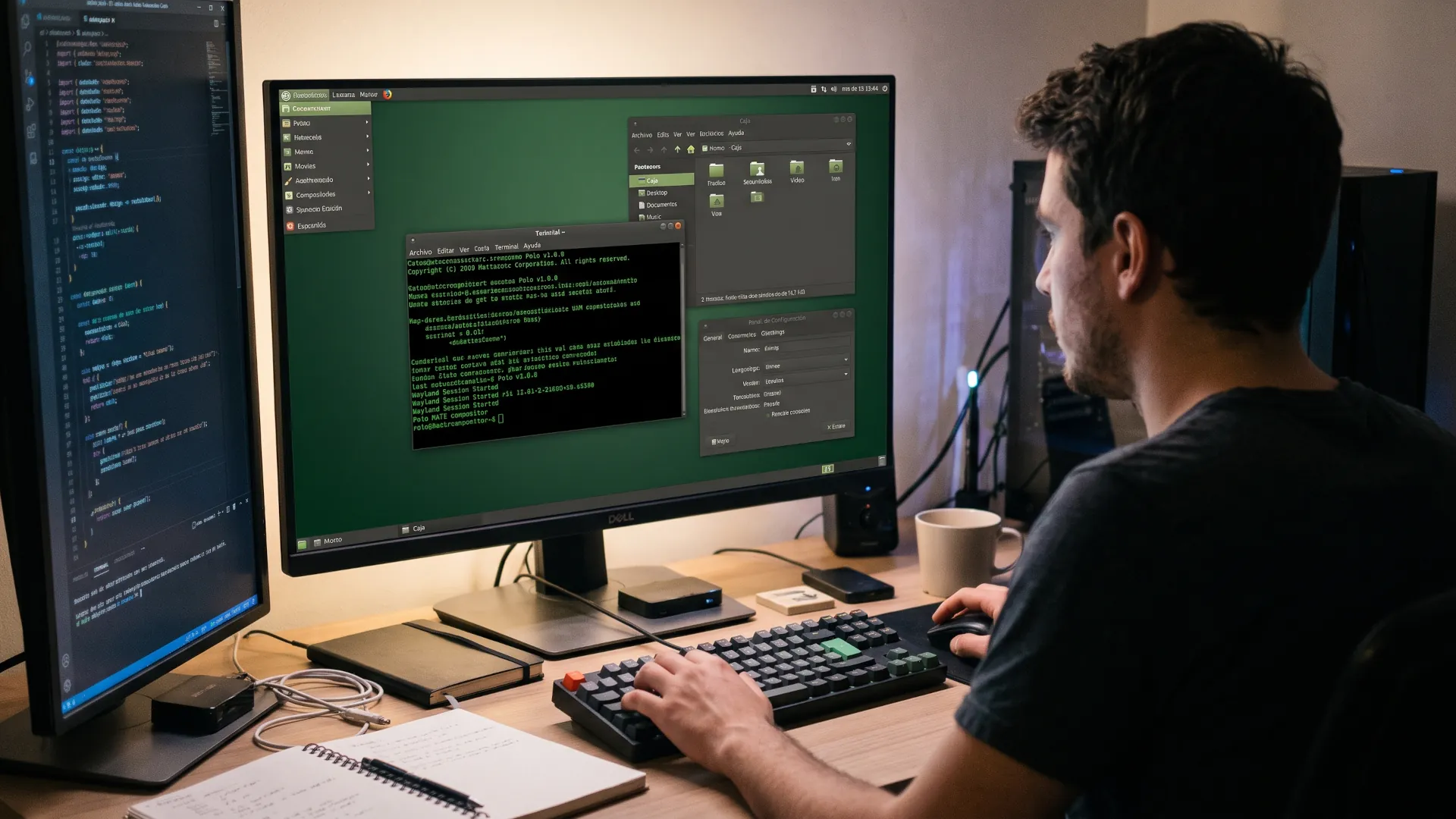
Your Ryzen AI 7 350 has 4 fast cores and 4 slow ones, but Linux treats them as equal and can send heavy work to the slow core. The frequency driver never told it which are better, and the scheduler distributes work blindly.
A two-patch series sent on November 12, 2026 proposes to close that gap in amd-pstate, the driver that governs the frequency of AMD processors. The second revision of AMD's patches for hybrid cores publishes the capacity of each core, synchronizes it between hyperthreading siblings and orders the scheduler's priorities.
What is striking is not the patch, but the symptom it documents. On a Ryzen AI 7 350, all threads appear with a capacity of 1024, the default value that means "all equal." A Zen 5 core at 5.09 gigahertz and a Zen 5c at 3.51 gigahertz get the same treatment, so the system can send the heavy task to the slow core and carry on as if nothing happened. The proposal does not add features for the user, but information that the hardware already offered and the system was ignoring.
Four fast, four slow and a single cache
The series describes the silicon with an engineer's precision. In the Ryzen AI 7 350, codenamed Krackan Point and family 1Ah model 60h, four classic Zen 5 cores with a maximum frequency of 5.09 gigahertz coexist with four dense Zen 5c cores that reach 3.51. All eight share a single 16 MiB L3 cache block, and they alternate in the numbering: the even ones are fast and the odd ones are slow.
That coexistence is what breaks the scheduler's assumptions. The amd-pstate driver records the performance score that the firmware exposes per logical processor, but does not convert it into capacity for the scheduler. When AMD's hardware-guided mechanism is active, the driver even disables its own preferred-core selection and delegates to another block that also does not publish capacity.
The practical result is a system that treats sixteen threads as if they were the same component. There are no visible errors or warnings in the log. Just a task assignment worse than the hardware allows, with the bill split between performance and battery life.
The difference measured in milliseconds
The proposal does not stay in theory. It includes measurements made on that specific laptop, and the figures explain why it is worth reviewing the code. In a pointer-chasing test with 450 million instructions, the Zen 5 core finished in 66.69 milliseconds and the Zen 5c took 95.18, 42.7% more latency.
The second experiment looks more like a real desktop: sixteen threads with two critical tasks, six work tasks and eight background tasks competing for the machine. Without distinguishing cores, the system averaged 75.77 milliseconds with a worst-case tail of 109.22. Separating loads by core type, the average dropped to 34.66 and the worst-case tail to 39.42.
These numbers should be read with the caution that a benchmark made by the patch's author, on a specific machine and workload, deserves. They are not a promise that the laptop will go twice as fast at everything. They are evidence that the missing information has measurable consequences, and that the scheduler decides worse than it could.
What do the two patches change?
The first patch touches the frequency driver. It records the maximum and nominal performance score of each logical processor when the processor announces that it is heterogeneous. If it detects asymmetry, it calls the core functions that enable capacity scaling on hybrid platforms and then assigns each core its relative capacity.
The fine detail is in the hyperthreading siblings. Two threads that share a physical core must announce the same capacity, or the scheduler complains with asymmetry warnings. The patch synchronizes those siblings to the highest value of the pair and leaves the rebuilding of the scheduling domains in a work queue, without blocking boot.
The second patch corrects the order of priorities that AMD's hardware-guided mechanism delivers to the scheduler. Today it assigns the same score to the main threads and to their SMT siblings, when the secondary sibling should rank lower. The fix lowers it to seven eighths of the main score, which avoids packing heavy work onto a secondary thread.
| Item |
Before |
With the patches |
| Capacity per core |
1024 on all threads |
Real relative value per core |
| SMT siblings |
Same priority |
Synchronized and ordered below |
| ITMT priority |
Identical on main and secondary |
Secondary at 7/8 of the main |
| Control |
None |
Boot parameter to disable it |
Why now and not in 2024?
The answer lies in AMD's calendar. Processors with dense cores stopped being a rarity of cheap laptops and have become the norm in the mid-range. With Zen 6 on the horizon, the patch itself anticipates a third type of low-power core, which will give the question "which core do I put this on?" even more possible answers.
The patch also arrives with a signature that says a lot about the moment. Its author is Aiden Hecker, an independent developer, and the text acknowledges that part of the work was done with assistance from Antigravity code, Google's agent tool. It is the same technology that rewrites entire software in Rust in other projects, applied here to a kernel driver.
That such a proposal comes from outside the usual circle of maintainers is not new, but it is increasingly frequent. The tools lower the cost of writing the patch and leave the hard work where it was: in convincing the reviewers that the change is correct and that it breaks no one.
What is missing to see it on your laptop
The series is in its second revision and needs the approval of the CPU frequency maintainers and the x86 platform subsystem. Even if it is accepted now, it will not reach the stable kernel or the distribution you use for several months, and only if the laptop manufacturer does not block the mechanism with its firmware.
For the user there is an immediate consequence worth understanding. If your machine is hybrid and you notice that long tasks get stuck for no apparent reason, it may not be your workload or the file system: it may be that the scheduler is placing the work on the wrong core for lack of data. The memory shortage and hardware prices have pushed many to stretch the laptop they already have, and making the most of what is there starts with not fighting the scheduler.
The other reading is more fundamental. For years, performance on Linux depended on drivers learning to talk to the hardware. On hybrid platforms, the pending work is no longer just talking: it is explaining to the system which part of the silicon is good for what.