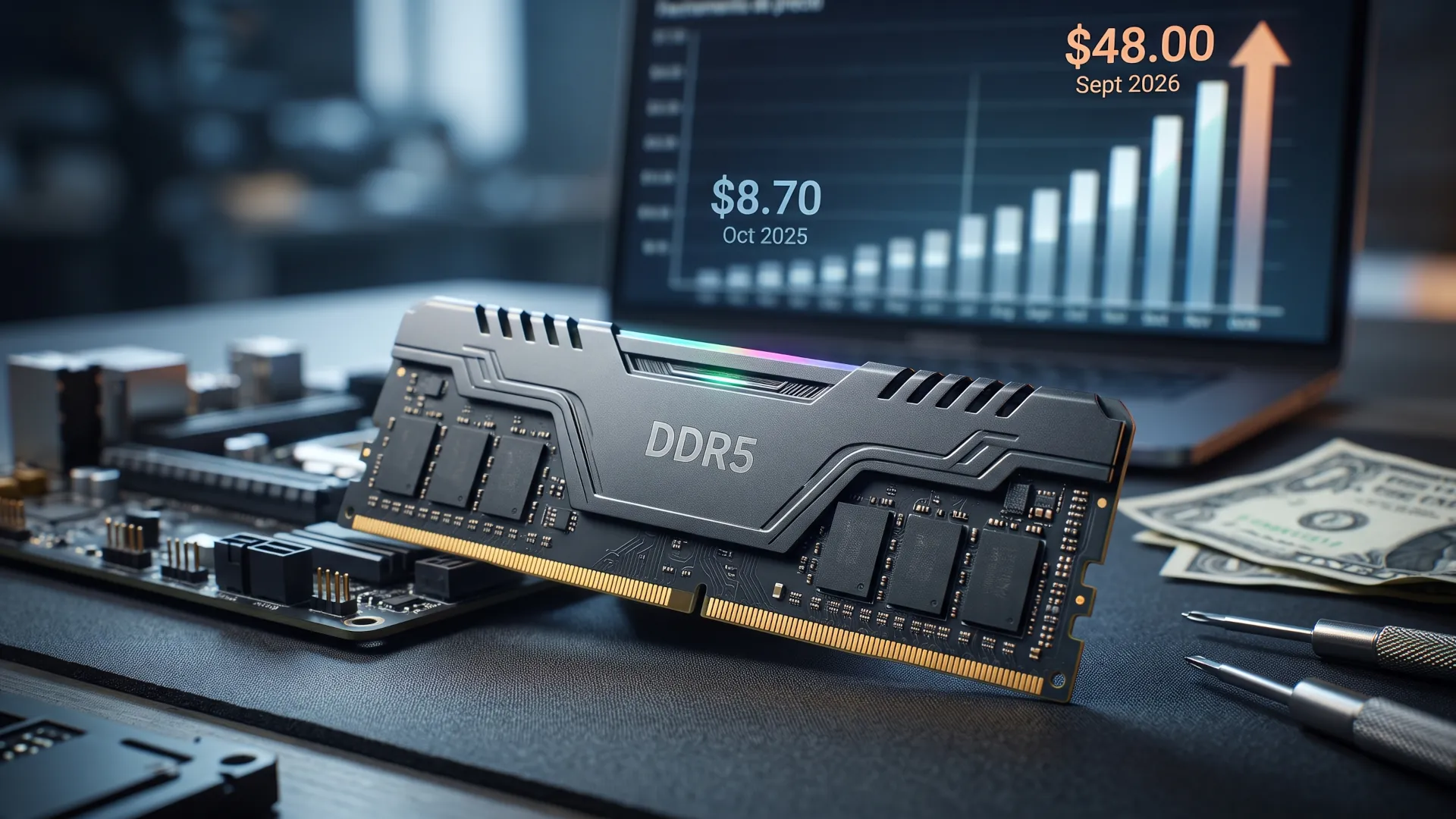
A 16 Gbit DDR5 memory chip (bits, not bytes) cost 8.70 dollars in October 2025. In September 2026 it was being paid at 48. The same part, the same supplier, five and a half times the price in eleven months. This is not an analyst estimate or a panic headline: it is the contract price a module manufacturer handles in its quarterly accounts. The figure comes from the company's earnings presentation, not from an analyst report, and that is why it carries more weight than any forecast about the sector.
That figure explains why a computer built from parts costs more today than a year ago with worse components. It also explains why memory prices have stopped being a topic for enthusiasts and have become technological inflation. TrendForce's memory price forecast for the fourth quarter points to another increase of 10% to 15% in conventional DRAM.
The fourth quarter is already underway and the numbers have not softened. The PC DRAM contract price update puts the quarter's increase at between 13% and 18% for modules that go into a personal computer. Anyone who was thinking of waiting until January to buy now knows what awaits them.
From 8.70 to 48 dollars in eleven months
The DDR5 price series is the easiest part of the problem to verify. TeamGroup CEO Chen Ching-wen laid it out in the earnings presentation on November 2, 2026: the 16-gigabit chip went from 8.70 dollars in October 2025 to 48 in September of this year. The company described it as an increase of more than 450%, and the calculation across the two endpoints gives more than 550%.
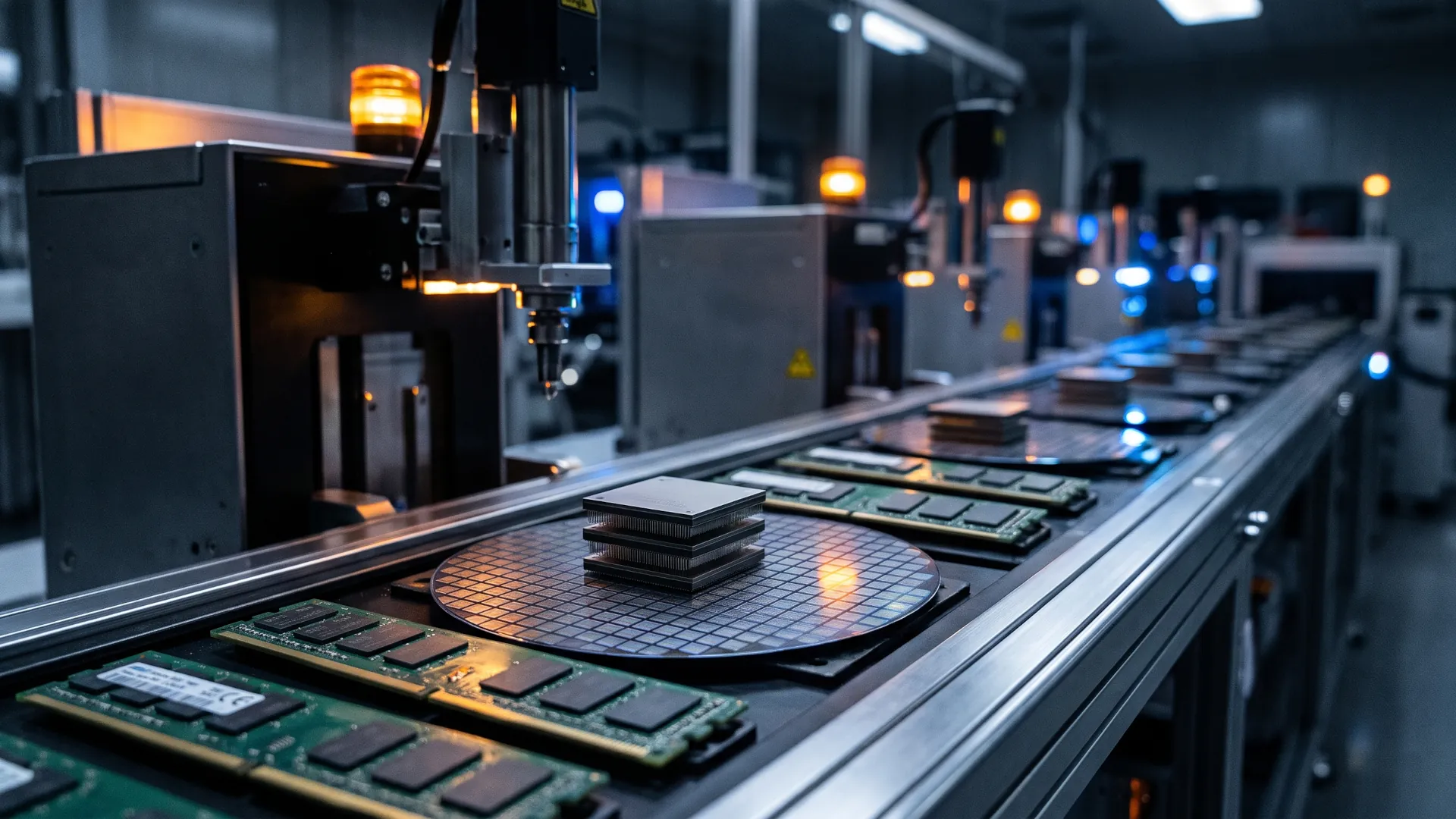
That gap has two causes that reinforce each other. The first is supply: manufacturers have shifted capacity toward high-bandwidth memory and server DRAM, where margins are higher. The second is demand: artificial intelligence data centers buy everything that is produced, and factories are not built in a quarter.
When capacity is scarce, the market is ordered by price and the consumer ends up at the back of the queue. That order explains the difference between the contract price and the store price, and also why modules sell out before they get cheaper. Priority is set by whoever signs year-long orders, not by whoever buys a couple of modules.
The server eats the factory
Capacity allocation is not a theory. Korean suppliers have cut production of PC memory and redirected wafers to servers, and the October contract price report indicates that DRAM supply for computers could fall in 2027. Taiwanese manufacturers are holding up the DDR4 market, which stays alive because of equipment that cannot migrate.
The effect shows up by tier. Server memory is undersupplied and its prices are rising with long-term contracts that cushion part of the blow. Graphics memory is seeing an uneven distribution: GDDR7 is bought mainly by the artificial intelligence industry, while some equipment manufacturers are looking again at GDDR6 to lower the total cost of the product.
For the domestic buyer, the summary is harsh. The component that has risen the most is not the one that delivers performance, it is the one that lets the rest work. A 32-gigabyte module that a year ago was a routine purchase has become the line item that decides whether the machine has 16 or 32.
The fourth quarter brings no relief
The quarter's forecasts paint a picture of expensive memory in every category, with nuances that should be separated so as not to buy out of excessive fear. The following table summarizes the expected increases and the reason for each, because not all of them respond to the same bottleneck or behave the same way in stores.
| Category |
Q4 2026 forecast |
Comment |
| Conventional DRAM |
+10% to +15% quarter-on-quarter |
Still undersupplied due to priority given to servers |
| PC DRAM |
+13% to +18% quarter-on-quarter |
Laptop manufacturers are already buying in advance |
| NAND Flash |
+15% to +20% quarter-on-quarter |
Enterprise SSDs accelerate the increase |
| Client SSD |
Below 5% |
The only segment that moderates, after the previous peak |
The most misleading row is the last one. A consumer SSD rising less than 5% does not mean storage is cheap, it means it already rose before and the effort is now concentrated on the enterprise product. The drop in laptop shipments, 15.8% quarter-on-quarter in the third quarter, does not make anything cheaper either: fewer sales do not equal more supply when the factory is allocated to another customer.
What does it mean for someone building a computer?
The first practical decision concerns timing the purchase. If the computer is needed now, waiting has a measurable cost: the quarter's forecast is for an increase, not a decrease, and the modules available in stores tend to rise before contracts do. If the computer can wait, the reasonable horizon is not January, it is the second half of 2028.
The second concerns the configuration. With memory expensive, the money goes on quantity rather than speed: 32 gigabytes of DDR5 at standard speed delivers more in almost any real use than 16 gigabytes of fast memory. For those running local AI on their own machine, the calculation changes: the graphics card's memory decides which models fit, and that cannot be expanded later.
The third concerns the second-hand market, which has become the escape valve. Machines stretched beyond their useful life stop being an eccentricity and become an economic decision. Upgrading the memory in a four-year-old laptop can cost less than a new machine with fewer features.
Will memory get cheaper in 2027? No, not until 2028
The short answer is that nobody knows, and the useful answer is that the most cited forecasts point to 2028. The module manufacturer itself places the balance between supply and demand in the second half of that year, and does not rule out a delay. The announced capacity expansions are earmarked for artificial intelligence memory, so they ease the enterprise queue before the domestic one.
There is a detail that usually falls outside forecasts and explains much of the nervousness. The spot price, the one paid for one-off purchases outside contract, has at times been between 30% and 50% above the contract price. That gap is the signal that the market is allocating by urgency rather than by need, and urgency comes at a price.
For the end user, the conclusion is less dramatic than the headlines suggest. Memory is not going to disappear, nor are computers going to double in price overnight. What is breaking down is the expectation that every year the same thing comes out cheaper, an idea that sustained three decades of upgrades and that now depends on how many wafers a Korean factory devotes to a data center customer.