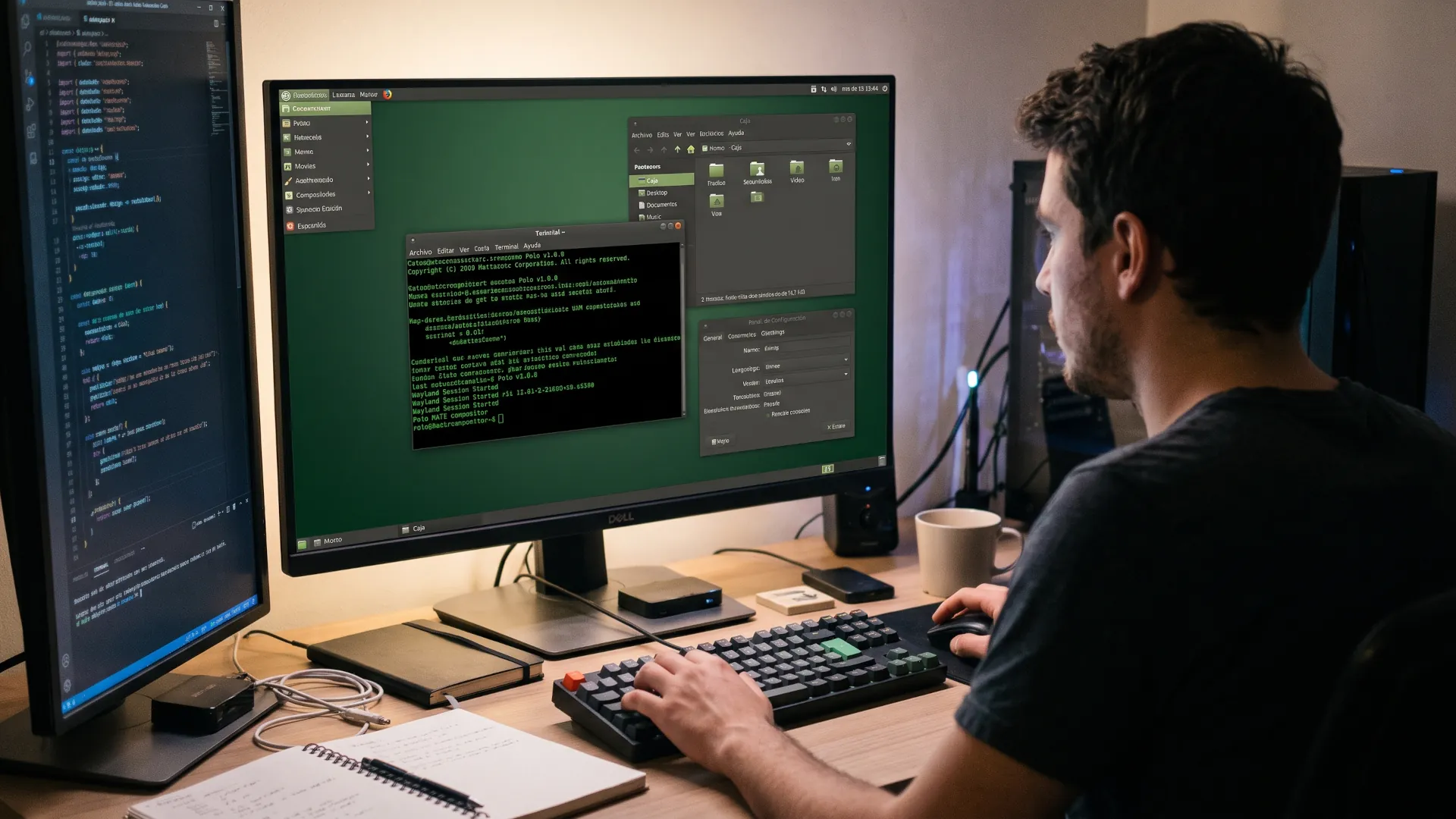
Discord is about to stop being a browser disguised as an application. Its CTO and co-founder, Stanislav Vishnevskiy, confirmed that the desktop client is abandoning Electron and that mobile is leaving React Native, and showed a screenshot of an early build on Windows 11 that uses 290.2 MB of memory, a figure picked up by The Verge. The current version, on the same machine, usually runs between one and two gigabytes.
The decision has been years in the making. Discord adopted Rust in 2018 for parts of its infrastructure and its voice technology, and much of the current client is already written in that language. What was missing was moving the entire interface over, and that turns the announcement into an architecture change rather than an update. Maintaining two mental models forces the same problems to be solved twice and makes every new platform more expensive.
The detail that cleared up the doubts was a reply to someone who assumed they would use Tauri, the usual Electron replacement. Vishnevskiy clarified that it is not Tauri, it is GPUI, the GPU-accelerated interface framework from the Zed editor. That technical precision changed the conversation in the following hours, because it ruled out the cheap solution and forced people to look at the client's code rather than its wrapper.
Goodbye Electron
Electron packages a full Chromium browser inside every application, and that decision means any client written this way carries the memory cost of an entire web engine. Tauri swaps the bundled Chromium for the engine the system already has, which saves memory without giving up drawing the interface with web technologies.
GPUI goes a step further and draws the interface natively on the GPU. If the Discord client ends up there, the browser ceases to exist inside the application, and with it a layer of consumption that cannot be optimized because it is not yours. Technical analysis notes that the change also eliminates the splash screen, because there are no Electron libraries left to load.
The cost of that path is high. Discord has voice, video, screen sharing, overlays and activities inside the app, and all those pieces currently rely on web technology. Rebuilding them natively is a project of years, and Vishnevskiy himself frames it as the hardest part.
290 MB of RAM and what they don't say
The figure of 290.2 MB is a screenshot of the task manager in a build called Discord Phoenix, and it has to be read with caution. An early build has fewer features connected, and a client that is light at startup puts on weight after hours of use with voice and video active.
Even so, the starting point matters. Discord acknowledged last year that its application could reach 4 GB on Windows and ran a test that restarted the client when it exceeded that figure, a solution that treated the symptom. The comparison with 290 MB, even if the final number doubles, leaves the problem on another scale.
Memory is not the only benefit that can be measured. The new client also won't load Electron libraries at startup, so opening it should be faster. What there isn't is a date: Vishnevskiy said he hopes to put the new client to the test with users soon, and Discord has not published a formal announcement or a timeline. Any date circulating these days is a guess.
Better late than never
The reasonable question is what has changed for a company with an enormous client to take on a rewrite. Part of the answer lies in the price of memory, which has multiplied over the past year and has turned efficiency into a product argument, a phenomenon we already explained when we analyzed the record revenues of the DRAM industry.
The other part is internal. Having the logic in Rust and the interface on web forces you to maintain two codebases and solve problems twice, and that cost grows with every platform. Unifying the code in a single language reduces the work of maintaining the client on Windows, macOS, Linux, Android and iOS, and that saving shows up more at a company that ships every two weeks.
There is also an ecosystem reason. The language matured enough to sustain an application of this size, and the work other projects did beforehand served as a test. The move to Rust 1.100 and its dependency quarantine is an example of how the ecosystem has been closing the problems that held back large teams.
What happens with mods and alternative clients?
The Discord community depends to a large extent on modified clients and plugins that hook into the Electron application. When the client stops being a packaged web application, those tools will stop working unless their authors rewrite what they do.
That is the cost that is almost never mentioned in performance announcements. An architecture change that improves the experience for the average user can break the ecosystem that sustains the most engaged users, and the transition is rarely managed with the same attention.
For anyone running a large server, the practical recommendation is not to build critical processes on unofficial integrations over the coming months, and to check whether the alternative client they use has a plan for when the base stops being a web application. The other possible reading is more optimistic, and it is that a native client opens the door to tools that don't exist today, such as those already being built on agents embedded in any application.
Discord's decision adds to Microsoft's, which has spent the year reducing Windows 11 consumption on machines with 8 GB, and to that of other developers who have started to review the weight of their applications. The pattern suggests that the era in which software could put on weight at the expense of cheap hardware is closing, and that efficiency is once again a design criterion that can be sold.