Vercel releases fx, a coding agent in Zig that fits in 6 MiB
There is a fairly straightforward way to tell whether a coding agent is a product or a piece of infrastructure: look at how much it weighs when you install it. On August 11, 2026, Vercel Labs published fx, a terminal agent harness written in Zig that ships as a single native binary of about 6 MiB, with no runtime to install and under the Apache-2.0 license. The repository has accumulated around 3,600 stars and more than 400 forks in under three months, according to public GitHub data.
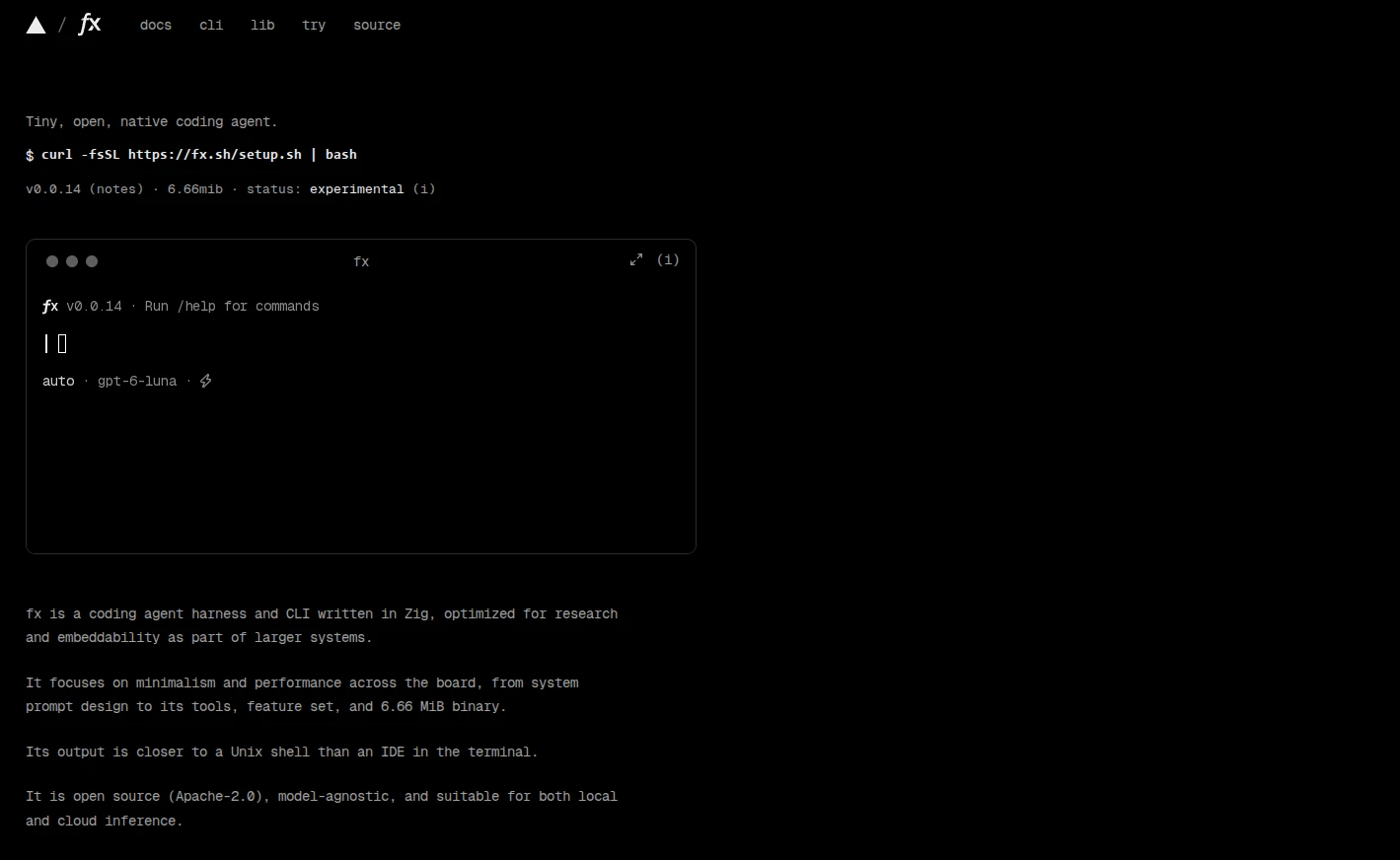
The project presents itself on its website as a small, native harness that is model-agnostic and works for both local and cloud inference. Vercel fx is not another chat window: it writes the conversation to the terminal's normal scrollback, exposes the same engine through the command line and through a library, and lets the user or the script decide what to do with the output. That design decision points to a different use from the usual one, with agents that live inside another system, whether a continuous integration server, an editor or a web application.
The figures accompanying the announcement come from Vercel itself and should be read as such: 10 microseconds of cold start and a memory baseline in the single-digit megabytes. An agent that starts in that order of magnitude can be invoked the way `grep` is invoked, and that changes the mental model of whoever uses it. The consequence is what underpins the whole launch: the harness stops being the destination and becomes one more dependency of the system that contains it.
A binary that installs like any other command
The practical difference shows up at deployment. An agent packaged in npm inherits npm's rules: you need Node, you have to resolve the dependency tree and update the runtime when it expires inside the container hosting it.
The Claude Code package has declared Node 22 or higher in the npm registry for several versions now. That requirement travels with the tool to any server where it is installed and adds a layer that the on-call team keeps up to date even if the agent itself has not changed a single line of code in months.
fx breaks that chain. The artifacts for version 0.0.14, published on October 16, weigh 5.91 MiB compressed for Linux x86_64 and 4.29 MiB for macOS with Apple Silicon, while the changelog notes a 6.66 MiB binary. The website says about 6 MiB, rounding down, which is reasonable in presentation material.
The least visible consequence is security. Every transitive dependency is a version someone has to watch, and every runtime jump opens a window in which the agent does different things with the same permissions on disk. A static binary does not eliminate the risk, though it reduces the inventory that has to be audited, and real isolation still depends on a separate cage such as the sandboxes for agents.
Aspect
fx, native binary
Typical npm agent
What gets installed
One executable per platform
Package plus Node 22 or higher runtime
Dependencies at runtime
None outside the system
Runtime and resolved package tree
What has to be updated
The binary
Node and every transitive dependency
Invocation for automation
`fx ask –json "summarize the tests"`
Script that wraps the CLI
Why Zig and not TypeScript?
Zig brings two things that explain the choice. The first is control: the language hides no control flow, no memory allocations, no macros and no preprocessor, and its standard library does not depend on libc, according to the project's official description. The second is cross-platform deployment, which that same material treats as a first-class use case: a Hello World in ReleaseSmall mode takes up 9.8 KiB.
None of that makes the agent better. A harness written in Zig does not reason better or write more correct code, and the quality of the result depends on the model behind it, something a benchmark such as Parsimony makes plain for anyone to see. What changes is the cost of distributing it and of putting it where a JavaScript runtime is awkward: minimal containers, fast-boot images and machines with little memory available.
The price of the language is also real. Version 0.0.14 requires compiling with Zig 0.17, and Zig is still below its 1.0, so anyone building fx from source ties themselves to the schedule of a compiler that still changes between versions. Vercel Labs accepts that toll in exchange for the artifact size, and the trade only makes sense if the binary is what you want to sell.
What you lose with a minimal harness
The savings come with a bill, and it is worth knowing what it is before putting it into production. A tool that updates every two weeks with breaking changes forces you to read release notes as if they were contracts.
Simplifying has trade-offs and the project does not hide them. fx is still in the 0.0.x series, with 315 open issues on GitHub on October 25 and breaking changes in almost every release: 0.0.14 renamed `createFxAgent()` to `createFxEngine()`, required declaring whether each tool is idempotent and raised the macOS requirement to version 15.
A look at fx, Vercel's harness
The ecosystem is the other gap. fx speaks MCP, supports skills, implements the ACP protocol for editors and allows subagents with their own model, so basic integration is covered and it is not an isolated harness. What does not exist is an extension marketplace comparable to the one surrounding desktop agents, so anyone who needs a specific integration will have to write it or wait for someone to publish it.
There was also noise around the launch. On Hacker News some users pointed out that the initial configuration routed requests through Vercel AI Gateway and that the polish was below that of other terminal agents. The company accepts it: the documentation calls the project experimental and the binary clashes with the JSON viewer that already used that same name.
That name clash is not a minor detail for anyone deploying. The `fx` viewer has occupied the Homebrew formula for years and there is an open issue discussing how the two commands can coexist on the same machine.
Embedding, the word that orders the design
The interesting part is not the CLI but libfx. The same engine is published as a library for Node and as a WebAssembly build, with no runtime dependencies in the package, and the documentation presents it as the way to integrate fx into your own applications. There the agent stops asking for a terminal and starts behaving like one more function of the host.
Version 0.0.14 pushed in that direction with durable sessions. A turn can survive a deployment or a timeout and resume afterwards, provided the tools that make it up are marked as idempotent, and an HTTP handler takes care of queued prompts. These are server pieces, not desktop ones.
Embedding is not free either. The libfx npm package declares almost 48 MB uncompressed, far from the 6 MiB of the native binary, and that distance marks where the real savings lie: in the compiled executable.
Where the competitive advantage moves
If the harness is open, weighs little and can be embedded, it stops being the place where the game is won. Vercel has already placed it in its AI SDK adapters layer, alongside Claude Code, Cline, Codex, Cursor, OpenCode and Pi, all behind a common interface. The plug gets standardized and the difference shifts to the model, the tools and the isolation where the agent runs, just as happened with containers.
One market consequence remains that Vercel does not hide. A free, tiny harness is the best gateway drug to a paid inference gateway: in the initial configuration requests go through it unless the user switches provider, and some users noticed that on launch day. fx is not competing to be the best terminal agent, it is competing to be the one that gets in the way least when someone decides to build their own.