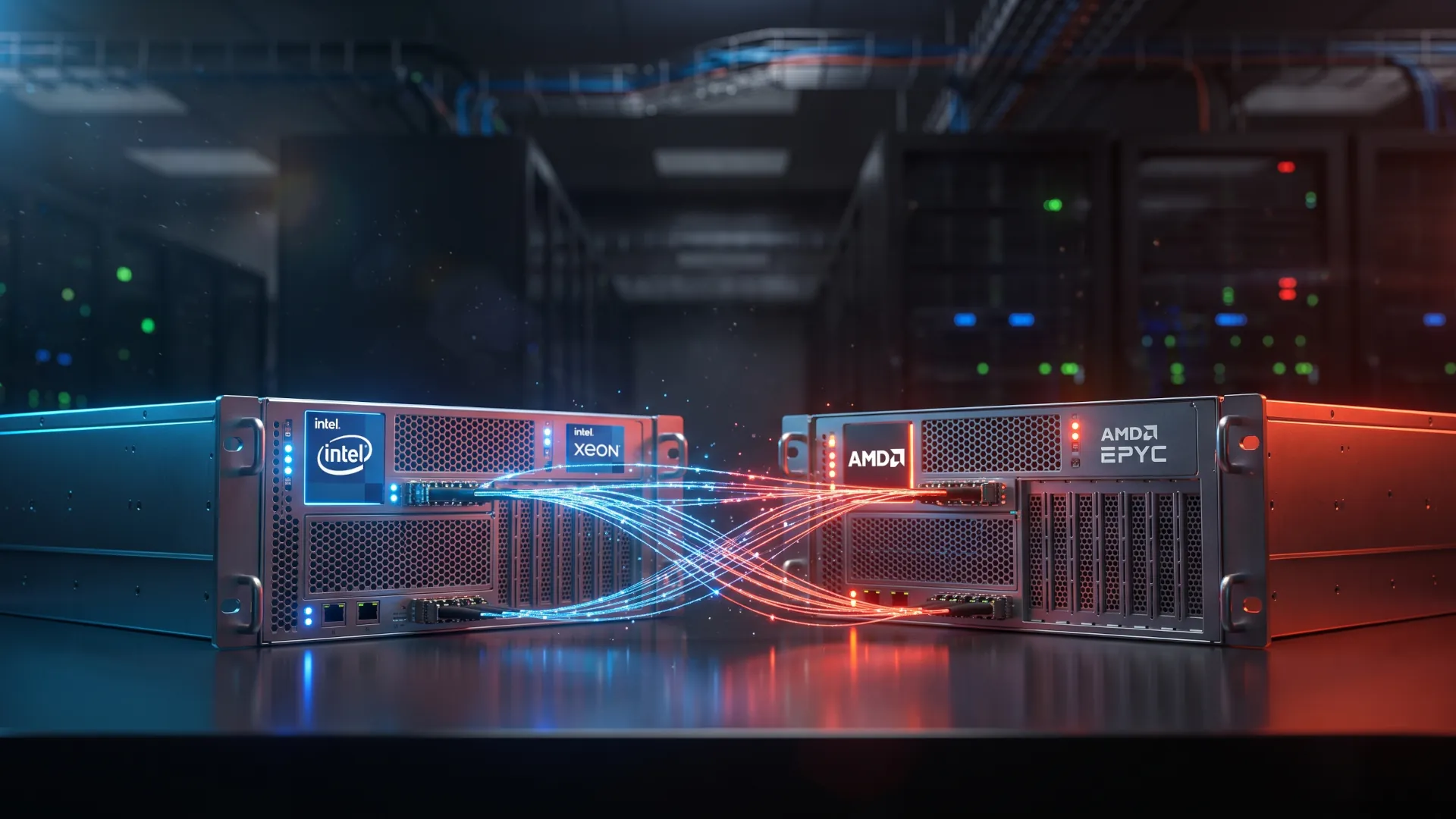
Anyone running AI models on an x86 CPU has faced an awkward decision at the start of every project for years: checking which build or which add-on performed best on their specific processor, because each manufacturer optimized on its own. That split began to come apart on October 20, 2026. Intel and AMD announced that day that they are unifying their optimization work for PyTorch within oneDNN, and that AMD is joining as a member of the UXL Foundation's steering committee, according to the statements from Intel and AMD.
.
The piece is no small matter. oneDNN runs the heavy mathematical operations underneath PyTorch, TensorFlow, ONNX Runtime and OpenVINO, and since 2023 it has lived under the umbrella of the UXL Foundation, the foundation that inherited much of Intel's oneAPI projects. Until the announcement, Intel published its improvements in that shared library while AMD maintained ZenDNN, compatible with the same interface and tuned for its Zen processors.
The result for anyone programming is a single path instead of two, with fewer checks before switching processors. For the market it is something else, because two rivals now jointly decide the direction of a piece on which several widely used frameworks depend.
What goes into oneDNN and what stays out? The statements choose the verb plan rather than deliver. The two companies have agreed to align oneDNN as the default open source library for accelerating PyTorch on x86 CPU, and AMD will integrate into it the optimizations that until now lived in ZenDNN. AMD's note adds that it will continue optimizing for its own processors, and the agreement comes on the recommendation of the x86 Ecosystem Advisory Group, the forum both presented in October 2024 and whose notes are public at.
| x86ecosystem.org |
Piece |
| What changes with the announcement |
oneDNN |
| Becomes the common x86 acceleration library within PyTorch |
ZenDNN |
| AMD integrates its optimizations into oneDNN and keeps tuning for its chips |
ROCm and GPUs |
| Outside the agreement, AMD continues developing its own graphics stack |
ACE |
Planned instruction set extension, with no arrival date The table leaves two gaps worth naming. The first is the graphics side: the announcement refers to x86 CPU and does not touch ROCm, AMD's software stack for GPU, which the company continues to push on its own even outside Linux, as we reported inFreeBSD ports AMD's ROCm software for HPC and AI on GPU
. The second is ACE (AI Compute Extensions), an expansion of the x86 instruction set designed to multiply matrices, the operation that dominates the computation of a neural network; Intel describes it as future integration through oneDNN updates.
Neither of those two gaps has a date. Anyone planning a server refresh twelve months out is left, for now, with a promise of direction and no calendar to hold on to.
Jeff McVeigh, vice president and general manager of data center strategic programs at Intel, summed up the goal with a phrase that also works as a diagnosis of the previous problem: "Developers shouldn't have to think about separate software paths to get the best out of an x86 CPU." Robert Hormuth, corporate vice president of architecture and strategy at AMD, emphasized freedom of choice: "AMD drives an open software ecosystem that gives developers more options and makes it easier to build high-performance AI applications."
ZenDNN stops being a fork and becomes shared code ZenDNN is AMD's fork of oneDNN, compatible with its interface and adapted to Zen processors. The reality is somewhat more tangled, and AMD's repository makes it clear: ZenDNN was rewritten and today can delegate to oneDNN the operations that are better solved there, so the two libraries were already talking before the announcement. For PyTorch, AMD also publisheszentorch
, an add-on that plugs ZenDNN into the framework and is installed separately.
That was the invisible bill for any team with mixed hardware. The same model could require two different installations, two test suites and two explanations for the on-call team when something slowed down after an update. Unifying the code does not eliminate that validation work, but it reduces it to a single path and prevents two groups of engineers from separately fixing the same bug in a matrix multiplication.
It is worth separating two things the announcement blends together. Shared code saves maintenance from day one, while the performance gain depends on how much each path is tuned for a specific chip. The first is an administrative certainty; the second, an expectation.
The word repeated most in the notes is default. oneDNN will not be the only option, but it becomes the one PyTorch chooses when nobody configures anything, and that matters above all in small projects that do not touch environment variables.
The bill for whoever pays for the hardware CPU inference does not grab headlines the way GPU does, but it holds up in the bill. A server with many cores and fast memory costs less than a dedicated accelerator, and for small models, batch workloads or applications where latency rules, the CPU remains the sensible option. As we reported inour review of local AI on the PC
, that path is not cheap either: a machine prepared to run models locally came in around 4,000 euros.
That is where a single path changes the conversation with the vendor. If the same binary performs across two brands, the buyer regains the leverage to switch manufacturers without redoing the deployment, and teams stop paying twice for the same work. The saving does not show up as an immediate discount in the store: it shows up in fewer integration hours and fewer surprises when renewing the server fleet.
That saving does not reach everyone equally. A team serving models with llama.cpp or vLLM touches other layers and will notice the change indirectly, while one that trains or fine-tunes models in PyTorch on CPU lives squarely within this decision. It is worth noting that local AI does not only move libraries: it also reshuffles the distribution of drivers and environments with which Windows and Linux
run the models, a layer this agreement does not touch.
One library, two rivals and a foundation in between oneDNN was not born in a foundation. It grew inside Intel, and today it lives under the umbrella of the UXL Foundation, created in September 2023 and operated under the Joint Development Foundation within the Linux Foundation, according to Crypto Briefing. Intel, Samsung, Qualcomm and Arm, among others, sit on the board, and the foundation lists six libraries inherited from oneAPI, with oneDNN as the one relevant to this article according to its own.
project catalog
Governance is the part the announcement does not fully resolve. AMD moves from general contributor to steering committee member, and that gives it a voice in the roadmap of a library its competitor previously commanded. The risk has a name: four major frameworks consume the same implementation, so a poorly set priority in oneDNN propagates through the entire chain and there is no second option ready to replace it. Stephen Watt, of Red Hat, defended the agreement precisely on that side, as an important step toward eliminating ecosystem fragmentation.
Two rivals sharing code does not mean they share interests. Each will continue tuning its own kernels and its own silicon, and the common part will cover only what both consider worthwhile, which does not always match what the customer needs.
Arm or RISC-V users, who also appear within oneDNN's scope, watch from outside a pact between two x86 manufacturers. The difference matters: the agreement lowers the cost of entry and does not guarantee that the common path is the fastest for every chip in all cases.
What the announcement has not yet signed
What is missing is what an engineer looks at first, which is version and date. The statements do not say which version of PyTorch will debut the common path, nor when ZenDNN will stop making sense, nor in which oneDNN release ACE support will appear. Nor do they clarify whether zentorch will continue to be published during the transition, a detail that decides whether a team in production touches anything this quarter.