At PayPal's headquarters in San Jose, the historic blue logo that defined the Web 2.0 era now faces a reality dictated by capital markets and technological innovation. The central news that has shaken the industry's foundations is confirmation of a deep structural crisis within the company, evidenced by the abrupt departure of its chief executive and a stock market valuation that has fallen back to levels not seen in nearly a decade.
The scale of this decline is crystallized in figures that have alarmed Wall Street institutional investors. At the close of trading sessions in February 2026, shares of PayPal Holdings (PYPL) were hovering near $40.42, after suffering a steep fall from previous peaks, losing approximately 50% of their market value in a span of just thirteen months.
This financial pessimism reflects a market thesis suggesting that the "payment button" model is being cannibalized by more agile competitors such as Stripe and by the growing adoption of stablecoins, which eliminate intermediaries and drastically reduce fee costs.
PAYPAL TRIPLES THE CAPITAL OF ITS STABLECOIN WITH A 3.7% "INTEREST"
Alex Chriss's departure and leadership uncertainty
Alex Chriss's resignation, effective February 2, 2026, represents the collapse of a restructuring attempt that failed to meet the expectations of a board impatient for tangible results. Chriss, who was recruited from Intuit with the mission of injecting efficiency and accelerating growth, encountered a corporate structure afflicted by what is called "organizational obesity," a bureaucracy that prevented the company from adapting at the speed of the cryptoasset revolution.
The board's official statement was unusually direct, noting that the pace of change and execution was not aligned with its standards, which has triggered a wave of investigations by shareholder rights law firms examining whether there was a lack of transparency in communicating financial prospects for 2026.
A new CEO for PayPal
The transition to the leadership of Enrique Lores, scheduled for March 1, 2026, has generated a mix of curiosity and skepticism in the Fintech sector. Lores, a veteran with 30 years of experience at hardware giant HP, takes the helm at a time when PayPal needs to stop being perceived as a processing utility and transform itself into a highly scalable software platform.
But the market questions whether an executive trained in managing physical product cycles and hardware margins possesses the technological sensitivity needed to steer a company that must compete in the realm of digital tokens and agentic artificial intelligence.
PAYPAL INVESTS IN STABLE, THE BLOCKCHAIN POWERED BY USDT
Stripe and the frictionless payment ecosystem
However, PayPal's most immediate challenge does not come from traditional banks, but from digital-native platforms that have understood that the future of money lies in programmability and invisible integration. In that sense, Stripe has positioned itself as the de facto standard for the internet economy, offering an API architecture that allows developers to integrate complex payment flows in a matter of minutes, an agility that PayPal has struggled to match with its legacy infrastructure.
In 2025, while PayPal saw its transactions per active account stagnate or even decline slightly, Stripe reported a total payment volume (TPV) of approximately $1.4 trillion, a 40% year-over-year growth that underscores the shift in the financial center of gravity.
Stripe's technological advantage has widened significantly with the launch of the Agentic Commerce Protocol (ACP) in collaboration with OpenAI. This protocol represents a paradigm shift: it is no longer the human who must click a button, but rather artificial intelligence agents can make purchases, negotiate terms and settle payments autonomously using shared payment tokens.
This "agentic commerce" capability allows applications such as ChatGPT to initiate secure transactions without exposing the user's payment credentials, something that renders obsolete the redirect and manual authentication model that PayPal popularized two decades ago.
A place for PYUSD
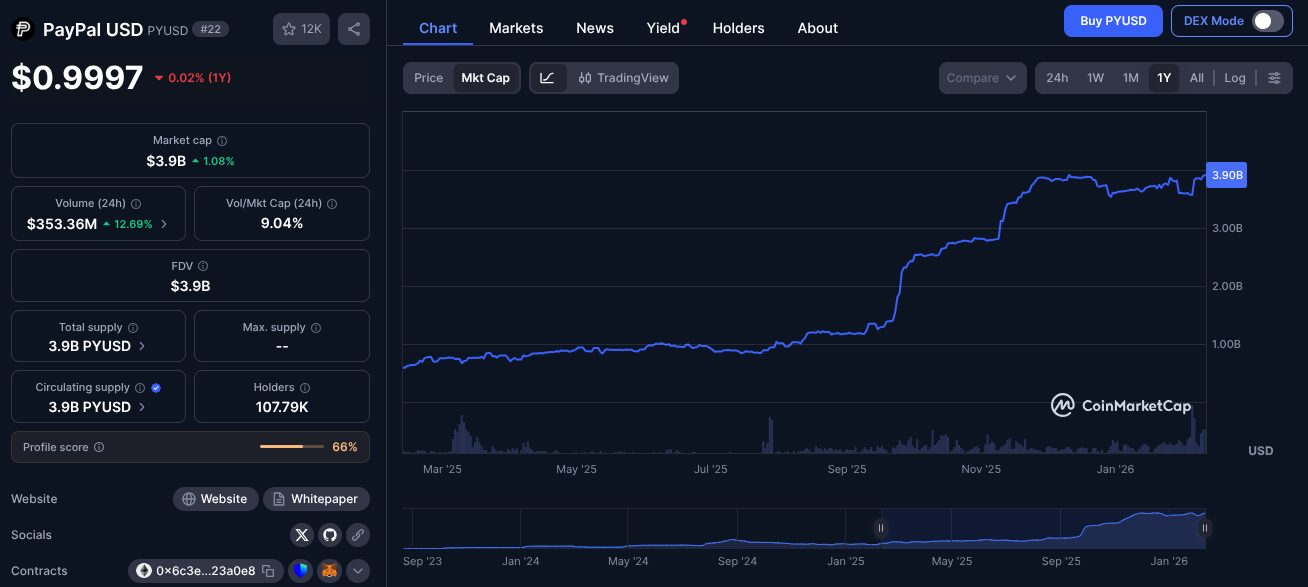
Despite the pessimism surrounding its core business, PayPal has achieved notable success in an area many considered tangential: its stable cryptoasset, PYUSD. In what appears to be an attempt to cannibalize its own traditional revenue before the competition does, the company has seen the market capitalization of its stable token jump from $500 million to $3.9 billion in a record period. This mass adoption is not due to daily retail use, but to a strategic integration into high-speed networks and decentralized finance (DeFi) applications.
PYUSD's expansion to the Solana network is a masterful technical move. By leveraging Solana's architecture, which offers transaction costs below $0.00025 and a speed of 125 transactions per second, PayPal has endowed its digital asset with real utility for instant B2B settlements. This contrasts sharply with traditional payment rails, where a cross-border transfer can take between 3 and 5 business days and cost tens of dollars in correspondent bank fees.
PAYPAL ANNOUNCES A "GLOBAL BIZUM" FOR PAYMENTS IN EUROS, DOLLARS OR CRYPTO
The B2B ecosystem and AI financing
PayPal's true innovation in 2026 lies in its partnership with USD.AI, a platform designed to use PYUSD as a financing vehicle for artificial intelligence infrastructure. Through this project, companies that need to acquire high-performance GPUs or rent space in data centers can receive loans denominated in PYUSD tokens directly into their PayPal accounts.
To incentivize this ecosystem, the company has launched a $1 billion program offering a 4.5% annual yield on PYUSD deposits earmarked for AI projects. This move is significant for several reasons:
- Real utility: It transforms the cryptoasset from a simple store of value into a working capital instrument for high-growth industries.
- Liquidity capture: By offering competitive yields, PayPal attracts capital that would otherwise remain in commercial banks or in competing stablecoins such as USDT or USDC.
- Reduced friction: By using a single payment channel based on digital dollars, AI startups can avoid the complexity of traditional banking systems and delays in credit approval.
Aiming at PayFi
In addition, PayPal is exploring the use of the Stellar network to introduce "PayFi" (Payment Financing), a solution aimed at small and medium-sized enterprises that suffer from slow invoice payments.
By using smart contracts on Stellar, companies could access working capital in real time, using their accounts receivable as collateral and receiving immediate settlement in PYUSD. Although this project is pending additional regulatory approvals from the New York Department of Financial Services (NYDFS), it represents the vision of a company trying to rebuild its relevance from the foundations of the blockchain.
STABLECOINS NOW MOVE 10 TIMES MORE MONEY THAN PAYPAL AND ARE ALMOST AT VISA'S LEVEL