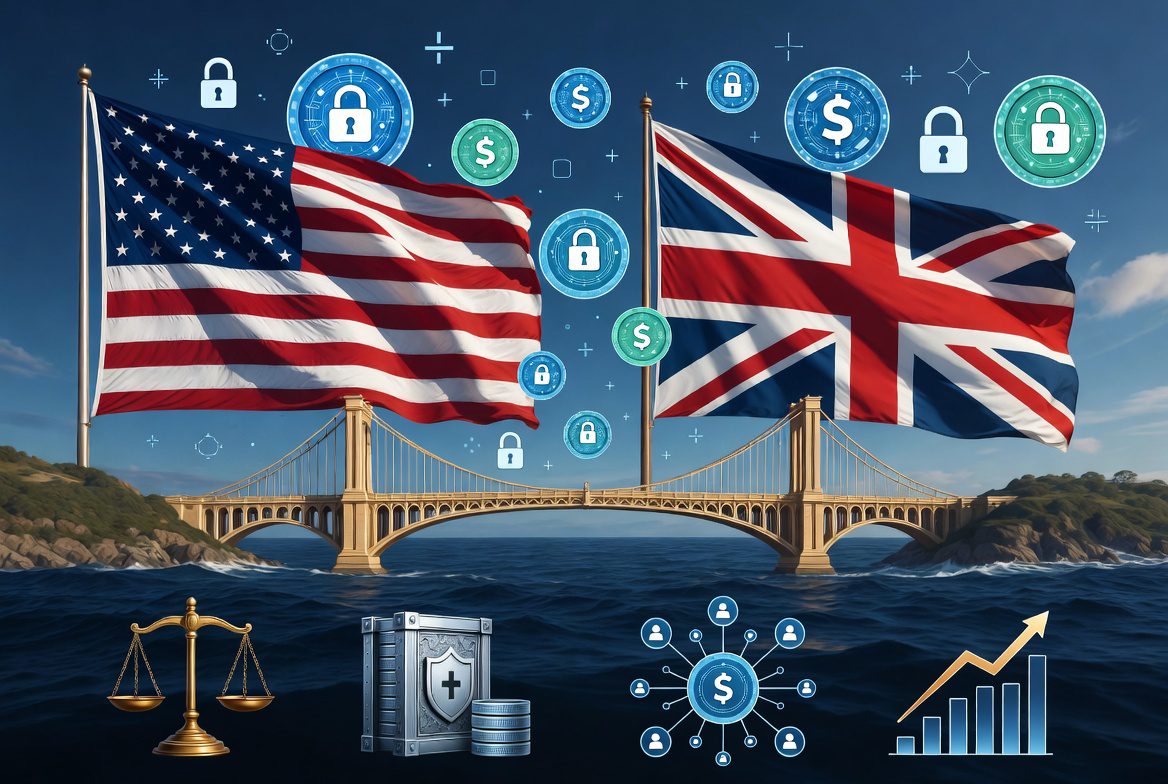
The UK Treasury (HM Treasury) has published a joint statement with the US Government in which both countries set out ten shared principles for the regulation of stablecoins. The agreement is part of the Transatlantic Taskforce for Markets of the Future, created in September 2025, and seeks to establish a common basis for the development of these digital assets in both markets.
Stablecoins in the United States and the United Kingdom
The stated aim of London and Washington is for digital financial innovation to help strengthen, rather than fragment, the transatlantic market. To this end, both administrations are committed to moving toward greater regulatory convergence wherever appropriate.
United States and United Kingdom recognize that regulated stablecoins can increase the efficiency and competitiveness of the financial system. They also believe they can modernize capital markets infrastructure and facilitate international payments and transactions.
At the same time, both governments stress that this development must come with safeguards. The aim is to protect financial stability, consumers and public confidence in money. All of this in an environment where different forms of digital money, both public and private, will coexist
The ten principles that will guide regulation
1. Promote innovation and cross-border payments
The United States and the United Kingdom aim to facilitate the use of stablecoins both in international payments and in the settlement of transactions in capital markets.
2. Recognize the coexistence of different forms of digital money
Both governments believe the private sector will play a relevant role through stablecoins, tokenized deposits and other forms of digital money, while it falls to the public sector to set regulatory standards.
3. Develop clear and consistent regulatory frameworks
The two jurisdictions will seek comparable regulatory outcomes for equivalent risks, with the aim of avoiding competitive distortions between the two markets.
4. Guarantee full backing of reserves
Stablecoins presented as money must be backed at least 1:1 with high-quality liquid assets, the definition of which will correspond to each national regulatory framework.
5. Apply prudential requirements without creating fragmentation
The agreement proposes avoiding disproportionate requirements that force resources to be held in isolation in each jurisdiction when this is not justified from a prudential standpoint.
6. Maintain proportionate regulation
Neither the United States nor the United Kingdom intends to impose reserve requirements that become unjustified barriers to entry for new market participants.
7. Favor integration into payment systems and tokenized markets
The document supports allowing regulated stablecoin issuers to access banking and financial services on market terms, as well as to use these assets as a settlement instrument in securities and commodities markets.
8. Strengthen custody and protection of reserves
Issuers must guarantee the timely redemption of the stablecoins issued, keeping reserves fully segregated from the issuing entity's own assets.
9. Provide legal certainty in the event of insolvency
One of the most relevant aspects of the agreement establishes that, in the event of bankruptcy or resolution of an issuer, stablecoin holders must have a clear legal right to the reserves, with priority over other creditors.
10. Facilitate cross-border recognition
Finally, both governments will explore formal mechanisms that allow a stablecoin authorized in one of the two jurisdictions to access the other's market clearly. Although the joint statement does not create immediate legal obligations, it clearly sets out the direction that stablecoin regulation could follow on both sides of the Atlantic. Priorities include the requirement for liquid and segregated reserves, legal protection for holders in the event of insolvency and non-discriminatory access for regulated issuers to the banking system.
For stablecoin issuers, custodian banks, financial institutions and legal advisers, the document is an early signal of how regulatory standards could converge between the United States and the United Kingdom, offering a useful reference for anticipating future licensing requirements, reserve structures and operating models.