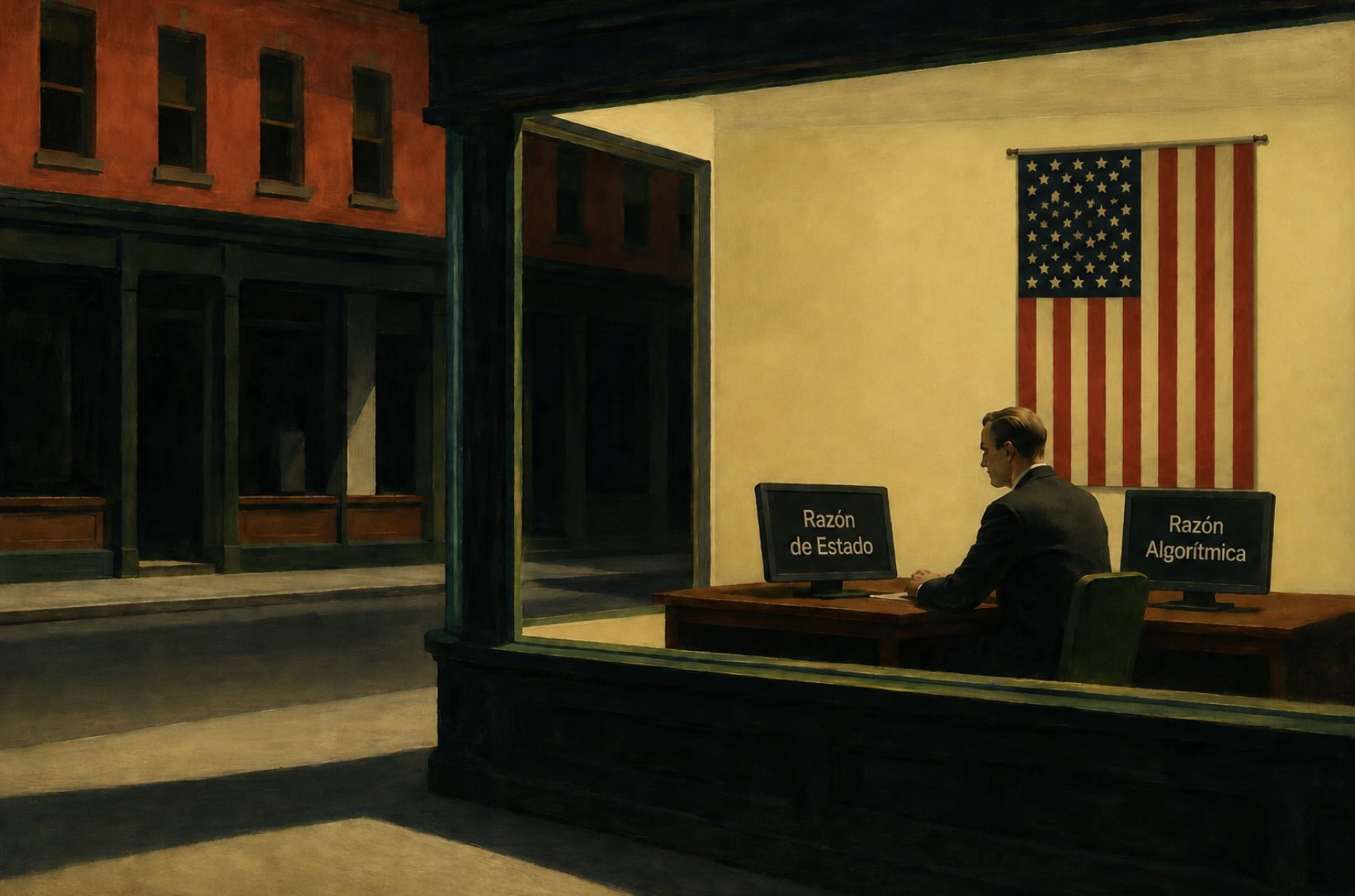
The US government has ordered restrictions on access to Anthropic's most advanced models (referred to in reports as Fable 5 and Mythos 5) through export controls, citing national security grounds. In fact, it banned Anthropic's new AI models from being used by foreign nationals, whether they live inside or outside the country.
For its part, the technology company maintains that the measure has been excessive. Anthropic says the risk identified was limited and that there was no public evidence to justify such a broad suspension. Because the order affected any foreign citizen, the company decided to completely disable those models for all users rather than attempting to verify each person's nationality. When a state bases its decisions on the need to protect itself from the outside, it sets in motion the core of reason of state. In this case, against what can be considered algorithmic reason.
Anthropic and reason of state
Anthropic has thus found itself entangled in its own strategy. It announces its model-products with otherworldly power. So much power that they could endanger the great power of modernity, namely the power of the state. So the state has reacted. Arguing afterwards that the threat or risk was limited seems to run counter to the initial display of power.
Reason of state, which is the basis for somewhat controversial and debatable decision-making, especially because it sets aside important rights of citizens or, as in this case, of companies. Reason of state is a justification for the barely justifiable. It is the state itself that justifies its decision on the basis of its need to protect the existence, security or fundamental interests of the state. An exceptional measure in exceptional situations. Here the exceptional element was Anthropic's models, still in an experimental state.
The official concern was that these models could be used to discover computer vulnerabilities or that their security mechanisms could be bypassed through jailbreak techniques or techniques that remove the restrictions and security barriers imposed by software or hardware manufacturers. They are cited as a threat, albeit without excessive detail about that perceived threat. It could serve to slow many innovations, and we will see how the near future will be crossed by these clashes between reason of state and what we will call algorithmic reason.
Claude Mythos's AI certifies the end of Modernity: we enter cyber-transgression
Today, much of the functioning of modern states depends on computer infrastructure. In fact, we are facing the Digital State. And faced with the announcement of innovations, such as those from Anthropic, of extremely powerful instruments capable of finding computer vulnerabilities in seconds, the choice has been to exercise the precautionary principle. A principle that seeks to curb excess risk; but which, in turn, is under suspicion of being a risk when it slows the development of innovation. As I said, we are facing a conflict that we will see become widespread.
In theory, reason of state refers to the preservation of the state itself, as the condensation of the essential interests of a society. It is already quite a lot to assume this; but let us assume it in line with philosophical-political currents that were very important during the last centuries and that have their roots in texts such as, for example, The Phenomenology of Spirit, published by Hegel in 1807, where the author's admiration for Napoleon is evident. The state as the higher phase of Reason. The problem is when that reason of state seems to protect the interests of those who govern more than the state itself.
Of course, algorithmic reason has less philosophical pedigree. It must even be admitted that it lacks a clear definition. The central idea is that more and more decisions that once depended on human judgment are now mediated or influenced by algorithmic systems. Well, these algorithmic systems, working autonomously, could endanger the interests of the state. Perhaps one way to prevent this is to program them not to make autonomous decisions when the state is involved. But that would practically make them useless, since the state is everywhere.
While reason of state justifies decisions in the name of the security or survival of the state, algorithmic reason tends to justify decisions because "the data indicates it" or "the model recommends it." They seem like logics destined to clash. On one hand, a digitized state that is omnipresent in the lives of citizens.
Thus, we increasingly interact less with the state through a counter and more through a computer screen, especially since the pandemic. To a large extent, digitization is a consequence of bureaucratic rationality. Classic reports on the computerization of society, such as the Nora-Minc report, already made this clear fifty years ago. Perhaps, dazzled by modernity, the digital screen seems to us less bureaucratic.
Ideological patterns in reason of state and in algorithmic reason
But, on the contrary, it takes bureaucratic reason to higher phases: decision-making without subjectivity, without a face. Decision-making that could now be threatened by increasingly powerful actors that are driven exclusively by modeled algorithms. They make cold decisions, such as identifying and resolving or attacking computer vulnerabilities. As cold as bureaucratic decisions.
The coldness of decisions, as if they were devoid of all human interest, is relative. One can always dig down to the deepest level and find ideological patterns in reason of state and in algorithmic reason. Returning to our case, since the beginning of this 2026, tensions arose between Anthropic and parts of the US government over issues related to military uses of AI and regulation of advanced models.
Disputes that may have influenced the harshness of the measures, even if that is not the official explanation. And it is that reason of state tends to be under suspicion. As much suspicion as reason of state itself projects onto algorithmic reason.