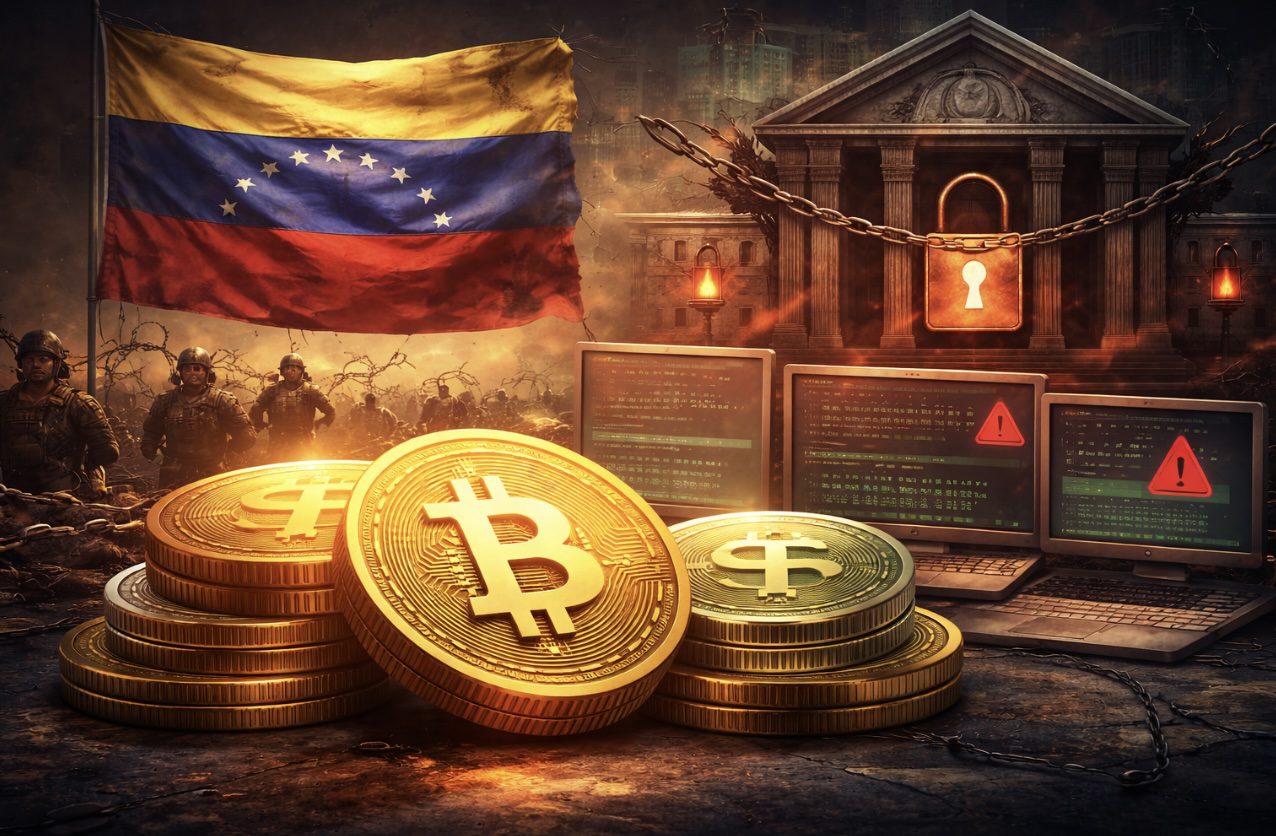
Recent events in Venezuela have generated endless controversy and debate in Spain, Latin America and surely in every society on the planet where information flows. Beyond the clashes of rhetoric, there is one consensus: the sudden encounter with a new world.
Something new in international relations or geostrategy. Just a little further on, in economics and politics. In power. In the relations between power and society. Venezuela has been left to be the experiment of these new relations between power and society. An experiment that reveals new forms of control and repression of its citizens through money and technology, blocking the bank accounts of those citizens who may be considered barely or not at all loyal to the regime. The practical alternative to these blockings has mainly been the use of cryptocurrencies.
Venezuela and cryptocurrencies
Account blocking that is barely reported, since who is going to report anything under the special circumstances of a dictatorial regime that, moreover, knows it is weakened and is afraid. The regime's way of fighting its fear is to produce more fear. Accounts are frozen without formal notification or a clear explanation of the reasons for the blocking. Nor is there transparent information about the procedures for remedying such actions.
The USDT stablecoin replaces banking in Venezuela's real economy
At most, the banks or financial authorities maintain that accounts are blocked when possible transactions linked to the financing of illicit activities or regulatory violations are under investigation. The feeling is that this is a tactic to financially suffocate citizens critical of the government. It is not new, since before Maduro's abduction it had already been used against social organizations, foundations and activists, especially around periods of protest or national strikes.
Surveillance of bank account use
It is never easy to pinpoint when something is entirely new. Even less so when talking about the emergence of a new world. These are complex processes fed by small and large cases. What is happening in Venezuela is, of course, a major case; but everything has its linked historical precedents: other US interventions against dictatorships, the confrontational geopolitical division of the world and a long etcetera.
Also: the increased surveillance of how we use our bank accounts by tax authorities, constantly demanding information from banks about our transactions under the argument of tax oversight and money laundering. Or the demonization of cash during the pandemic.
Beyond the specific circumstances the Caribbean country has been going through, it is a sign that state power has the capacity to control and repress citizens through surveillance and action on their bank accounts. All of this when we have been forced to channel all our financial operations through bank accounts.
Cash
When salaries, bills, loans, mortgages and even the smallest payment are obliged to go through the record of a bank account. There are countries, such as the Nordic ones, South Korea, Australia or China, where the use of cash has practically disappeared. In fact, since the covid19 pandemic, pressure from Western states for every transaction to be recorded on a current account or credit card has been strong, placing any payment in physical money under suspicion. Incidentally, without this entailing greater security, with the exception of potential and exceptional viral contamination, which is what drove this state move when the coronavirus was pressing.
They have us by our bank accounts and cards. And we citizens know it. It is estimated, always in the unofficial way in which things that are very difficult to observe empirically are estimated, that one in three Spanish households keeps considerably more money at home than it might need for its regular expenses after the recent chain of crises.
Household deposit
A household "deposit" with no remuneration whatsoever — not that the one offered by financial institutions is anything to write home about, as they say around here — and with the constant danger of being devalued by inflation. Nevertheless, it is held. More driven by the latent fear of "corralitos" than by supposed tax or political surveillance.
The fear of surveillance and control lies in the reluctance toward CBDCs (Central Bank Digital Currency). The horizon of surveillance and control of citizens lies behind the Digital Yuan promoted by the People's Bank of China, a country that is not exactly an example of respect for human rights and freedoms. The fear of losing privacy is one of the main arguments against the digital euro.
Little trust in banks
An increase in money kept at home and less trust in leaving it in the hands of traditional banks, which appear to be taking hold among young households. When the Center for Sociological Research (CIS) asked about trust in banks, three out of four people interviewed said they had little or no trust in them. Among young people, distrust was even higher. The CIS stopped asking the question; but that did not stop distrust from growing among young people and society in general. What is new is that there are now alternatives to fiatmoney. In Spain, Venezuela and the whole world.
According to various sources, including the Bank of Spain and the European Central Bank, the percentage of people residing in this country who hold cryptocurrencies stands between 5% and 9%. A percentage that rises among young people with a higher level of education. About Venezuela, as in so many other things, there is hardly any data; but it must be borne in mind that the use of cryptoassets has been driven by necessity in a context of hyperinflation and constant crisis.
Stablecoins for volatility
It is not hard to find everyday businesses that accept and even encourage payment with crypto, especially stablecoins, given their lower volatility. A resource that is saving those who have experienced losing the ability to access and manage their bank accounts, their property. As it can never be said that situations are not comparable, since the uncertain future can always bring circumstances for comparison… You know: when you see your neighbor's beard being plucked, put… As it cannot be otherwise, we will continue to watch the historic Venezuelan experiment. An experiment of control and repression, and of alternatives and resistance from an educated and active society.