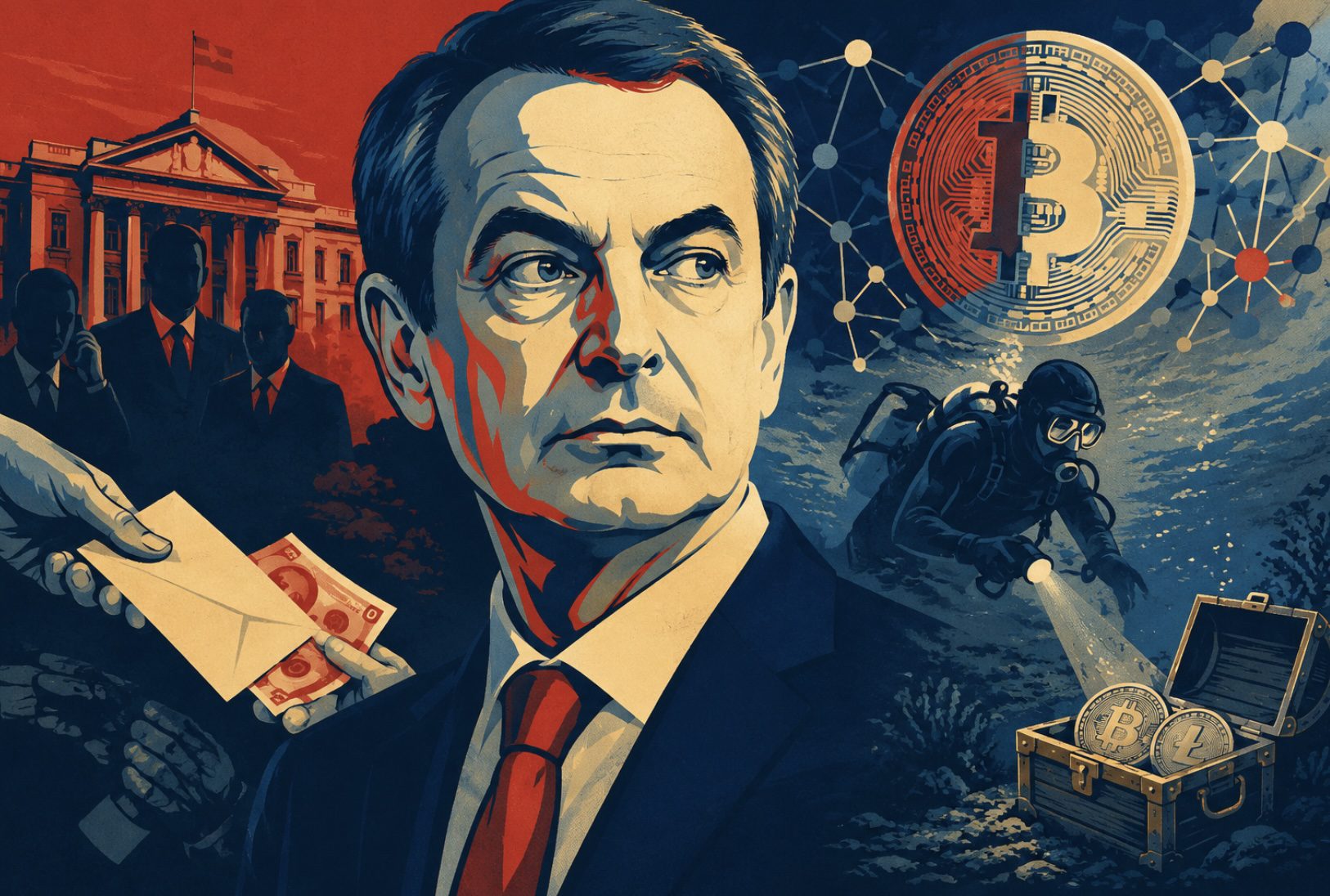
According to the judicial summary of the scheme led by former president Zapatero, it records the suspicion that the network may have used cryptocurrencies and other digital assets to move its money and evade controls. Given the various indications, the judicial investigation has requested the seizure of cryptocurrencies such as bitcoin or litecoin. As reported in Observatorio Blockchain, the Central Investigating Court number 4 of the Audiencia Nacional issued an order on May 18 authorizing the tracking and seizure of cryptocurrencies that could be linked to Zapatero.
What is new is not the corruption cases. Not even that the dark shadow reaches the upper echelons of former presidents and presidents. What is new is the instrumental use of cryptocurrencies for politicians' misdeeds. Crypto has entered the heart of Spanish politics through the back door. In Parliament, silence has prevailed, beyond the transposition of European directives.
When it seemed that politicians were trailing behind on everything related to crypto, as something alien to them that they barely understood, it turns out that some have been using it for their own benefit. Whether those who have used it understood it a little or a lot remains to be seen. Perhaps this is one of the most interesting questions to clarify in the police and judicial investigation, beyond, of course, clarifying possible criminal behavior. It should be remembered that the network is being investigated for money laundering, document forgery and misappropriation.
For such a seizure, the Court has implemented a protocol that will surely set a "legal precedent." The technical custody of the cryptocurrencies will be carried out through what are known as the services of a crypto bunker, contracted by the Secretary of State for Security from the entity Prosegur Custodia de Activos Digitales. It is a kind of vault armored against the possibility of hacks. This is where the seized digital assets would be deposited. But first, you have to reach the assets, find the assets.
The matter is considerably more complex than "putting something that is there into a safe." Among other issues because that "being there," like the jewels found in the former president's office, is not so clear. In the case of cryptocurrencies, you have to find the treasure. However, the map for the search is not in the old sea chest of the old and surly sailor Billy Bones, as in Stevenson's novel.
An immense ocean of transactions called Blockchain
Here the sea is an immense ocean of transactions called Blockchain. In this Blockchain ocean, police investigators will have to dive. Honestly, I hope one of these investigators has a certain passion for literature and sets out to write, even if in the form of noir fiction, the process of searching for the crypto booty.
A kind of field notebook of this fascinating investigation, with its tools, some brilliantly noted here by José Maldonado. But also with the doubts, the decisions. And, above all, with the investigative logic set in motion, where mathematical reasoning joins reasoning about how criminal networks operate until identities are found, behavioral pattern after behavioral pattern.
An opportunity to make an impact on a literary genre that always requires renewal, given the accelerated process of technological innovation. As in almost everything, there are already literary precedents connecting corrupt politicians and cryptocurrencies, such as: God is a Gamer, by Ravi Subramanian. But an update, with a real event as background, would be very welcome. The seed is planted for a narrative that exploits the fierce intellectual battle between the most advanced villains and the most advanced protectors of our security. In the end, we may have to thank Zapatero for the catch-up effort it demands.
Reconstructing the layout of the digital treasure map
In any case, reality precedes fiction and may surpass it. Especially when we talk about politics and corruption. Thus, Torrente Presidente seems like a sequel to the Ábalos-Koldo plot. The narrative of the search for the crypto treasure of Zapatero and Co., of the real investigation process carried out.
Without aiming to spoil the plot of our hypothetical novelist, there are some key aspects. Namely: crypto transactions are at the bottom of the Blockchain ocean; but the users of these funds are tempted to see them - and use them - on the "surface" of the traditional financial system. Surfacing through virtual cryptoasset service providers (VASPs). Well, since 2021 the providers of these VASP services must mandatorily register with the Bank of Spain and comply with anti-money laundering obligations. Providers that hold the identity of their users.
The behavioral patterns of the identified digital assets will allow the reconstruction of the layout of this particular digital treasure map. Especially if special concealment techniques have been used or different techniques to place such assets far from the eyes of the Bank of Spain or the Public Treasury.
Cryptocrime
While the results of the judicial investigation tracking the network's digital assets arrive, along with the work of SEPBLAC (Executive Service of the Commission for the Prevention of Money Laundering and Monetary Offenses) and international collaboration, especially facilitated by the recent entry into force of the European MiCA regulation, it remains to ask about the impact on society of the use of cryptocurrencies by corrupt politics.
Above all, the impact on the image of the crypto ecosystem. That politicians use crypto may serve as an example and boost the industry. That corrupt politics uses crypto to commit crimes raises more doubts. Or that the police investigation is capable of accounting for the illegal use of crypto may even create confusion among the population regarding their image of the crypto ecosystem. In any case, the fact that politicians accused of corrupt behavior use cryptocurrencies is already an event. We will be watching its repercussions on the social representation of crypto
Cryptocrime has multiplied in the last five years, the same years in which the scheme led by former president José Luis Rodríguez Zapaterohas operated, according to the judicial summary of the case investigating various crimes, including large-scale international money laundering. The judge suspects that they may have used cryptocurrencies or other digital assets to move their money and evade controls. In fact, has already requested the seizure of cryptocurrencies (bitcoin and litecoin, among others) given certain indications.
New mechanisms
The data shows that criminals increasingly use these new mechanisms to carry out or conceal illicit activities, including money laundering and terrorist financing. A recent report by Funcas indicates that in 2025 cryptocrime reached 154 billion dollars (132.36 billion euros, at the current exchange rate) compared to 11 billion dollars (9.45 billion euros) in 2020. That is, the volume has risen 1,300% in five years, especially from 2022 onward after Russia's invasion of Ukraine.
The document, analyzed by THE OBJECTIVE, indicates that the data comes from Chainalysis and is due, above all, to geopolitical tensions. It explains that these "have profoundly reconfigured the illicit use of cryptocurrencies." "In 2025, various countries and economic agents have stopped using them as a marginal instrument to integrate them as a structural part of their financial architecture, especially in contexts of international sanctions."
We would have to see for ourselves. When the CIS was the CIS, it studied these things. It proposed studies on society's representations and opinions about political corruption. It is true that such scrutiny of the collective unconscious based on what people said they reported was disheartening. And it is that, as Lacan says, the unconscious is a calculator.
The CIS has stopped observing what is inconvenient
The collective and the people also said things, to argue the lack of electoral punishment for corrupt governments, such as: "these have already taken theirs and will take less in the future; but if others come in, they arrive empty-handed ready to take whatever they can." This is the social cushion of corrupt politics. Sordid realism of an anti-political culture well fed with hardly edifying examples from the political class itself.
In sociological observations on political corruption, the corruption of politics and the broad participation - symbolic and real - in the dynamics of corruption peeked through. I fear that this has increased, despite the CIS having stopped observing what is inconvenient for a government that sustains itself through leaps of corruption of institutions and society.