
Central Investigating Court No. 4 of the Audiencia Nacional, under Judge José Luis Calama, issued an order on 18 May 2026 formally authorizing the tracing and seizure of cryptocurrencies allegedly linked to former Spanish prime minister José Luis Rodríguez Zapatero. This line of judicial inquiry stems from the suspicion that the former leader's circle could be leading a hierarchical influence-trafficking structure that may have diverted money in irregular commissions using virtual wallets to evade traditional financial controls.
This is how the National Police traces cryptocurrencies in the Zapatero case
Find out how the National Police uses blockchain analytics and wallet clustering to trace possible cryptocurrencies in the Zapatero case

The investigation may have intensified after the police searches on 20 May 2026 at the former president's professional office and at several companies linked to his daughters. All of this stems from the possibility that the accused hold hidden assets in the digital ecosystem. In this regard, the National Police's Central Money Laundering Investigation Brigade is leading a series of complex forensic operations. These proceedings also have the analytical backing of the United States Department of Homeland Security (DHS) and its national security investigations agency (HSI). The question that must be asked is How is the National Police able to trace these cryptocurrencies?
Forensic investigation on the blockchain
Well, the tracing of digital assets within a decentralized network is based on the public and immutable nature of transaction records. Unlike the traditional banking system, where transfer information is private, blockchains such as Bitcoin or Ethereum record everything openly.
This means that the hash of each operation, the amount transferred, the exact time and the wallet addresses involved are publicly visible. This feature turns the blockchain into a permanent forensic database, where the initial pseudonymity of users can be broken through advanced statistical and computer analysis.
Is Florentino Pérez a cypherpunk? The connection between the Super League and Blockchain
To process these massive volumes of data, the National Police uses cutting-edge analytical tools such as Chainalysis Reactor and TRM Forensics. These platforms make it easier to visualize flows and allow investigators to reconstruct the trail of illicit capital visually. Basically, they are enormous databases of all blockchain operations, into which additional data and profiles can be fed to generate a trace linking person A to the corresponding balances on the blockchain.
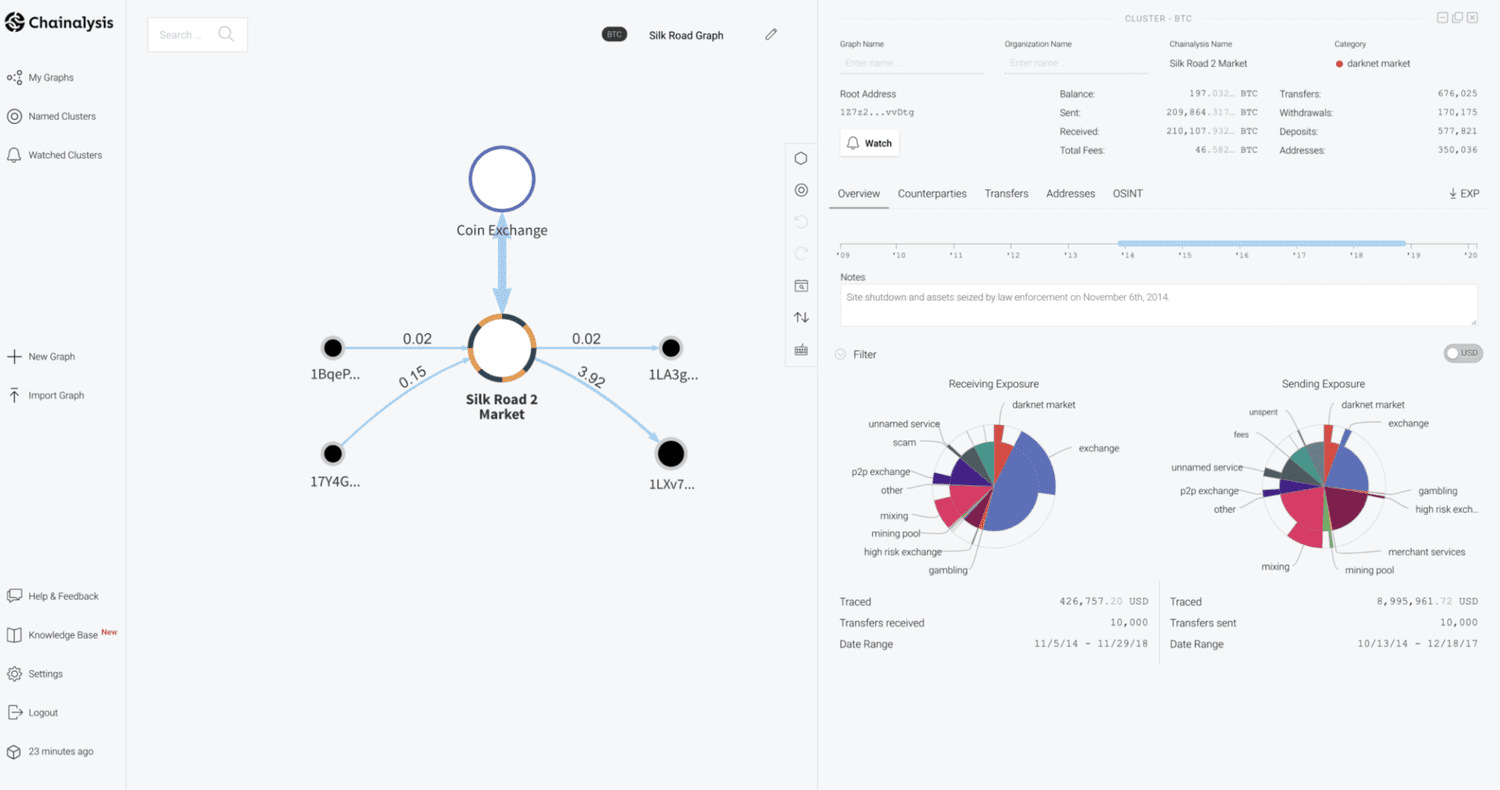
All of this thanks to the use of sophisticated algorithms that can detect patterns of fund dispersion and asset consolidation evidencing transnational money laundering techniques, and which are fed both by blockchain data and by the operations of the traditional banking system and exchanges' KYC/AML systems.
Advanced clustering and transactional analysis techniques
One of the key mechanisms for untangling money laundering networks is the common-input-ownership heuristic. This principle establishes that if a single transaction uses multiple source addresses as fund inputs, all those accounts mathematically belong to the same controller. The application of this wallet clustering rule) allows the National Police to unify apparently unconnected wallets under a single operating entity.
Investigators must also follow the trail through the so-called peel chains. This technique, commonly used by criminal organizations, consists of transferring a significant balance through a continuous circuit of single-use wallets, shedding a small portion of the capital at each hop to camouflage the final destination. Automated analysis of these routes allows experts to identify the physical accumulation points where the funds are consolidated again.
From digital identity to the physical attribution of those involved
The traceability of a digital asset has no legal validity unless the link between a specific virtual wallet and the physical identity of a suspect can be proven. To break the barrier of pseudonymity, officers from the Economic and Fiscal Crime Unit (UDEF) focus their efforts on the points of contact with the conventional financial system. These mandatory connection points are the virtual asset service providers (VASPs), mainly centralized exchange platforms.
Exchange platforms operating within regulated jurisdictions are required to carry out a rigorous user identity verification process (KYC). Through international judicial requests, the Audiencia Nacional can ask these exchanges for their clients' access records. This yields critical data such as email addresses, phone numbers, originating bank accounts, withdrawal histories and the IP addresses associated with each transaction.
Betting markets give a 39% chance of Zapatero's arrest
The role of physical evidence and international cooperation
During the searches of the former president's office and the offices of the companies controlled by his daughters, the UDEF seized computers, mobile devices and a safe. Judicial computer experts are analyzing this physical material in search of private keys, seed phrases or remnants of non-custodial wallet software that would prove exclusive control of the funds.
International cooperation with United States federal agencies has been decisive in narrowing down the network's movements. The financial intelligence exchange coordinated by Homeland Security Investigations (HSI), provided key data on the international triangulation of the accounts underpinning the Audiencia Nacional's investigation. This technical cooperation scheme resembles the operational success of Operation Bonanza, in which the Spanish National Police, with direct support from Chainalysis, managed to freeze and recover 21 million dollars diverted in an international fraud.
The corporate network suspected of financial triangulation
Judge Calama's court order details that the criminal influence-trafficking network operated through a complex web of shell companies designed to hinder the traceability of payments. These companies, presumably used to triangulate commissions from simulated consultancy contracts, channeled multi-million flows that were later withdrawn in cash or converted into digital assets.
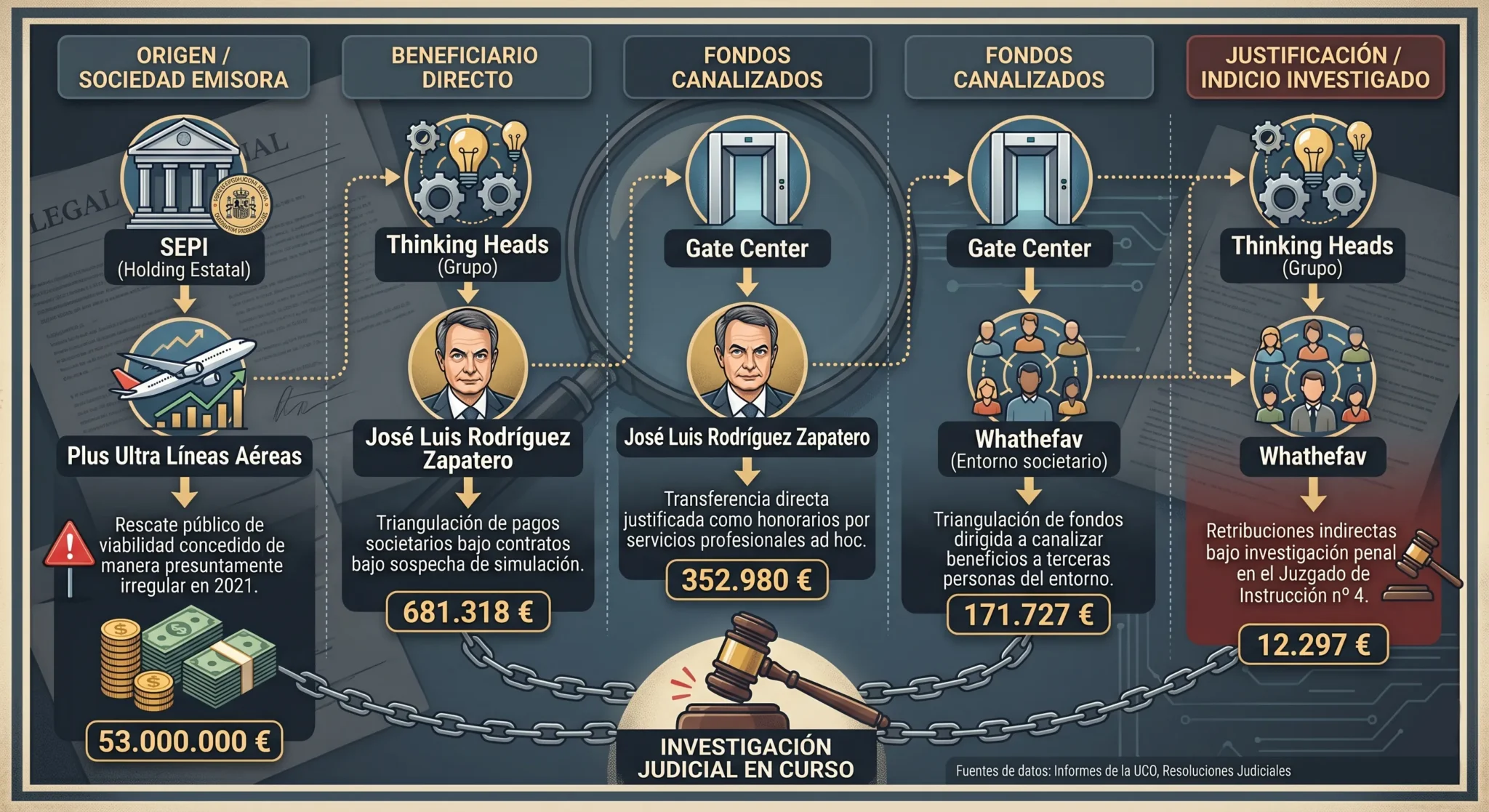
This web of cross-invoicing between companies such as Caletón Consultores and Summer Wind could reinforce the judicial thesis that the suspects may have used advanced techniques to conceal and convert illicit assets in order to hinder their tracing. Analysis of these flows could suggest that the use of cryptoassets was not an isolated event, but may have formed part of comprehensive planning allegedly aimed at diversifying the diverted assets beyond the reach of the Tax Agency and the Bank of Spain.
The stablecoin boom and the role of the dollar force Brussels to review MiCA
The eventual seizure of digital assets poses significant logistical and technological challenges in the judicial sphere, especially because of the risks associated with cyberattacks, loss of private keys or irreversible fund movements. In this context, the Spanish authorities have specific mechanisms for the custody and preservation of cryptoassets seized in criminal proceedings, through technological infrastructures designed to guarantee their secure conservation while judicial proceedings are under way.
These types of systems usually rely on physical network isolation protocols (air gap), offline storage and advanced cryptographic security modules designed to prevent unauthorized access. Absolute separation from the internet significantly reduces the possibility of remote intrusions or external tampering with the private keys linked to the seized assets.
Air-gap isolation protocol and electromagnetic shielding
In addition, infrastructures intended for the custody of digital assets usually incorporate electromagnetic protection measures, redundant authentication systems and high-security physical controls to minimize any risk of extraction or alteration of the sensitive information stored on the devices.
EURR and USDR, the European stablecoins backed by Tether, hacked
The reference to cryptocurrencies in the proceedings of the Plus Ultra case could reflect how economic and money laundering investigations are increasingly beginning to incorporate the analysis of digital assets and blockchain traceability tools. However, the publicly released court document only generically mentions the possible seizure of "cryptocurrencies and any other goods or assets", without detailing specific platforms, token types or specific custody mechanisms.
The final outcome of the proceedings could help define future technical and legal criteria on the prosecution of economic crimes linked to the digital ecosystem. It also highlights how computer forensics, blockchain analytics and international cooperation have become increasingly relevant tools in complex financial investigations.

Author
The latest
From Huang to Botín, from Zara to Byron: corporate responsibility in global capitalism


