The InfoScan desktop client accepts a certificate it cannot verify and carries on. That detail, which in a browser would be an unforgivable error, is the most serious of the six that the US cybersecurity agency (CISA) published on November 17, 2026 in the advisory ICSA-26-321-01. All six affect InfoScan, the SCADA from Dorsett Controls, the supervisory control and data acquisition software used to operate a plant, in versions 1.45.0 and earlier.
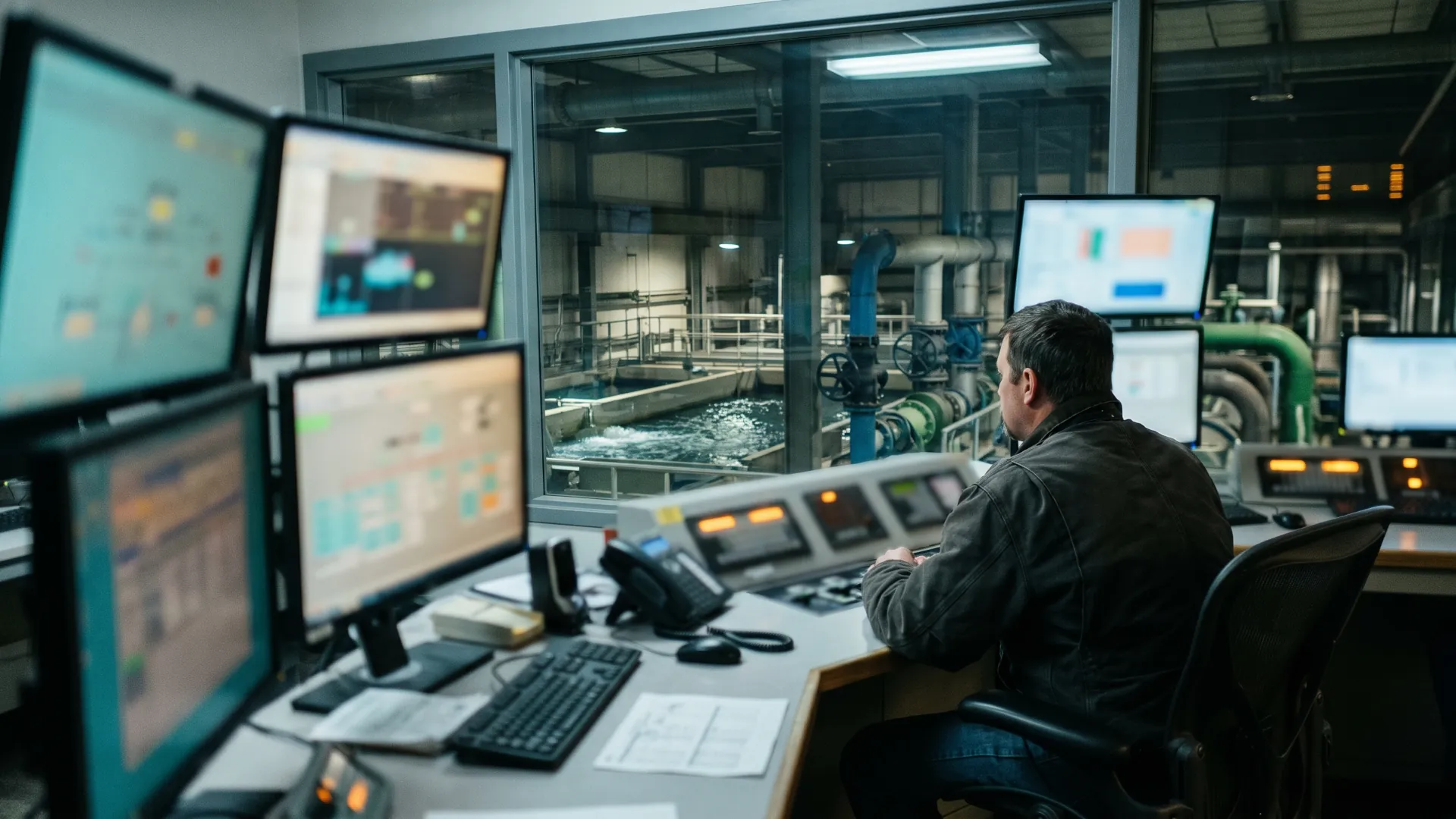
The Dorsett Controls SCADA product sheet sells InfoScan as a complete system for water and wastewater plants, with real-time control and remote monitoring. CISA classifies it in the water sector, with deployments worldwide, and states that it has no knowledge of public exploitation of these six vulnerabilities.
Only one of the six CVEs scores above 7 on the CVSS scale, the standard severity score, and the other five sit between 4.3 and 5.5. Anyone filling in a prioritization sheet with that data closes the advisory the same day. The pattern says otherwise: an Electron client with its protections switched off, cryptographic keys inside the program and screens that respond without asking for credentials.
The certificate nobody checks
8.1 on CVSS 3.1 and 8.5 on CVSS 4.0. Those are the scores for CVE-2026-117659, the flaw that accepts certificates without checking whether they can be trusted. The client launches Electron, the framework that builds desktop applications with web technology, with nodeIntegration active and with contextIsolation and webSecurity disabled.
Translated: the window can execute system code, the page's code shares space with the application's privileges and the internal browser stops enforcing the same-origin policy. The Electron security guide asks for the opposite: disable nodeIntegration, enable context isolation and do not disable webSecurity.
The configuration the client is compiled with is the problem, and there are companies that have taken the opposite path: Discord abandoned Electron and rewrote its client in Rust. Rewriting takes months; checking three boxes takes an afternoon.
With those pieces in that position, anyone who intercepts the connection presents a fake certificate and the client accepts it. CISA scores the attack as remote, low complexity and without privileges, with one condition that only partly holds it back: someone at the workstation has to open the connection. An operator's workstation stays open for the entire shift, with alarms and valves in view.
Keys inside the installer
CVE-2026-120255 scores 4.3, the lowest of the six, and it is the flaw that leaves the database password within reach of anyone who has two files. InfoScan carries keys and initialization vectors embedded in the program itself to encrypt the MongoDB password before writing it to the Windows registry, so with the registry value and the binary in hand the password comes out.
The installer adds the map. CVE-2026-120157, at 5.3, notes that the public package includes configuration files with hostnames from customer installations and from internal development and testing infrastructure. An installer ends up being a target list with names and surnames.
The third piece is CVE-2026-120298, also 5.3: malformed requests to the login and password change screens return Node.js traces with file system paths and directory names. It does not execute anything, but it saves the weeks spent guessing what is running in there.
Together they describe a quiet reconnaissance chain: the installer gives the hostnames, the traces confirm the version and the keys open the database. The cheapest piece of the advisory, the 4.3 one, is precisely the one that opens the door.
What responds without a password
A request without credentials returns the installation's account inventory, with username, display name and second-factor status. It is CVE-2026-120271: the user enumeration and version endpoints respond without authentication with all of that, plus the application version, the firmware of the hardware modules and the BACnet/IP port of that installation.
The MFA status (two-step verification) deserves its own line because it decides who gets attacked first. An account inventory with the second-factor label saves weeks of trial and error, and in a small plant it includes the technician who administers everything. The BACnet/IP port, the building automation protocol from the ASHRAE 135 committee, says where the field equipment is spoken to.
CVE-2026-120260 is the odd one. It scores 5.5, the second highest, and requires a local attacker: its sales automation templates endpoint delivers data without a valid session to anyone already inside the system. It is the only one of the six that cannot be reached from the network.
Two years earlier, the same kind of advisory
CISA had already published an advisory about this same manufacturer on August 8, 2024. The advisory ICSA-24-221-01 documented three vulnerabilities in InfoScan and in its update server with two classes of error that repeat the pattern: information exposure and directory traversal on the client's download page.
The difference between the two advisories is scope. A little over two years ago CISA limited deployment to the United States and the remedy was version 1.38 or later; now it writes "worldwide" and asks for 1.46.
Dorsett Controls presents itself as a manufacturer of complete systems with more than 40 years of history, free updates and no license fee, and cites Iredell Water among its water customers. That the update costs nothing does not mean it has been applied at every plant: a free version that nobody installs leaves the same flaw in the same place.
The month does not help with prioritization either. With the N-able N-central cloud down for 33 zero-days, the calendar was already full. The Outlook zero-day from November's Patch Tuesday adds another urgency competing for the same people. The technician deciding this week is not choosing between them: they are choosing what to leave unpatched.
What a plant that cannot patch today can do
The update is in System Maintenance and Check for Updates, or in the package the manufacturer publishes on its customer portal for installations without internet access. Upgrading to v1.46 or later is the only way out, and the advisory mentions no alternative.
If you administer a plant with InfoScan and cannot stop the process this week, what is left is to reduce exposure. Taking the control network off the internet and separating it from the corporate firewall reduces the surface, and even so the keys are still inside the binary: the MongoDB password needs rotating.
None of those measures closes the flaw. They buy time until the maintenance window, and it is worth saying it that way because the usual mistake in a busy week is confusing relief with a patch. The advisory offers no intermediate remedy either: only the update.
CISA does not publish how many plants use InfoScan or in which countries, and this article cannot know that either. Anyone who has to start today is left with two questions: which version is running on each workstation and which ports on that network respond from outside.
What the advisory leaves out
The advisory confirms no intrusion, and that part is worth reading twice. That there is no known exploitation means nobody has reported it to CISA, not that the reconnaissance chain described could not have been walked. The agency also does not name affected operators, and that absence is a disclosure decision.
What remains to be seen is the next advisory. If Dorsett Controls fixes the client's certificate and isolation, the question will be whether the rest of its desktop catalog keeps the same boxes disabled and whether the water sector, with small patch budgets, finds the installations it stopped updating before anyone else does. Revision 2 of ICSA-26-321-01 will tell whether the advisory stays at six CVEs.