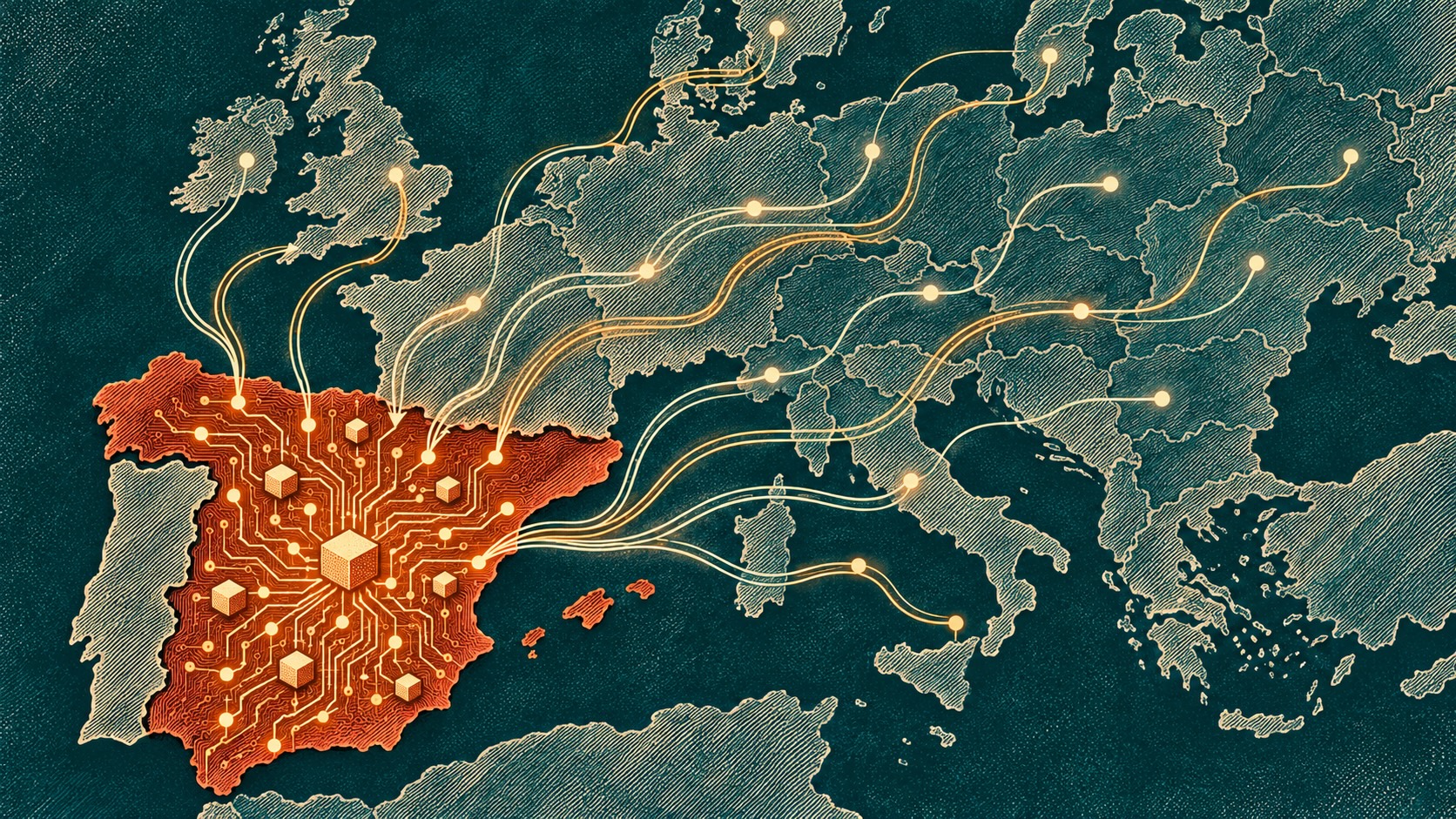
While crypto activity fell 1.6% globally, in Spain it grew 24.6%, according to Chainalysis's 2026 Geography of Cryptocurrency Report. Between July 1, 2025 and June 30, 2026, the firm estimated Spanish activity at $156.1 billion, the fifth-highest amount in Western Europe. Over the same period, activity rose 2.2% in the European Union and 1.2% in Western Europe.
Spain ranked behind the United Kingdom, $424.5 billion; Germany, $288.8 billion; France, $215.8 billion; and the Netherlands, $207.8 billion; and ahead of Switzerland, $132.8 billion. Chainalysis links the growth of Spain and Switzerland to greater activity on centralized exchange platforms. Despite falling 8%, the United Kingdom kept the region's top spot.
Mastercard lets businesses pay suppliers with stablecoins in 11 currencies
To calculate each country's activity, Chainalysis adds up the funds received by crypto services, certain transfers between personal wallets within the country and certain inflows from abroad to personal wallets. For services, it estimates users' country from web traffic and adjusts the distribution by income.
More funds than in the rest of Europe
In the twelve months analyzed, users in the rest of Europe sent more funds to platforms registered in Spain than Spanish users did. Since 2024, inflows from both groups have increased, with those from other European countries growing faster. Western European users sent $521 million, 79.1% more than in the previous period. From July 2023 to June 2026, those transfers totaled $984 million.
Inflows from Western Europe grew more than three times faster than Spanish crypto activity as a whole. A year earlier, both indicators had advanced at the same pace.
Italy and Portugal lead the transfers
Italy and Portugal were the two main countries of origin for funds sent to platforms registered in Spain. Growth in transfers from Italy went from 22% to 329% between the two editions of the report. In Portugal, it went from 36% to 751%. Among the countries that had sent at least $100,000 in the previous period, average growth per country went from 100% to 198%, and the median rose from 82% to 162%.
Gabriel Ayala, API and Banks director at Bit2Me, points to the structure of both markets as a possible explanation. In Portugal, he notes the size of the market and its linguistic particularities. In Italy, he cites the fragmentation of the sector and regulatory complexity. Ayala also believes that MiCA, the European regulation on cryptoassets, makes it easier for authorized platforms to expand within the EU.
International stablecoin transfers grow 77.5%
Global crypto activity stood at $9.4 trillion, according to Chainalysis's rounded estimate. The value received by exchange platforms, decentralized finance protocols and other crypto services fell 4.3%. International stablecoin transfers with origin and destination identified by Chainalysis rose 77.5%, to $220.3 billion.
Sub-Saharan Africa recorded the highest growth of the eight regions analyzed, at 13.4%, to $101 billion. Eastern Europe saw the largest decline, at 7.9*, to $642.1 billion.