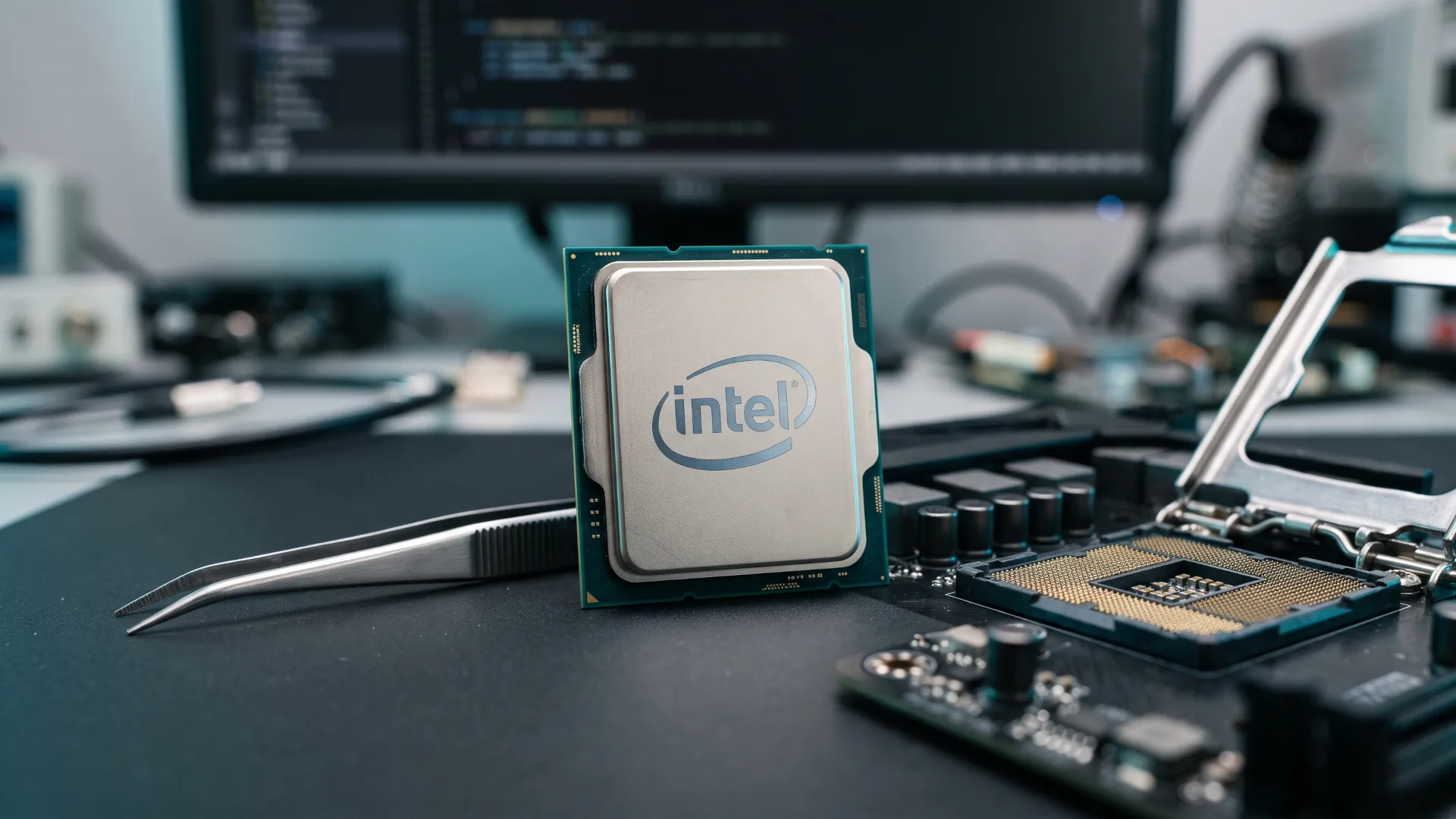
A processor not expected until 2028 already has an identifier in the Linux kernel, and that apparent contradiction is the usual way of working in open source. Intel engineer Tony Luck sent the first patch registering the company's future processors on November 13, 2026, and with it the internal names and family numbers of the next generation were laid bare.
The first kernel patch for Razor Lake is short and does one thing: declare identifiers so that later ones can refer to them. The interesting part is not in the code but in what the code names, because there four Razor Lake variants appear along with a server family called Coral Rapids.
For anyone buying hardware, the news has a practical reading and a patient one. The first is that Intel will keep two desktop lines and two laptop lines in its next generation, a split that does not change from what it already offers. The second is that more than a year remains before knowing whether those labels correspond to products that reach a store, and no official announcement confirms the schedule.
A patch that puts Razor Lake in Linux
The table extracted from the submission orders the five identifiers by family and model. Razor Lake and Razor Lake-S stay in family 18 with models 6 and 10, while Razor Lake-L and Razor Lake-U use models 7 and 9 of that same family. Coral Rapids, the server generation that succeeds Diamond Rapids, appears in family 19 with model 8.
Three fronts telling the same story is how the industry avoids getting it wrong. If the compiler, the kernel and the documentation agree, the error would have to be in all three at once.
The classification matches the instruction reference Intel had updated days earlier and the GCC patches published the same day, so the three fronts tell the same story from different angles. The breakdown by families and models makes clear that the five identifiers belong to two separate families and that none of them yet describes a product on sale. A compiler knows which instructions to generate, a kernel knows how to handle the machine and the documentation says which names exist.
What the patch does not say is almost everything else. There is no core count, no frequencies, no power limits, no cache, no release date, no explanation of how one variant differs from another. All of that lives in internal documents and will arrive, if it arrives, in later patches or in leaks.
The only technical clue available comes from the compiler. GCC currently treats Razor Lake as an alias of Nova Lake, with the same declared capabilities, including AVX10.2 and APX. Sharing a profile does not prove the processors are alike inside, but it does say which instructions a developer can use today without waiting for the hardware, and that includes anyone compiling libraries that will be distributed for years.
Two desktop and two laptop
The four names split into two pairs that the community interprets with the usual logic. The suffixes with and without S point to desktop, and the U and L suffixes to laptop, consistent with the nomenclature Intel has used in recent generations. There is no H or HX variant in this submission, the high-power laptop tier that usually appears later.
The absence of the H and HX range also says something. Intel usually reserves those letters for later, when the silicon has already shown what it can do in thick laptops.
The differences between the two models in each pair remain a mystery, and the submission itself invites readers not to read too much into it. Family and model names are internal CPU definitions and need not match the commercial names that appear on a box next year, something the specialist press repeated as soon as the patch circulated.
The other unknown is platform-related. Reports suggest Razor Lake-S will keep the LGA 1954 socket that Nova Lake will introduce in 2026 according to the plans in circulation, although that family has not been officially presented either. If confirmed, anyone buying a board next year would have two generations of processors ahead.
A socket with two generations is good news for anyone upgrading the processor rather than the whole machine, and bad news for anyone expecting a platform change. The decision is not settled in any public document, so it is best treated as what it is: a reasonable expectation built on mailing list submissions.
The two desktop models on the same base add another question to the list for hardware buyers. If Razor Lake and Razor Lake-S coexist on the same board, the difference between them could lie in core count rather than socket, which is precisely the detail the patch does not reveal.
Why does the kernel know about chips that don't exist?
The open source calendar runs ahead of the stores' for a simple reason. A kernel change takes years to reach all the distributions people use, so if Intel waited for the commercial launch to send its patches, support would arrive late for machines sold on day one.
That prior work is standard in the industry: first identifiers are registered, then platform patches arrive and finally support for specific features, which is where the juicy details leak out. In November 2026 only the first step has been covered, and the rest will be published in the coming weeks at the lists' usual pace.
That step also serves as damage control. A misspelled identifier discovered now costs an email on a public list and one more patch, whereas the same error detected with units in customers' hands costs a firmware update and a press release.
AMD made the same move five days earlier with the patches that teach the scheduler to distinguish fast and slow cores in its hybrid Ryzen chips. The two stories together describe a sector where the operating system learns about the processor architecture long before the end customer.
For a Linux user, the practical consequence is that their next machine will have support from first boot instead of six months later. For Intel, the submission serves as a public test: any error in the identifiers is caught now, when fixing it costs an email, and not when there are units in customers' hands.
The socket that decides the upgrade
The most useful information in the patch is not the name of the next generation, it is the confirmation that Intel keeps two separate segments in desktop and laptop. That continuity matters more than any performance figure, because it defines which boards and which chassis will still work in two years.
The dates the industry handles place Razor Lake in 2028, with Nova Lake as an intermediate step in 2026. Between one and the other there is an entire generation of boards, memory and power supplies that will be renewed first, so anyone buying today should not plan their machine around the socket of two years from now.
The sensible reading is the usual one: the kernel knows about Razor Lake because its job is to know, not because there is anything to buy. The next time this processor appears in the news it will be because of a platform patch, and then there will be data on cores, graphics and power draw to decide whether it is worth waiting.