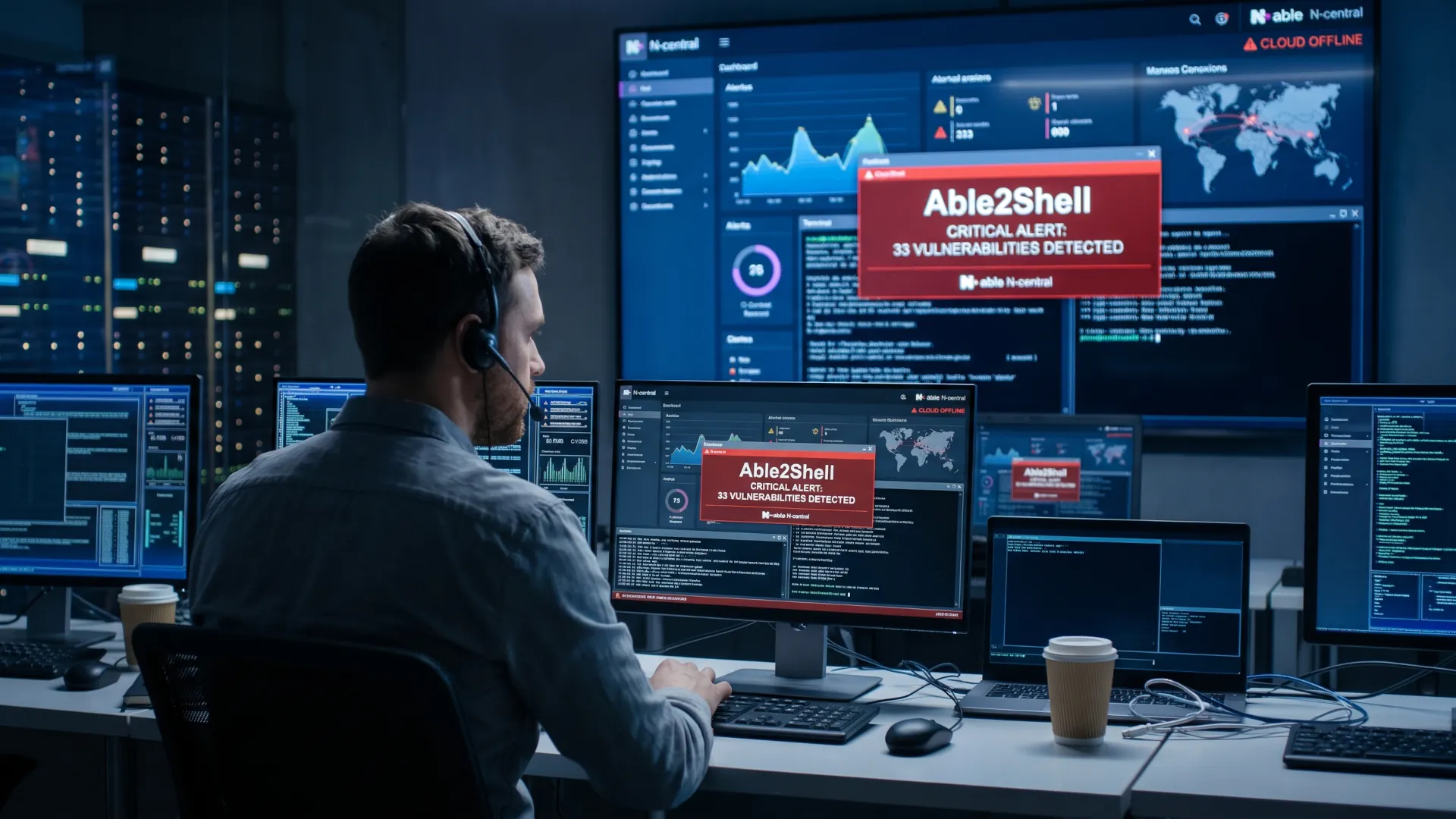
N-able makes one of those tools that almost nobody knows about and that half the industry depends on: N-central, a monitoring and remote management platform that managed service providers use to administer their clients' computers. On the night of Sunday, November 8, an independent security consultant published on GitHub a repository with more than thirty vulnerabilities in that platform and working exploits to take advantage of them. On Monday at 15:15 UTC, the company opened a critical incident, disconnected its cloud service in the Americas, Europe and Asia-Pacific, and asked customers who have the product installed on their own machines to shut it down.
The package is called Able2Shell and the most cited count is 33 flaws that chain together into four complete attacks: three lead to remote code execution and one to root privileges. The tests were run against N-central Appliance 2026.4.0.31, and the documentation of the finding itself takes it for granted that earlier versions are also affected. N-able insists it has not seen successful exploitation or unauthorized access to customer data, although it acknowledges scanning activity associated with the published code.
The story has two layers and it is best not to mix them. The first is technical: a product that administers other people's networks had accumulated flaws that could be exploited in a chain, some as inelegant as an arbitrary file write. The second is procedural: the researcher did not notify the vendor before publishing, and his reason is the part of the case that should worry any company that buys management software.
Publishing a "Swiss army knife" for attacks
The repository brings together arbitrary file writes, directory traversal, credential disclosure, cross-site scripting, XML external entity injection and remote code execution. In isolation, several of those flaws would be moderate. The problem is that they combine: the analysis of Huntress on the Able2Shell chains describes chains that link an XXE with trust abuse in the NCI service, theft of support tokens, execution of unsigned NSP packages, an XSS that escalates to OGNL and authenticated reverse shells. A fourth chain uses a stack overflow in the GenericTCP component to reach root.
The practical result is that an attacker with access to the management interface can create administrator accounts, read credentials and execute commands with system privileges. In a remote monitoring tool that is not a local breach: it is the key to the entire estate.
N-able reacted quickly operationally and coolly in public. Its status page marks the incident since midday on Monday and keeps the warning that customers with their own servers should not turn them on until the company confirms it is safe. The company describes what happened as irresponsible disclosure of critical vulnerabilities and says it is working on an urgent patch, without giving a delivery time.
There is one detail that sets this case apart from an ordinary security advisory: the product does not protect a website or a database, it administers other people's computers from a single control point and with system permissions.
The RMM as a supply chain weapon
Remote management platforms are a coveted target for a simple reason: whoever controls them does not need to attack a hundred customers, it is enough to use the tool that is already installed on all hundred. Legitimate software becomes the vector, and the victim does not have to do anything wrong to fall. That pattern has been seen before in the sector, and there are precedents in N-central itself: during the exploitation of CVE-2026-86218, attackers used the compromised servers to distribute scripts and tools into end-customer environments. It is the same mechanic that left the 3AM ransomware with 37 machines encrypted at a schoolthe provider goes down and drags all its customers with it.
That is why the recommendation to shut down the server is not an overreaction. A powered-on, vulnerable N-central is not only a risk for whoever administers it, it is a ramp into its clients' networks. The checks the analysts advise point in the same direction: look for anonymous agent sessions, creation of new administrators, unexpected scripts and downloads of device configuration, and scrutinize the logs from November 8.
The appearance of probes within hours confirms that the code did not land in a vacuum. watchTowr detected exploitation attempts against its honeypots during the early hours after publication, and other teams have described anonymous agent sessions followed by configuration extraction. None of that proves a real compromise, but it sketches the sequence that precedes one.
Hours passed between publication and the first probe, not days. That speed is what turns shutting down the server from a precaution into the only defensible decision.
The fight that matters, which is not the technical one
The researcher explained his decision with an argument that is repeated all too often in this sector. His version is that five or six months ago he reported two remote execution vulnerabilities and one privilege escalation vulnerability in another N-able product, and they remain unpatched. He adds that he, his manager and his director sent some five queries in recent weeks without a response, and that the bounty platform paid him nothing. He himself puts it this way: none of what was published on Sunday had been reported to the vendor beforehand.
N-able has not publicly responded to those accusations nor confirmed the status of the earlier reports. The consultant's version is, for now, one-sided, and there is no independent evidence of that sequence. Even so, the case fits a pattern that security teams recognize: when the disclosure channel does not respond, the researcher ends up choosing between silence and the shop window.
Europe has a yardstick for this. The UK Department for Science, Innovation and Technology's voluntary software security code of practice, drafted with the national cybersecurity centre, asks manufacturers for an effective and published disclosure process, as well as timely updates for customers. The NCSC's own tool sums it up in a phrase that leaves no room for interpretation: don't ignore the report. If the process breaks down, the cost ends up being paid by the customer who shuts down their server on a Monday morning.
What the patch calendar does not fix
The industry has spent years measuring how long it takes a vendor to patch. This case measures something else: how long it takes them to reply. A product that administers thousands of third-party networks needs a disclosure channel that works even when the researcher is a consultant with no firm behind him and the report arrives by email on any given Tuesday. If that channel depends on the goodwill of an overloaded team, the next Able2Shell is already on the calendar. The parallel with PHP2Shell, which lay dormant in the code for a decade before waking up with root, it is no coincidence: in both cases the flaw was old and the report was new.
What remains for customers is the urgent part, which is simple and admits no shortcuts: keep the server switched off until the company confirms a fixed version exists, review the logs from November 8 onward looking for administrator accounts nobody created and agent sessions nobody started, and assume that any credential that passed through that server in recent weeks deserves rotation. The uncomfortable part is that these three tasks can be carried out today, while the manufacturer's response is still pending.