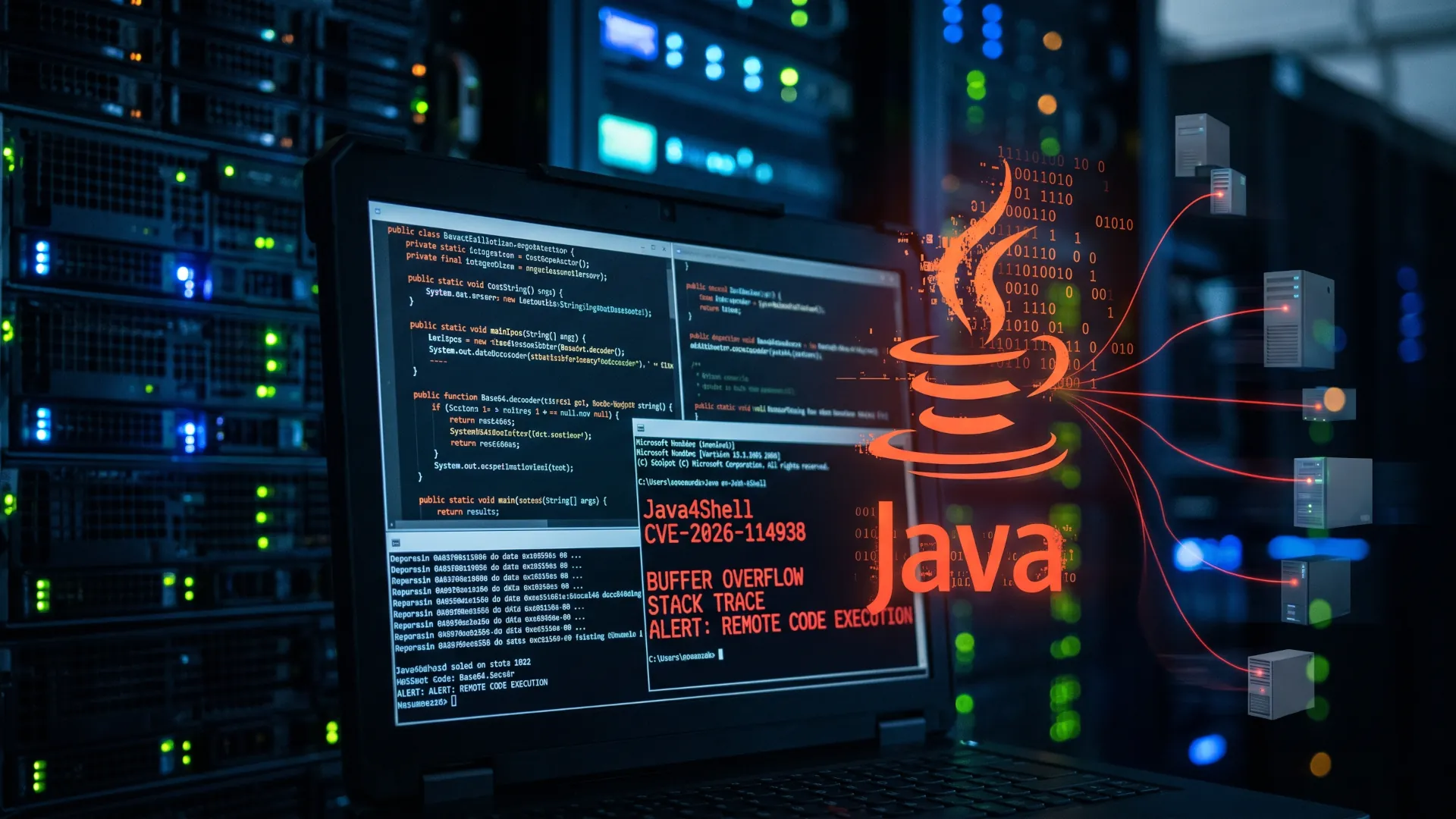
There are flaws that are explained with a diagram and flaws that are explained with an uncomfortable sentence: the component that converts text into binary data has a memory error and anyone can send it text. The vulnerability registered as CVE-2026-114938 and dubbed Java4Shell lives in the Base64 decoder of the HotSpot virtual machine for x86-64, and CISA's alert on Java4Shell calls for treating it as an operational emergency.
The agency describes the effect without embellishment. A manipulated Base64 input can crash the virtual machine and, under certain conditions, allow a remote attacker to execute code without authenticating in the process hosting it. The flaw affects the reference implementation that is part of the Java development kit.
The recommendation comes with a warning that in Spain affects more systems than it seems. Java does not appear in inventories as an application, but as a dependency inside other applications, and the alert itself warns that JDKs and runtime environments may not appear as separate entries in an organization's software catalog. Those who do not know where their Java is also do not know where the flaw is, and that asymmetry between the severity of the warning and the visibility of the inventory is what turns a routine alert into a week of work.
Why is the Base64 decoder the worst place?
Base64 is the piece that converts binary data into text so it can travel by email, in an HTTP header or inside an XML document. It is on the entry path of almost everything, and that is why a flaw in its decoder does not require the application to expose anything special: it is enough that it accepts data from outside.
The second reason is memory. The decoder reserves space based on the length declared by the input, and a miscalculation at that boundary produces writes outside the buffer. Censys' analysis details which versions of OpenJDK include that code and why the flaw does not show up in a dependency scanner. That type of error is what turns a crash into code execution, because the attacker can place data in an area that the program then interprets as instructions.
The third is trust. Nobody audits a decoder because it is considered solved, and that certainty is what makes the flaw go unnoticed for years in a library copied by thousands of products. When it appears, it appears in all of them at once.
CISA does not publish its own score in its advisory and refers to the vendor's bulletin to learn about affected products and versions, a gap that BleepingComputer's coverage fills with the list of main products. Anyone who has to prioritize should look there rather than at the headline, because the real scope depends on which implementations include that code.
The inventory nobody has
The first task the agency calls for is identifying affected installations, and that sentence hides weeks of work at a mid-sized company. A JDK can be installed as a service, embedded in a third-party application, tucked inside a container image or hidden in an industrial appliance with a web interface.
Runtime environments included in commercial products are the hardest case, because the customer does not control the update and depends on the vendor. An application server with long-term support can take months to receive the patch, and in the meantime the exposed system remains the same.
The second task is sorting by exposure. The alert calls for prioritizing systems accessible from the internet, which in practice means starting with payment gateways, customer portals and any service that accepts Base64 data from unauthenticated users.
The third step is detection. CISA recommends monitoring unauthorized runtime environments, unexpected virtual machine crashes and Java processes that do not correspond to what the organization has installed. A repeated crash in the same service is the cheapest signal that someone is probing.
In practice, inventory tools cover part of the problem and fall short on the rest. A scanner that only looks at system packages does not see a JDK copied by hand into an application directory, and that is the usual scenario in commercial products that package their own runtime environment.
What to do if you cannot patch today?
The agency acknowledges that the patch may take time and proposes temporary controls that do not depend on the vendor. The first is to validate and restrict Base64 input at the application edge, with format and length rules before the data reaches the vulnerable decoder.
The second is to impose size limits. A strict cap on the request body reduces the surface of the error and, although it does not close it, it forces the attack to be more precise and noisier in the logs.
The third is to limit unauthenticated access to services that use Java. Prior authentication turns a remote execution flaw into a flaw that requires credentials, and that does not fix it, but it changes the profile of who can attempt it.
None of the three measures replaces the patch, and it is worth saying clearly because it is the usual temptation in a week with two critical alerts. The controls buy time until the vendor publishes the update for the product wrapping the dependency.
There is a fourth path that does not appear in the advisory and that in practice solves the problem at the root: changing the exchange format. A service that accepts JSON or XML instead of opaque Base64 strings reduces the number of places where the decoder runs, and that design decision is made in an afternoon and drags on for years.
The other path is to reduce the number of places where the flaw can live. Every version of Java an organization keeps active is a surface that must be patched separately, and consolidating environments is an architecture task that pays off in weeks like this one.
The calendar does not help either. A Java patch usually comes with its own testing window, because changing the runtime environment of a critical application can break it, and that work is not done the same day the alert is read. The gap between publication and deployment is where the real risk lives.
Java is critical infrastructure again
Java has spent fifteen years being the technology nobody chooses and everybody runs, and that invisibility is precisely what turns a flaw of this kind into a management problem rather than a programming one. Nobody remembers which applications depend on the runtime environment until they all have to be updated at once.
CISA's advisory follows the pattern of recent weeks, with several exploited vulnerabilities entering the federal catalog within days and with remediation deadlines counted in days, not months. That pace turns the list of known flaws into the real calendar of any infrastructure team, above the internal roadmaps that nobody cancels. The catalog of exploited vulnerabilities is the source worth checking every morning instead of waiting for the vendor's monthly summary.
For the reader who administers systems, the practical conclusion fits into two questions: where is there a JDK you do not control and which service accepts Base64 from strangers. The first decides how long it will take you to close the flaw, and the second decides whether the flaw will find you before you close it.