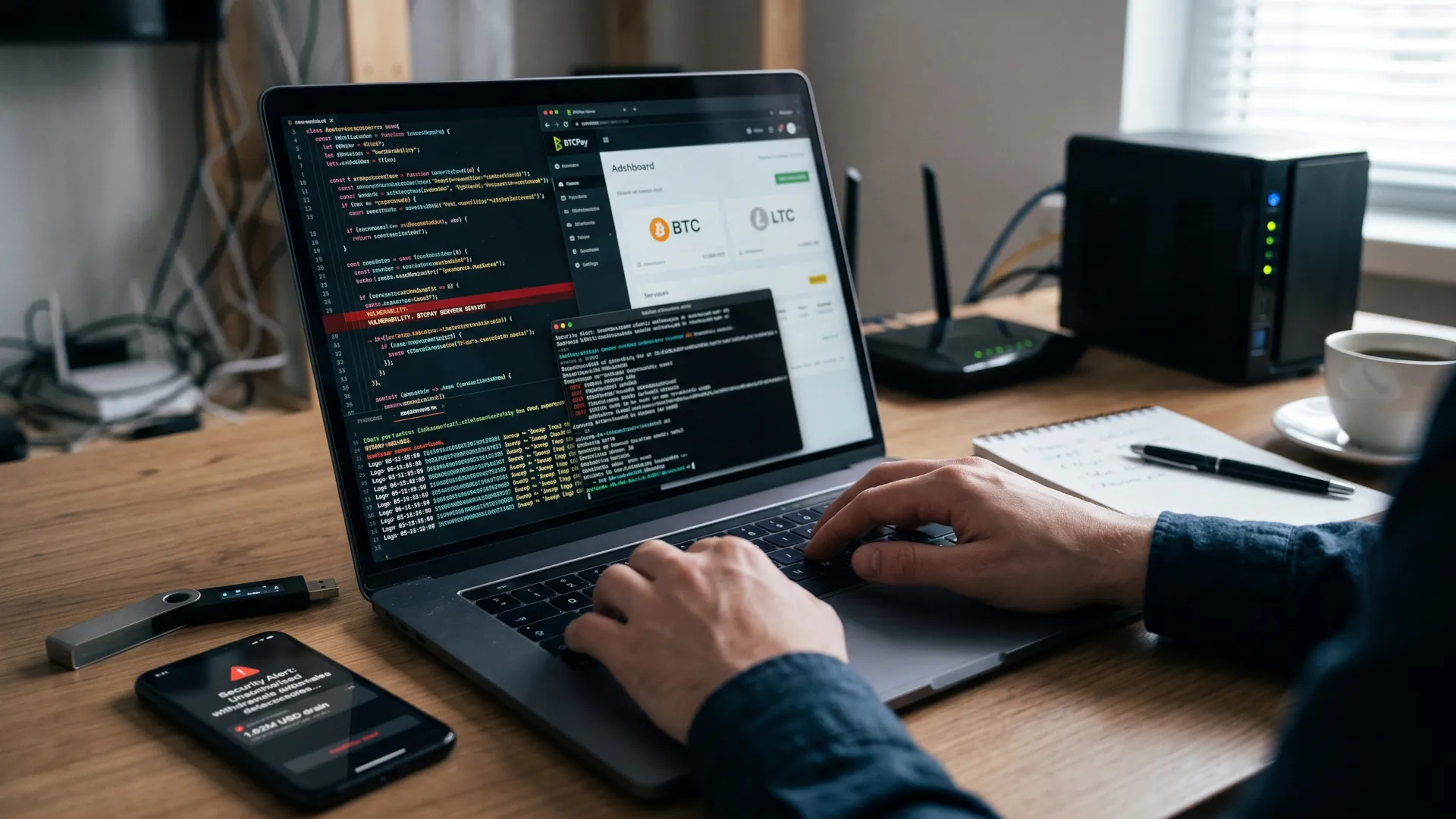
BTCPay Server confirmed on November 1 that bitcoin and litecoin were being stolen from hot wallets on installations running version 2.4.1 or earlier. The fix had been published for almost three months, since 2.4.2 came out on August 7, and the project admitted it in its security notice with an unusual sentence: it would have liked to do more to warn those still on older versions.
Bitquery's on-chain analysis put figures to the incident three days later: $1.62 million in 18.38 bitcoin and 3,405 litecoin, withdrawn in 682 separate sweeps. 87% of the money left in a single wave on November 1 between 14:12 and 22:16 UTC, and the oldest sweep the researchers could date occurred on October 30, less than a day after the project published version 2.4.7.
The story is good for more than recounting a theft. BTCPay exists precisely so that a merchant can accept crypto without relying on an intermediary, so the incident lays bare the flip side of self-custody: if you hold the keys, you administer the server that stores them. The difference is not rhetorical, because an exchange can freeze your funds while an unpatched server loses them without warning anyone.
Which versions were exposed?
The project's notice is precise about the scope. The attacks targeted servers running version 2.4.1, published on July 23, 2026, or any earlier one. 2.4.2, from August 7, fixed the vulnerability, and the attackers used a different method to exploit the same flaw, which in practice means that applying the August patch closed the known door and left open the one now used.
Since then the project has published 2.4.4, 2.4.5 and 2.4.7. The latter fixes a critical vulnerability and several medium-severity ones found by Anthropic's open source scanner. Instances that were on 2.4.2 or higher when the November 1 notice arrived showed no impact, and the project insists it has no credible record of thefts on 2.4.7.
Wallets with spending keys outside the server, such as hardware wallets, were unaffected. That detail is the best design guidance the incident leaves behind, and the project itself turned it into a permanent recommendation: accept payments into a wallet whose keys do not live on the same machine as the store.
Emptying a wallet without touching the key
A hot wallet stores the keys needed to spend on the server itself. That decision is convenient, because it allows paying fees, consolidating balances and moving funds without manual intervention, and it is the reason a flaw in the application becomes a theft of money rather than a data leak.
The project has not published the technical detail of the vector, and it is best not to invent it. What is documented is the result: deposit addresses emptied, transfers grouped toward two addresses published by the team, one bitcoin and one litecoin, and a withdrawal pattern repeated hundreds of times with very different amounts.
That pattern matters for the investigation. Almost half of the sweeps moved less than $100, while 32 operations concentrated 77% of the money. An attacker who automates the sweeping of every wallet it finds produces exactly that profile, with many small operations that draw no attention and a few large ones that justify the work.
Hosting providers also took action. LunaNode and others shut down instances as a precaution, something the project publicly thanked them for and which explains why some merchants found their store down without having done anything.
Updating does not erase access that already exists
The project's notice is explicit on the point people most often skip: updating does not remove access an attacker may already have obtained. An intact balance does not rule out an earlier attack either, because the attacker could have copied keys and waited.
That is why the recommendation for anyone who was on 2.4.1 or earlier is to rebuild, not just patch. The procedure the team describes has four steps and none is optional: create a new wallet with a new seed on a trusted device, sweep whatever remains from the hot wallet, shut down the old server while keeping logs, and bring up a new machine with the latest version without restoring the old system on top.
The step most often skipped is the seed. Reusing the old seed on the new server returns the problem to square one, and that includes the backups many administrators restore out of habit. Credential rotation covers hosting, SSH, applications, API and Lightning, always from a device other than the compromised one. The technical analysis of the incident includes the full timeline and the two destination addresses published.
Self-custody is also systems administration
The conversation about self-custody is usually framed as a choice between trusting an exchange or trusting yourself, and the BTCPay incident shows that the second option has requirements that do not appear in the comparison. A server has to be updated, monitored and rebuilt when the time comes, and ideological conviction does not do those tasks.
The parallel with other incidents from the same week is direct. The backdoor served through the cPGuard update channel and the poisoned package of LiteLLM 1.107.0 share the same root: someone with access to the distribution mechanism and many users who install without checking.
For a merchant who accepts crypto, the practical lesson comes down to three decisions. Keep only the daily operating balance in the hot wallet, move the rest to a wallet with keys outside the server, and treat updating the application as part of accounting rather than a maintenance task that can be put off until Friday. The full list of measures for a small team is in the nine layers of defense for SMEs.