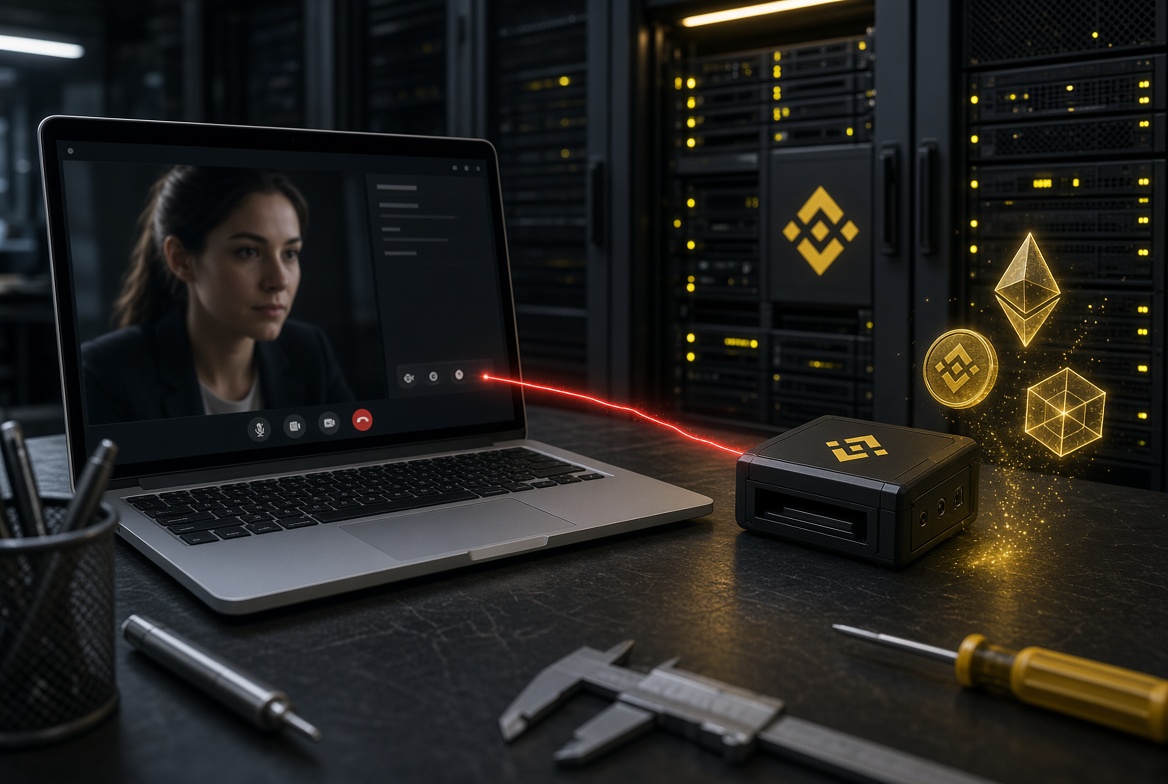
According to Binance, it was a fake job interview that allowed a company engineer's computer to be compromised and opened the way to the theft of 6.340 billion dollars in cryptocurrencies on 29 October. According to the initial report published by the platform, the attackers then used an internal artificial intelligence tool to access the devices of two other employees and obtain permissions with which they reached the signing system for its wallets.
A fake job interview
The explanation expands on Binance's preliminary account, which had placed the possible origin of the attack on an engineer's laptop. The new document describes an operation involving fake identities, malicious software and movement between several devices until reaching the infrastructure that authorizes transfers.
The contact that allowed the computer to be compromised took place in September, through a real job search platform. A supposed project director arranged a first interview with a person who presented themselves as head of human resources and a second with someone who claimed to run a company that, according to Binance, was fictitious.
During the first video conversation, the interviewer shared a social media profile with personal photographs and videos to build trust. At the end of the second interview, the engineer was asked to download a programming exercise onto their work computer. The repository contained malicious code that ran during installation.
Binance states that the program replaced a legitimate component of a development tool with a tampered version, established communication with a server belonging to the attackers and tried to cover its tracks. The device's protection tools did not detect the malicious software at the time.
AI to reach other employees
The next step came on 20 October. According to Binance's investigation, the attackers used the compromised computer and an internal AI tool to access the devices of a wallet operations engineer and another software engineer. On the first one's computer they found a token with permissions to deploy containers, environments used to run programs. On 29 October they accessed the other employee's device and used the stolen credentials to deploy a container and run the program that launched the attack.
The company also discloses an incident that occurred in June. An engineer on the wallet operations team downloaded a tampered Homebrew installation while trying to install an AI programming tool they had searched for online. Binance detected the anomaly, replaced the device and changed the related credentials.
However, it acknowledges that this episode exposed to the attackers the employee's functions and their relationship with other members of the wallet infrastructure team.
An internal signing service
The attackers managed to use an internal signing service to order transfers outside the usual withdrawal procedure. The theft affected wallets on various networks, including Bitcoin, Ethereum, Solana and XRP Ledger.
On Ethereum they used the EIP-7702 mechanism, which allows certain functions of an account to be delegated to a smart contract. According to Binance, the attackers used it to grant a contract under their control permissions over a platform wallet.
Those authorizations were recorded on the blockchain and could remain in effect even if Binance suspended withdrawals and shut down its wallet services. For this reason, stopping the internal systems did not automatically cancel the attackers' ability to move assets.
The platform maintains that the revocation was complicated because the wallet used a distributed signing system, known as MPC. According to its explanation, it had to develop and execute a specific procedure to cancel the malicious authorizations.
The last unauthorized transfer, of 2,961.9 ethers, was confirmed at 23:56 UTC on 29 October. Binance specifies that it had been sent previously and remained pending. At 00:10 UTC the following day it executed a new authorization to remove the delegation from the affected wallet.
98% of assets restored
Binance puts the affected assets at approximately 6.340 billion dollars and the frozen or intercepted funds at 2.850 billion. The company states that it has set aside more than the amount needed to absorb the losses and that, as of 31 October, it had restored 98% of the affected assets.
After the attack, Binance says it has rebuilt the affected wallet systems, replaced devices and revoked the credentials of the engineers involved. It has also announced a review with external cybersecurity specialists.