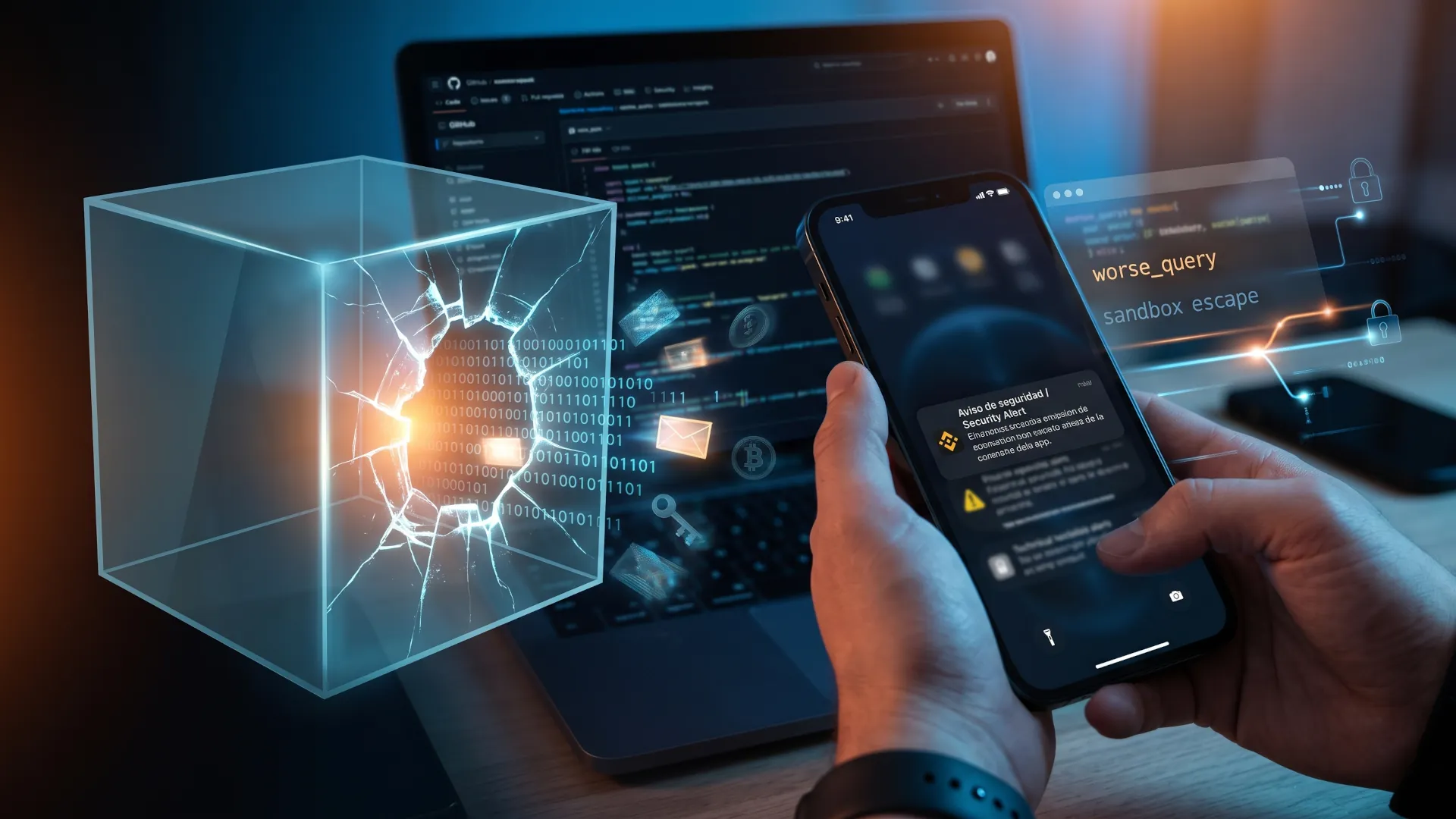
On Sunday, November 8, a project called worse_query appeared on GitHub with an uncomfortable description: sandbox escape for iOS 26 and 27. Two days later, Binance published an urgent notice on X for its iPhone users. The warning is not about a flaw in the exchange, but about a hole in the system that keeps the phone's applications separated, and about what that hole means for anyone who stores a seed phrase in a mobile wallet. To date there are no confirmed thefts via this route.
The mechanics of the escape are simpler than the name suggests. An application that declares a shared group container can point that group's cache folder to a location that does not belong to it and get the iOS container manager to hand it an access token for other apps' files. With that token, the code reads data from other apps, shared containers and some system folders on iOS 27. It is not a jailbreak: it does not break the phone or grant root access, and it requires the user to first install an application built with that code.
That is the nuance that separates panic from risk management. The flaw does not steal anything on its own; it opens a door that was previously closed and leaves the rest to how each wallet stores its data. A wallet that writes the seed phrase to a plain text file inside the app container is exposed if the user installs something malicious. One that keeps it in the system keychain, and hardware wallets, which never leave the key on the phone, do not play by the same rules.
An isolation failure, not a broken wallet
The technical description of worse_query, published by the researcher who signs the project, insists that the proof of concept is material for developers and is not useful on its own. That is true and at the same time irrelevant to the end user, because others have built applications on top of it that can indeed be installed. The full chain requires three things: an app signed outside the App Store, an affected operating system and a wallet that stores secrets in plaintext. All three occur more often than it seems on corporate devices where people install utilities from dubious sources.
Binance listed three versions in its notice: iOS 26.7.1, 27.0.1 and 27.2. The researcher's repository gives a broader range and speaks of iOS 26.0 through 26.7.2. The discrepancy is not anyone's mistake, it is normal when the researcher tests a set of versions and the wallet manufacturer warns about the ones it has verified. When in doubt, the practical conclusion is the same: if the phone is not on the latest published version, it is worth updating it today.
App isolation is one of the founding ideas of iOS and Android. Each app lives in its own box, and the system makes sure no one looks inside the neighbor's box. When that guarantee fails, it is not one application that fails: the model on which all the others rest fails.
That model is what sustains cryptocurrency wallets, password managers and email clients with two-factor authentication on the same phone, and also banking apps that trust that no one else can read their box.
What Apple did not say on November 9
Apple released iOS 27.2.1, iPadOS 27.2.1, iOS 26.7.3 and an update for older devices on November 9, a day after the code went public. The release notes for those versions list fixes in AirPlay, Bluetooth, Messages, App Intents and the brotli library. None mentions worse_query or describes a sandbox escape. Nor is there a CVE assigned, which does not mean it does not exist, but rather that Apple has not turned the finding into a public identifier.
SlowMist maintains that iOS 27.2.1 blocks the technique. It is a reasonable and unconfirmed claim, and it should be read for what it is: the assessment of a third party that has tested the PoC against the new version, not a confirmation from Apple. The company's usual policy is not to discuss flaws until a patch exists, and that policy leaves the user exactly where they were, with an update that probably fixes something no one is going to confirm.
Updating is still the right decision for a simple reason. The cost of installing 27.2.1 is ten minutes and a possible battery quirk. The cost of not doing so, if the flaw remains open, is that any app installed outside the App Store can read what others store on disk.
The part that depends on you and not on Binance
The exchange's notice includes three instructions that are worth more than any alarmist headline. The first is to delete applications installed from untrusted sources, especially those that arrive via sideloading or with a manual signature. The second is to update the system and all apps to the latest official version. The third is the one almost nobody carries out: if you suspect that something ran on the device, create a new wallet on a clean phone, move the funds and close all active sessions.
That last step is uncomfortable because it means accepting that the money may have been exposed. It is also the only one that truly stops the damage when the key may have been read. A seed phrase that passed through a compromised device is not recovered by changing the app's password: it is recovered by generating another wallet on a clean device and leaving the previous one empty, with the cost in fees and time that this entails for anyone with funds on several networks.
For wallet developers, there is a technical lesson that this case once again brings to the table. Storing secrets in the system keychain, encrypting whatever is written to disk and leaving no traces in WebView caches are architecture decisions that are made once and protect for years. The opposite pattern has already been seen with the Chrome and Firefox extensions that stole cryptocurrencieswhere the user was installing the problem with their own hands. Wallets that don't do this aren't insecure through an oversight, they're insecure by design.
The difference between a wallet that encrypts and one that doesn't is usually invisible until an operating system flaw emerges that puts it to the test. On the home screen, the two look exactly the same.
The link that no exchange controls
Binance did what it had to do: warn quickly, distinguish its responsibility from Apple's and give specific instructions. The theft of 6.3 billion it suffered in October had made it clear that a fast response is part of the product, and this time it applied that to a flaw that was not its own. The rest of the risk lives in a place no platform can audit, which is the user's phone and the decisions they make when installing software. That asymmetry explains why hardware wallets keep selling well even when the price of convenience is high.
Until Apple publishes a note naming the flaw, the question of whether worse_query is still open will have only an empirical answer: someone will test it, report it and we will have to take their word for it. For the user, what remains is a three-minute routine that depends on neither leaks nor press releases, and that consists of checking the iOS version, checking which apps were installed outside the store and deciding whether the wallet they carry deserves that risk.