This is how Binance was hacked and these are the consequences
At 20:20:59 UTC on October 29, a Binance hot wallet received a transaction carrying fifty signatures inside it. Four minutes later, 167,464 ether, 1.615 billion USDT and sixty more tokens had left it for a newly created address. The wallet, labeled Binance 14, was left with one ether in balance.
The total is not yet known with complete certainty. On-chain estimates have ranged from 5.57 to 5.8 billion dollars across Ethereum, Bitcoin and Tron, more than three times what was taken from Bybit in February 2025. Binance has not published the loss figure, but it has made two commitments: that it will cover all losses from the hack and that it will publish a technical report when the investigation is complete. Its first official figure is different: 2.54 billion frozen by stablecoin issuers and partners.
What is interesting is not the amount, which changes every hour, but how the money left. Someone got a hot wallet to sign a permission that should not have existed, and that permission held until Binance revoked it. The question the case leaves behind is not how much was lost, but what a signature control system looks at when the order arrives with the correct key.
The day before, three Tornado Cash withdrawals and a six-dollar test
The preparatory work began on October 28. The address that would act as the operator, `0x7C86…5CA0`, was funded with three withdrawals from Tornado Cash, according to the on-chain reconstruction reported in the analysis by Int Cyber Digest. The mixer remains the standard entry point for seed capital.
The next day, the operator rehearsed the full play. He did it on three wallets he controlled himself, with amounts of between two and six dollars, to verify that the contract did what he expected. At 15:59 UTC he deployed the final contract, `0x63e8…6fAe`, unverified and with a particularity that explains half the story: only the operator's address can call it. Any other address that tries to use it is locked out.
That contract had two functions. One sweeps all the tokens and ether from the account to a recipient. The other allows the delegated account to call other contracts on its behalf. Whoever controlled the Binance wallet only needed it to execute that code.
Fifty signatures to hit a nonce
The mechanism is the technical part most worth understanding, because yesterday a simplified version circulated that does not hold up. There was no Ethereum vulnerability. What there was, according to the review by Yan at Swan,it is access to Binance's signing infrastructure at scale: someone was able to obtain valid signatures from Binance 14's key, or from the system that holds it in custody, and use them.
The feature that turned it into a catastrophe is EIP-7702, a piece of Ethereum's Pectra upgrade that took effect this year. It allows an ordinary wallet, the kind everyone has always used, to delegate its control to a smart contract. The authorization is a signed message naming a contract, and once a transaction includes it in a block, any call to the wallet executes that contract's code with full access to its balances.
The detail that spared the attacker from needing more signatures: the authorization is tied to the wallet's transaction number, its nonce. Binance 14 kept operating and paying out withdrawals, so that number kept moving. Whoever signed did not know which one would be active at the moment of the strike. The solution was to bundle fifty authorizations into a single transaction, one for each nonce between 18,914,775 and 18,914,824. Forty-nine were worthless. One matched.
At 20:20:59 that transaction entered a block. The delegation became active over Binance 14 while the wallet kept operating normally. This is the point Blockaid emphasizes: a normal signature is spent once; this one left code installed until Binance replaced it.
The sweep that left one ether in the wallet
Three minutes and twenty-four seconds later, the operator called the sweep function. In a single transaction, 167,464 ETH, 1.615 billion USDT and around sixty tokens went out to `0x5227…2f8c`, an address with no prior history. At the prices of that hour, some 2.5 billion dollars. Etherscan labeled the destination as "Binance Hot Wallet Exploiter 2" and Binance 14 was left with one ether.
Twenty-four seconds later came the second blow. Binance 16 sent 28,005 ETH to the same address along with five minor tokens, including 55 million in USDT. Here it becomes clear why the delegation was more dangerous than a standalone signature: once active, the attacker inherited Binance 14's operator rights over other wallets, including the withdrawal of 780 million in USDC from Hot Wallet 34.
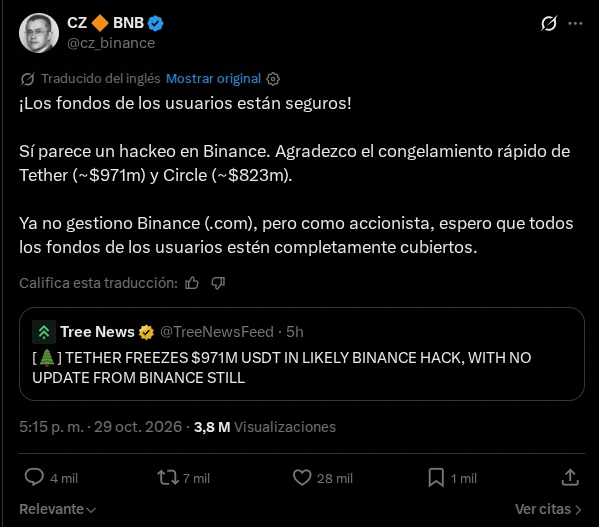
The first public alarm came from analyst Spreek, before any outlet had the story. PeckShield flagged the outflows at 20:55 UTC. Between those two hours, Binance's official account said it was investigating and that it had not confirmed any impact on user funds. Its founder, CZ, went further at 21:15: it looked like a hack and he expected the funds to be covered.
CZ warns on X of a hack at Binance
Twelve minutes, ten wallets and four chains
The scope did not stop at Ethereum. In the twelve minutes following the first sweep, ten more hot wallets distributed outflows to the same address. Binance 55 on Optimism sent 44.2 million OP and four wallets on Arbitrum moved 74.6 million ARB.
Four other wallets on Avalanche withdrew 1.81 million AVAX along with other tokens. Tron and Bitcoin completed the map with 630 and 1,440 million respectively, and none of those networks required a new signature.
That pattern is the signature of an attack with access to the signing layer rather than to a specific wallet. Ten different systems do not get compromised by chance in twelve minutes: they get compromised because they share the infrastructure that authorizes outflows. One hypothesis circulating last night, which philarekt raised, is that part of the movements on Tron were Binance's own. The exchange has not clarified this, so it remains an open question.
The four errors that turned a failure into a catastrophe
The first is architectural. A hot wallet that handles withdrawals should not be able to execute arbitrary code on itself with a single signature. The EIP-7702 delegation was designed for end-user wallets, where the holder is also the signer. In an operating wallet holding balances in the hundreds of millions, it turns any leaked signature into persistent control.
The second is policy. Systems that approve a transfer have something to review: where the money is going, how much is leaving, which token is moving and what hourly limits apply. An EIP-7702 authorization offers almost none of that, barely a chain identifier, contract address and nonce. For a rules engine, that signature is opaque. Blockaid sums it up the same way: there was nothing useful to inspect.
The third is rotation. The nonce spray worked because the wallet kept issuing transactions while the attacker fired fifty signatures blindly. Forty-nine fell flat, and one was enough. Rotating keys in hot mode, with a wallet producing activity, is a race the defender loses if the attacker already has the signatures.
The fourth is scope. The delegation was not limited to the compromised wallet: it inherited its permissions over others. Therein lies the difference between losing a safe and losing the master key to the corridor.
The tally, with the figures Binance has accepted
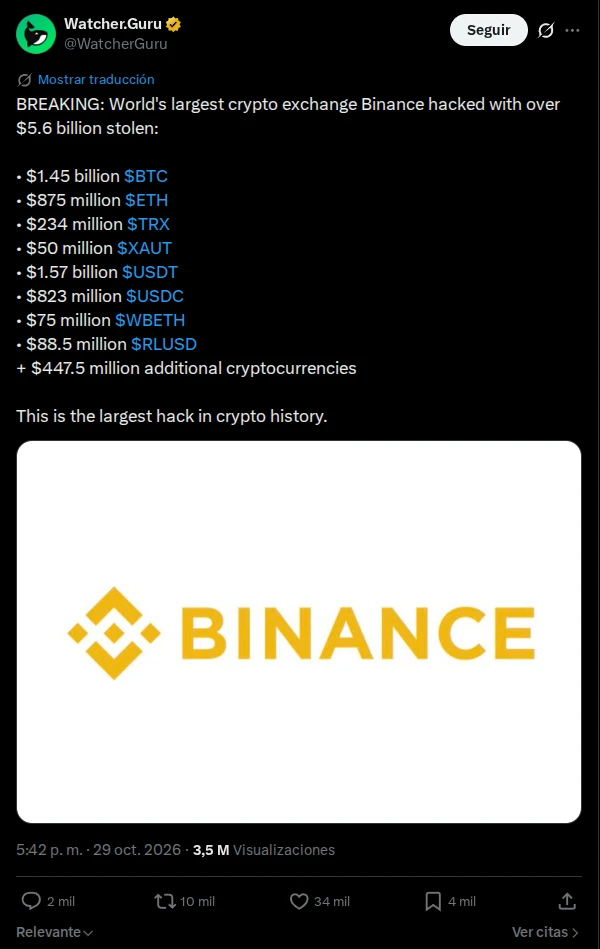
The breakdown by asset that it published Watcher.Guru at 21:42 UTC is the most complete breakdown in circulation, and it matches the holdings Arkham is tracking across 55 addresses labeled as part of the attack. This is the composition:
1.450 billion in bitcoin, 18,270 units
1.570 billion in USDT
875 million in ether
823 million in USDC
234 million in TRX
88.5 million in RLUSD
75 million in wBETH and 50 million in XAUT
447.5 million in other tokens
Watcher.Guru speaks of the hack of Binance and gives amounts
On the freezes, the figure that counts is the official one. At 23:22 UTC Binance corrected the 1.800 billion that had been circulating and set the verified total at 2.540 billion, with a notice that it would rise. Tether contributed 1.567 billion in USDT, Circle 823 million in USDC, Ripple about 200 million in RLUSD according to co-CEO Yi He, and World Liberty Financial 27 million in USD1. Decrypt warns of something that is easily forgotten: freezing is not recovering, and those processes take weeks.
The figure that matters is the subtraction. With 2.540 billion blocked against more than 5.600 billion outside, the gap exceeds 3.000 billion. The first backstop is SAFU, the fund Binance converted last year into 15,000 bitcoins, about 1.000 billion at the current price. For the low scenario it would be enough; for the high one, it would not.
What the market is pricing in this early morning
The price moved before there was any confirmation. Bitcoin lost the 80,000-dollar threshold and is trading below 78,000, with a drop of more than 4% in a single day.
Ether gives up nearly 5% to $2,247 and BNB sheds 7.7% to 694; AAVE, exposed because its markets were used as an exit route, fell 8%. There are two readings that should not be conflated. The first concerns confidence: the punishment meted out to BNB reflects the market pricing in that the world's largest exchange may have a hole of billions of dollars without having said how much. The second concerns safe havens: Hyperliquid rises 9.7% and Monero advanced 6% the previous night, two assets that benefit from money seeking hands outside the compromised system.
And there is the data point that is being cited least. According to the reserves collected by CoinDeskon October 1 Binance held exactly 100% of its clients' ether and 108% of their USDC. The roughly 204,500 ETH taken amount to 5.6% of its ether reserves, leaving backing at around 94%. In ENA, UNI, PEPE and AAVE, the attacker's positions represent between 7% and 15% of what the exchange declared it held of each.
The next 72 hours
The first thing is to reopen. Binance suspended deposits and withdrawals at 00:04 UTC, after having cut only withdrawals at 22:15 and Binance Alpha trading at 23:06. The sequence is that of an operation rotating keys and clearing delegations before letting anything move, and it explains why there is no reopening time: each chain needs its wallets to be reauthorized.
A reopening without a second incident is the only real proof that access is cut off. A statement saying everything is under control is worth little if the first test withdrawal reactivates a delegation that was still live.
The second thing is the report. The promise of a full post-mortem is more demanding than it seems, because it forces an explanation of how fifty valid signatures were obtained. If the answer is a compromised internal system, the problem stops being Binance's: any exchange using the same custody and signing infrastructure has to review its delegation permissions before someone repeats the trick.
Leak or infiltration?
If the answer is a leaked key, the sector has a secrets management problem it has been putting off for years. And it is not fixed with a press release, but with key inventory, scheduled rotation and signing limits that can be verified from outside.
The third is the regulator. A theft of this size in the jurisdiction that hosts the world's largest exchange opens the door to specific demands: reserve audits more frequent than quarterly, exposure limits per hot wallet and blocking protocols coordinated with issuers. MiCA already requires client funds to be segregated. What this case shows is that keeping funds segregated is useless if the key that moves them sits in the same place as everything else.
The fourth is the money left free. The more than 3,000 million not frozen is in bitcoin, ether and stablecoins that have already jumped to later addresses. The route looks like the usual one: stablecoins to ether on Uniswap, ether borrowed against collateral on Aave, and from there to mixers or bridges.
Aave froze its V3 markets on Ethereum and Kamino paused its own on Solana. They are two defensive decisions, and both point to the same thing: the protocols assume the attacker is still looking for exits and that the window has not closed.
A permission that is still granted
The uncomfortable part of the case is that the vector was not exotic. Not a contract with a subtle bug, not a badly designed bridge, not a manipulated oracle. It was a signature. The industry has spent a decade strengthening the blockchain and very little time strengthening the authorization chain behind it, the one that decides what a machine can sign and what it cannot.
EIP-7702 arrived to make user wallets more convenient, with transaction aggregation and gas payment by third parties. In a hot wallet it became a permanent permission that nobody supervised. The next logical step is for signing systems to learn to inspect that type of authorization and reject it when it comes from an operational wallet, and for exchange wallets to no longer be able to delegate code to themselves.
Until that happens, the promise to cover all losses solves the problem for Binance's clients and leaves everyone else's untouched. Any exchange with hot wallets, broad permissions and a signing policy that does not understand the new types of authorization has the same hole, with or without a hack.