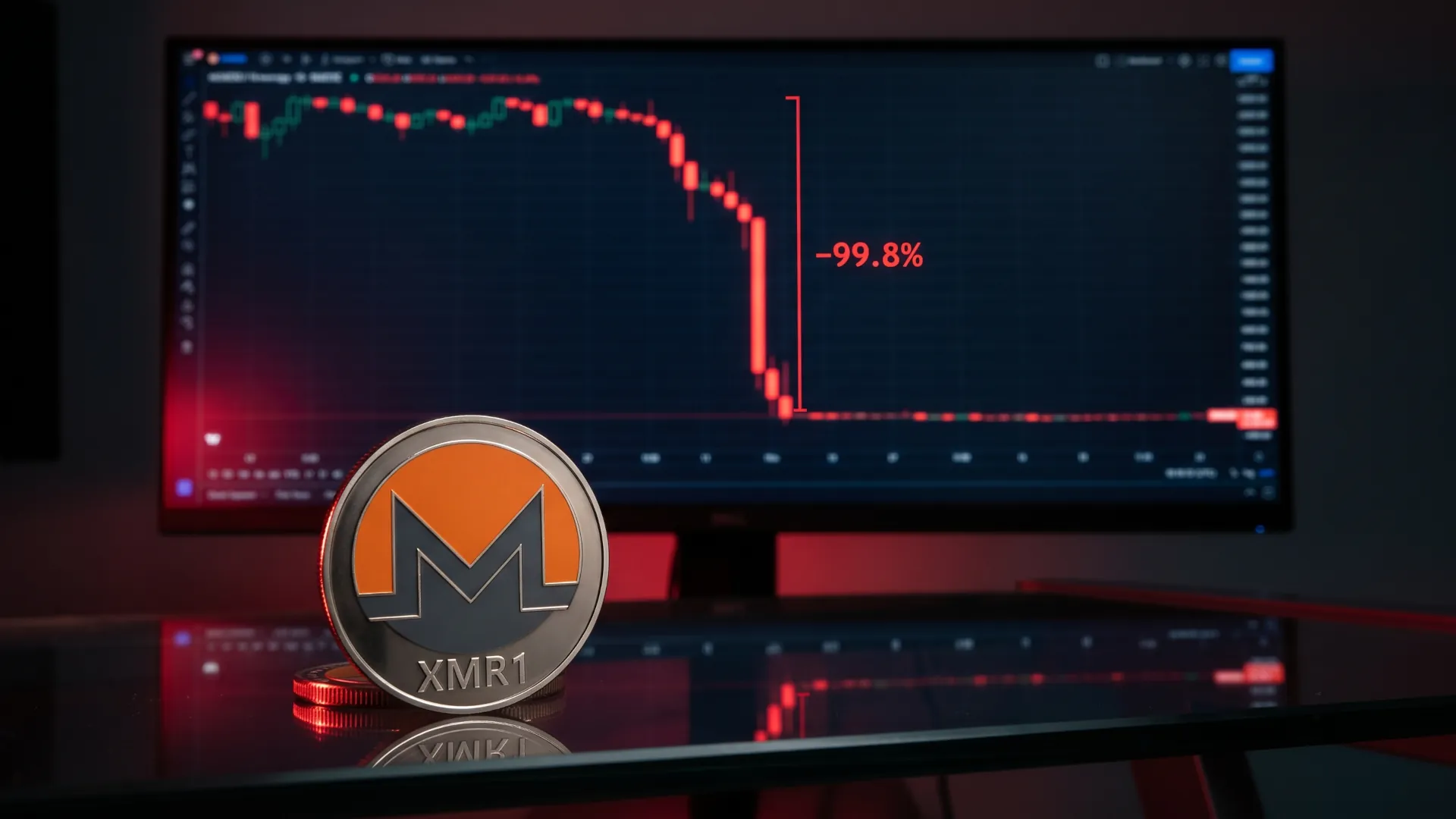
XMR1, the token representing Monero within Hyperliquid, went from trading near $500 to around $1 in half an hour. It happened on Friday, November 20, between 04:49 and 07:42 UTC, when a newly created wallet sold 363,804 tokens to 388 accounts for $13.5 million, according to the trail reconstructed by data firm Bitquery. The low reached $0.65.
The token belongs to Wagyu, a cross-chain exchange service that lets users deposit Monero and receive XMR1 to trade on Hyperliquid, then convert it back. Monero runs on its own chain and cannot be traded natively on that market, so the wrapped token is the only route. Native Monero was not affected by what happened, and XMR futures on Hyperliquid remained near $482 after the wrapped token's collapse.
The operator's explanation came the same day and points off-chain. The pseudonymous founder, PerpetualCow, attributed the incident to a breach at 1984.hosting, the Icelandic provider where the server holding the deploy key was hosted. According to his account, he had deleted that server, but the provider retained the files and logs. The Icelandic company and the national response team, CERT-IS, confirmed a serious attack and suspended all services.
The on-chain sequence is precise and does not depend on the founder's account. The account that deployed the token sent 5.2 million XMR1 to a new wallet in three transfers early on Friday. That wallet began selling against the buy orders already placed in the book near the previous price, and 76% of the proceeds came in during the first eleven minutes.
The detail that explains the size of the loss is the depth of the book. A single account paid $3.56 million filling orders waiting at $500, and the 388 buyers did not know the seller had 5.2 million tokens available. By 08:00 UTC, the wallet had sold only 7% of what it received and around 315,000 units remained for sale, almost all at $1.
| Data point |
Figure |
| Price drop |
From about $500 to near $1, 99.8% |
| Tokens sent to the attacker's wallet |
5.2 million |
| Tokens sold |
363,804 between 04:49 and 07:42 UTC |
| Buyers |
388 accounts |
| Proceeds |
$13.5 million |
| Largest individual buyer |
$3.56 million in orders placed at the previous price |
The outcome for the buyer was the worst possible. Whoever paid $3.56 million for tokens now worth $1 holds a position that cannot be redeemed at the price paid, and the operator said those affected would be reimbursed. PerpetualCow maintained that customers who used Wagyu to swap tokens lost nothing and that the blow fell on the market makers who kept buying during the drop.
Tornado Cash, 7,348 ether and a trail that identifies no one
The funds took a familiar path. Bitquery tracked $13.22 million in USDC converted into 7,467 ether, and at the close of its analysis counted 7,348 ETH spread across three Ethereum and Arbitrum wallets, with 4,836 in the largest. The attacker's account received its first funding from the Tornado Cash mixer minutes before it was created, a pattern that in previous investigations has served to complicate traceability.
There is a limit worth stressing because it separates analysis from narrative. The chain shows which account sent the tokens and when, but it does not prove who used the key or how they obtained it. Bitquery said so explicitly, and that caution makes sense: between the attack on the hosting provider and the sale there is a chain of custody that only the hosting logs could close, and those logs are now in the hands of an ongoing investigation.
The same deployer account still controls 99.97% of ZEC1, the wrapped Zcash token that Wagyu issues with the same mechanism. That figure, which Bitquery verified when reviewing balances, is the most uncomfortable part of the incident: the system that failed once is still standing for another asset, and the operator announced a relaunch for the first with no date.
The key was on a server its owner had deleted
The infrastructure lesson is the one that will be repeated most in the coming weeks, and also the simplest to understand. The founder explained that the deploy key was on an old server he had deleted, and that the provider retained the files and logs after the deletion. His conclusion, written on X, was that hosting providers keep data even when the customer believes it no longer exists.
That behavior is not an anomaly: backups, retired disks and access logs survive logical deletion by design. Any key that has passed through a rented server must be considered compromised once that server is no longer under control, and rotation is not an option, it is the only way out. In the case of a contract deployed on a chain, even that is not enough if the account that can issue tokens retains privileges.
The other half of the problem is the trust placed in a wrapped token. Wagyu published its terms on November 12, with a minimum of 0.01 XMR in both directions, free deposits and a 2% fee on withdrawals, and had already reported a different data leak in October. A small service that holds custody of the backing for a private asset concentrates a risk that does not show up in the price until it appears all at once.
What backs the XMR1 that remains?
The question no one can answer with public data is how much Monero sits behind the tokens still in circulation. Bitquery warned that it cannot verify that backing because the Monero side of the bridge is not visible from Hyperliquid, and that opacity is a feature of the design, not a flaw in the analysis.
With the token at $1 and native Monero at $482, the gap measures the market's distrust of redemption. Neither party has published a proof of reserves, and the operator has not detailed how much Monero remains deposited in the bridge or what will happen to the tokens still circulating. Anyone holding XMR1 can try to redeem it in the bridge and trust the operator to honor it, or sell at the market price and accept the loss. The recent history of Hyperliquid and the accounts flagged after the Binance theft shows that this market has already been the scene of disputes over who is responsible when something breaks.
What changes for wrapped tokens
The practical consequence for the rest of the sector is a reassessment of assumptions. A wrapped token promises that an asset exists behind it and that someone can return it, and both promises depend on a key, a server and a person. When all three fail at once within half an hour, the market discovers that the price did not factor in that risk.
Wagyu promised individual reimbursements and a later relaunch, with no dates or instructions for claiming. Until that materializes, the episode leaves a better question than Friday's: how many other wrapped tokens keep their issuance key on a rented server that someone believes they deleted. The answer is not on the chain, and that is why no one has published it.