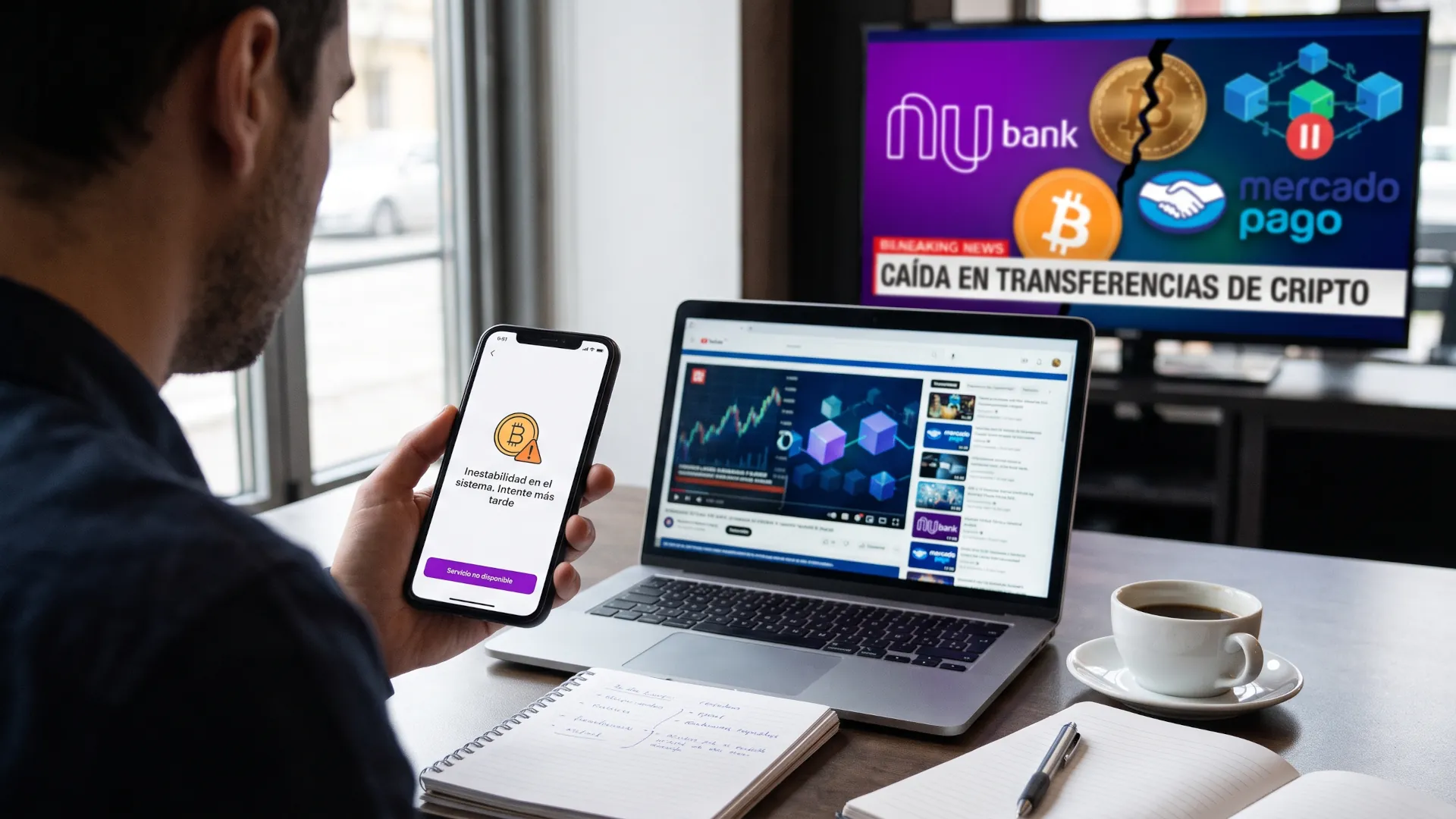
Two of Latin America's largest fintechs cut cryptocurrency transfers on Friday morning almost simultaneously. Nubank and Mercado Pago notified their customers that digital assets could not be sent due to system instability, and both kept their other products unchanged. The episode lasted hours and left a question no one has answered with names and surnames: which piece of the shared infrastructure failed.
Nubank was explicit about one thing. It said the incident is not due to its own infrastructure and does not compromise customer security, with assets and information protected. Mercado Pago limited itself to showing an instability message in the app, without detailing origin or scope.
What links the two platforms is a provider. Nubank signed an agreement with Paxos in 2022 for its cryptoassets service, and the same company is the blockchain infrastructure for Mercado Pago, the digital bank of the Mercado Libre group. Reuters tried to contact Paxos on Friday and got no immediate response, a silence that lasted longer than the service outage itself and left the two brands facing the music alone.
Nubank's statement has three parts that should be read separately. The first is the cause: an incident outside its infrastructure. The second is the scope: crypto transfers down, the rest of the products operational. The third is the promise: neither assets nor data compromised. All three are verifiable, and only the last depends on the bank's word.
Mercado Pago did not publish an equivalent text. Its notice appeared in the app itself, with the system instability formula and no mention of the provider. For the user, the difference between a technical explanation and an on-screen message is the difference between understanding what happened and waiting for it to be fixed.
Neither of them spoke of a cyberattack. That matters because the public conversation jumped straight to that hypothesis, and the available sources do not support it. An instability can be a deployment failure, a liquidity problem, an overload or a security incident; without detail, all of them fit.
The market crash that same week adds context. With bitcoin losing the 76,000 dollar mark and billions in liquidations, a platform that cannot process transfers becomes a problem for anyone trying to hedge positions.
Paxos, the provider they share
Paxos is one of the companies behind the stablecoin market and institutional custody. It issues regulated dollar assets and provides the infrastructure for other brands to offer crypto without building their own system. Nubank chose it in 2022 for its service, and Mercado Pago uses it for the blockchain side.
That model has an obvious advantage: it allows a fintech to launch a product in months without assembling a custody team. And it has an equally obvious risk: if the provider fails, the failure shows up on the fintech's customer's screen, not the provider's. The brand the user sees is the one that gets the complaints.
Friday's episode is the cleanest demonstration of that risk in the region. Two competing companies, with different products and millions of users, went down at the same time because they share the same piece. Provider concentration is already being discussed in Europe with stablecoins and in the United States with custody; in Latin America it has just had its first visible test.
There is a detail that should not be exaggerated: sharing a provider does not mean sharing the failure. It is possible that both platforms reacted to the same signal without Paxos being the origin. What cannot be denied is the coincidence in timing and the coincidence in dependency.
An outage Latin America notices
For a European user, being unable to send crypto for a few hours is an annoyance. For a user in Argentina, Venezuela or Colombia, the same outage can affect the way they get paid, save or send money to their family. Dollar stablecoins have become a daily-use tool in the region, not a weekend investment.
That context explains how quickly the topic moved on social media. Nubank and Mercado Pago are not niche exchanges: they are the apps through which millions of people manage their money. When one of them says it cannot move digital assets, the conversation stops being about technology and becomes about trust.
The dependency is not symmetrical either. Nubank has spent years building a crypto investment product with external custody, while Mercado Pago integrates the blockchain side into an app that is also used to pay at the supermarket. The first can afford to say "incident"; the second has to explain why the merchant checkout still works and the transfer does not.
That difference explains why Nubank's statement was so careful. An entity that holds third-party assets cannot afford to sound ambiguous: every sentence is read as a potential admission. The fintech chose three verifiable claims and left out everything else, including any reference to the provider they share.
It also explains why Paxos's silence weighs so heavily. A provider serving several brands has to give explanations to all of them at once, and that takes time. While that time passes, every customer of every brand is assessing whether their money is where they think it is.
What to check if you are caught with funds inside?
The first check is to separate balance from availability. The app showing a balance does not mean you can move it, and in episodes like this it is worth taking a screenshot with date and time in case you later need to file a claim.
The second is to look at whether the affected product is a transfer between users, a withdrawal to an external wallet or an internal conversion. Nubank said the rest of its crypto products remained operational, and that distinction changes what you can do while you wait.
The third is not to improvise an emergency move. Moving funds to an alternative platform during a shared outage can carry the problem from one provider to another, especially if the destination uses the same infrastructure. The freezing of 2.6 billion by Circle and Tether was a reminder that the ability to block a balance does not depend only on the platform that displays it, and that the token issuer has the final say.
The fourth is to save the platform's message and the identifier of the failed transaction. In an incident lasting hours, most problems resolve themselves; in one lasting days, the difference between a refund and a lost complaint usually lies in the trace the user kept.
There is a fifth check that almost no one does and that is useful for next time: look at who the custodian is in the product terms. If the app says the assets are held by a third party, that third party is the one that decides when a transfer resumes, and knowing its name saves hours of uncertainty when the service goes down.
There remains the underlying lesson, which is not new but is more costly in this region. The convenience of a fintech offering crypto in one click rests on a chain of providers that the customer does not choose and does not see. Knowing who occupies the critical link is part of understanding where your money is, and this time the link had the same name for two competitors.