In 2026, tokenization has ceased to be a technological promise and become a real engine of the capital markets. The definitive signal came when BlackRock decided not to create a closed private network, but to launch its BUIDL fund directly on the public Ethereum network, validating it as the global settlement infrastructure. With more than $2 billion already managed in this fund, Larry Fink has made it clear that the financial future does not lie in walled gardens owned by a single bank, but in shared, transparent rails.
However, this openness poses a security and compliance challenge that only open standards such as ERC-3643 can solve. For Europe, it is a question of strategic autonomy. Either it leads the creation of these standards on public networks, or it will be held hostage by external infrastructures.
Today, the global financial system is immersed in a structural transformation focused on redefining the very nature of ownership, liquidity and regulatory compliance, driven by the tokenization of real-world assets (RWA).
The RWA sector has already reached a market value of more than $360 billion, according to data from RWA.xyz. But despite this enormous success, the sustainability of this ecosystem and its ability to integrate with traditional capital markets depend on two fundamental pillars: the adoption of open standards and the implementation of open source software.
The tokenized asset market has grown more than 240-fold between 2020 and 2025. This phenomenon is driven, above all, by massive institutional demand for yield, transparency and balance sheet efficiency. Thus, US Treasury bonds, for example, have consolidated as the most immediate growth vector, with funds such as BlackRock's BUIDL, attracting billions in conservative capital seeking safe digital collateral.
This growth, while impressive, carries the risk of creating fragmented ecosystems if each institution develops its own closed technology. The efficiency of near-instant settlement and the reduction of barriers to entry can only be fully realized if there is a common language that allows an asset issued on one network to be recognized, held in custody and traded on any other platform without technical or legal friction.
Ethereum's roadmap to survive the post-quantum era
Open standards: the ERC-3643 protocol and on-chain identity
Standardization is the process that transforms an experimental technology into critical infrastructure. For example, in the Ethereum ecosystem, the ERC-20 standard laid the foundations of fungibility, but its inability to integrate native compliance controls makes it insufficient for regulated markets. This is where the ERC-3643, also known as the T-REX protocol, positions itself as the global reference for the tokenization of securities and permissioned assets.
ERC-3643 is not simply a token format; it is a complete suite of smart contracts that integrate a decentralized identity layer called ONCHAINID. Unlike other standards that rely on external or off-chain validations for each transfer, ERC-3643 keeps the entire verification loop on-chain.
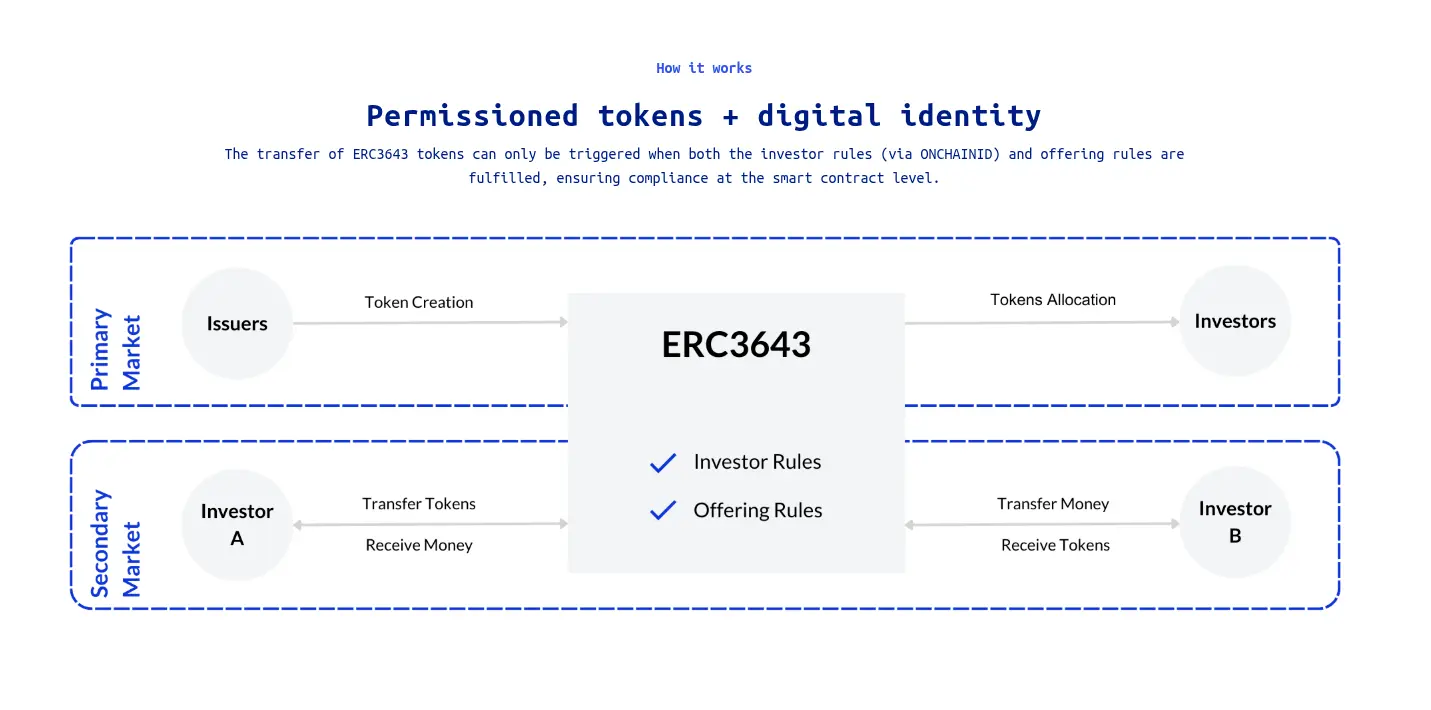
This allows compliance (KYC/AML) to be an intrinsic property of the asset. Before a transfer is executed, the smart contract automatically verifies that both the sender and the recipient hold the necessary credentials in their respective identity contracts, ensuring that the asset never ends up in the hands of an unauthorized or sanctioned entity.
The transition of ERC-3643 toward international standardization through technical committee ISO TC 307 represents a fundamental milestone that is expected to be reached in 2026. By becoming an ISO standard, the protocol ceases to be a technical specification from a developer community and becomes an international financial standard recognized by regulators and central banks. This backing eliminates legal uncertainty for issuers and gives investors certainty that digital assets meet the security and governance levels required in traditional financial markets.
UK suspends political donations in cryptocurrencies over opacity risk
Free software: a guarantee of transparency and auditable security
The second pillar of robust tokenization is the use of free and open source software (FOSS). In an environment where tokens represent legal rights over multi-billion-dollar assets, the opacity of proprietary software constitutes an unacceptable systemic risk. Open source allows any actor, from regulators to independent auditors, to inspect the system's logic to verify that there are no vulnerabilities, backdoors or manipulation mechanisms.
Security in the field of tokenization is not achieved through secrecy, but through public scrutiny. The so-called Linus's Law states that, with a sufficient number of observers, all software bugs are identifiable. In proprietary systems, a vulnerability can remain hidden for years, known only to the vendor and, potentially, to malicious attackers.
By contrast, open source projects such as Hyperledger Besu or the Ethereum ecosystem benefit from the constant contributions and audits of a global community of developers, which makes them intrinsically more resistant to attacks and technical failures.
The end of vendor lock-in risk
One of the greatest dangers for financial institutions adopting digital infrastructures is vendor lock-in. When a tokenization platform is built on proprietary software, the institution loses control over its own operating infrastructure. If the vendor decides to raise fees, changes its technical roadmap unfavorably or ceases operations, the institution faces astronomical migration costs and the possible interruption of its financial services.
In this case, free software guarantees technological sovereignty. By using open source-based solutions, companies and public administrations can contract support from various vendors or even develop in-house capabilities to manage their own infrastructure. This fosters a competitive market where vendors must earn their value through service quality and not through the technological capture of their clients.
Bitpanda launches a blockchain to integrate banking, DeFi and the euro in Europe
Digital sovereignty and the global commons in finance
Moreover, the importance of free software transcends operational efficiency and enters the realm of geopolitics. In an increasingly fragmented world, dependence on digital infrastructures controlled by foreign powers represents a vulnerability for national autonomy. Open source works as a global commons, a technological lifeblood that allows regions such as the European Union to build their own digital financial systems without being subject to extraterritorial laws or unilateral commercial decisions by external technology giants.
The ability to control the hardware and software in which national wealth resides is the core of banking digital sovereignty. Central banks and systemic entities require systems that no one outside their jurisdiction can shut down or censor. The use of open standards and free software ensures that tokenization infrastructures are resilient to geopolitical shocks, since the knowledge and code needed to operate them are universally accessible and not subject to restrictive licenses or commercial blockades.
The path toward a resilient and open financial system
Finally, asset tokenization represents the greatest financial modernization opportunity of our generation, but its success depends on not repeating the mistakes of opacity and dependence of the past. Building on the pillars of open standards such as ERC-3643 and free software is not an optional choice, but the only viable path to create a financial infrastructure that is simultaneously secure, efficient and sovereign.
Morgan Stanley finalizes the launch of the first Bitcoin ETF from a major bank
The architecture of trust that emerges from these principles ensures that regulatory compliance is automatic and verifiable, that custody is impregnable thanks to the transparency of hardware and software, and that the market is truly global and interoperable. For financial institutions, regulators and content developers, the message is clear: openness is the foundation of stability and sustainable innovation in the new era of digital assets.
However, the success of this ecosystem is not without challenges. As we move through 2026, the major outstanding task remains full interoperability. That is, that an RWA issued on a public network such as Ethereum can interact without friction with the private networks of central banks.