Ethereum has begun one of the most ambitious technological transformations in its history in order to prepare for the arrival of quantum computing, a scenario that, although still distant, will completely redefine digital security. This new technological paradigm has the potential to break the cryptographic systems on which not only blockchains but practically the entire internet depend. Faced with this possibility, Ethereum has decided to get ahead of it with a long-term strategy.
Roadmap
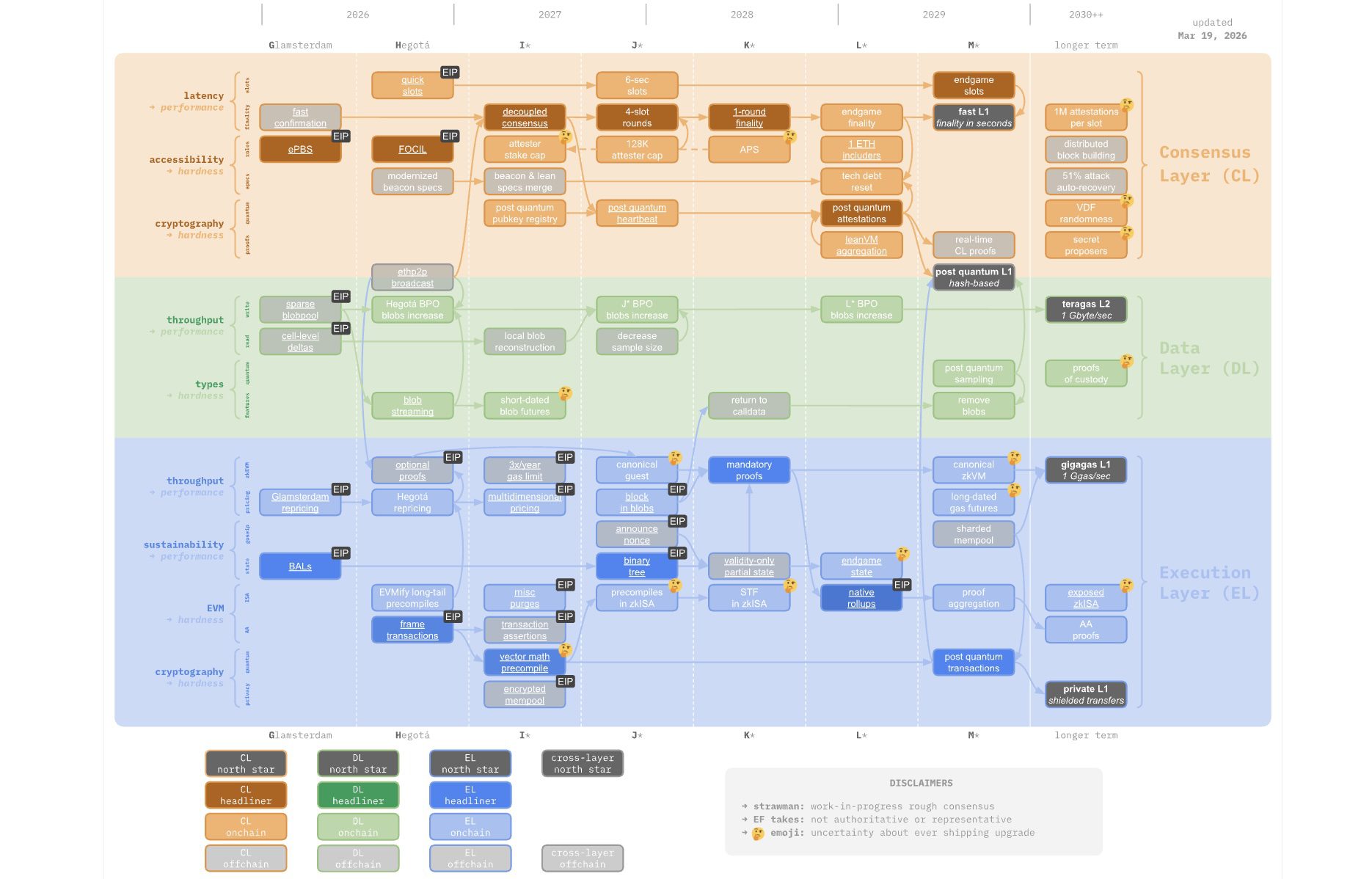
The central pillar of this preparation is what is known as crypto agility, an approach intended to allow the protocol to adapt over time without the need for abrupt changes. Instead of relying on a single security system, Ethereum is being redesigned so that its cryptographic algorithms can be upgraded progressively and in a coordinated way. This is especially important in a decentralized network, where any change requires global consensus and extremely careful implementation so as not to compromise stability.
Gradual migration
Unlike other upgrades, the transition to a post-quantum Ethereum is not limited to a single part of the system, but involves a complete transformation of its architecture. At the execution layer, the goal is to allow users to adopt new forms of authentication resistant to quantum attacks through mechanisms such as account abstraction. This will facilitate a gradual migration, in which each user can decide when and how to upgrade their security without affecting the overall operation of the network.
The people leading Ethereum's post-quantum transition
At the same time, the consensus layer, responsible for validating blocks and maintaining the integrity of the system, is also being redesigned. Ethereum plans to replace its current signature scheme with post-quantum, hash-based alternatives that offer greater resistance to quantum attacks. However, these new signatures present challenges such as larger size and lower efficiency. To solve this, advanced solutions are being developed that combine cryptographic proofs such as SNARKs with new tools such as a lightweight virtual machine, known as leanVM, capable of optimizing processing without sacrificing security.
Protecting data
The data layer is not left out of this transformation either. In a post-quantum context, guaranteeing the availability and integrity of large volumes of information will be key. Ethereum is exploring new ways to protect this data, especially in handling structures such as blobs, which are fundamental to the scalability of the network.
One of the most relevant aspects of this strategy is that it is not an immediate change, but a carefully planned migration that will unfold over years. The roadmap envisages different phases, from the introduction of post-quantum keys and signatures to the implementation of a consensus fully adapted to this new environment. This gradual approach minimizes risks and ensures that each stage is tested, audited and validated by the community.
An opportunity to strengthen its infrastructure
Moreover, all this work is being developed as an open source public good, in line with Ethereum's core principles. The Ethereum Foundation coordinates research and development, but final decisions are made through open governance processes involving developers, researchers and community members from around the world. This global collaboration is essential to tackle a challenge of this magnitude.
Beyond the threat posed by quantum computing, Ethereum has turned this transition into an opportunity to strengthen its infrastructure, improving key issues such as security, protocol simplicity and decentralization.