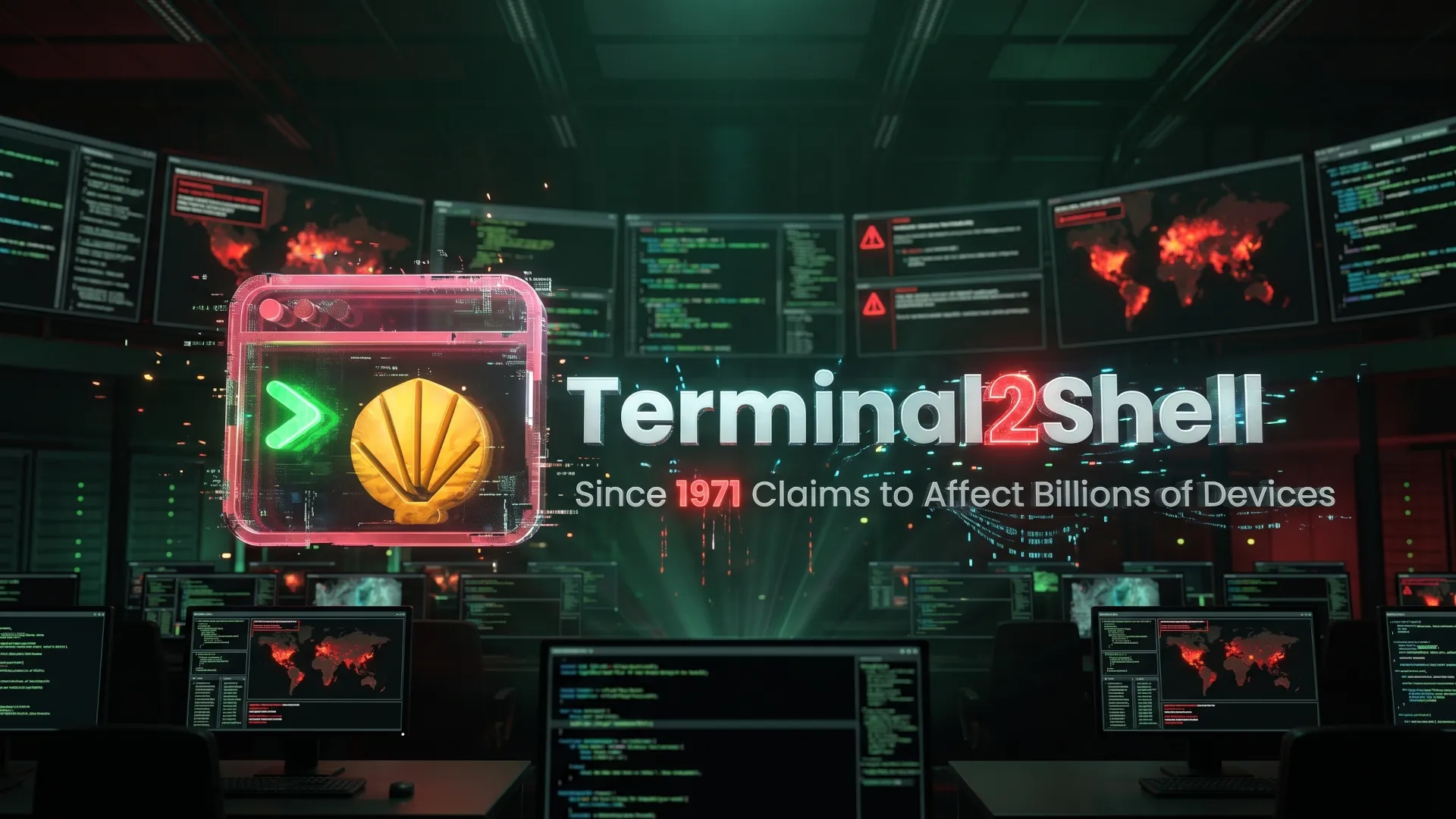
Any unsuspecting reader who opens terminal2shell.com these days finds a notice in red capitals: active exploitation, some two billion devices affected and no patch available. Below, a list of vulnerable systems that includes macOS, all Linux distributions, Windows, FreeBSD, the 1978 VT100 and the router's console port. And one exception: Microsoft Paint is not affected.
There is no CVE-2026 vulnerability behind that page. What there is is a well-built satire of how the sector names, documents and sells security flaws, and it works because the reader recognizes the format before reading the joke. The page admits it in the timeline section: in 2026 researchers notified all manufacturers and "the manufacturers responded that that is what a terminal does."
The text describes the "vulnerability" with bureaucratic precision: when a terminal is opened, a shell process is launched connected directly to the keyboard, and from there the attacker can send commands with the user's privileges. The exploitation steps are two, and the second does not exist: opening a terminal is the whole exploit, and the attacker's keyboard is the same as the victim's. The rest of the page keeps the register with a seriousness that makes the joke more effective.
A simple joke, to hit the ecosystem
The humor rests on a real detail of the ecosystem. The family of flaws named with the *2Shell suffix (Node2Shell, PHP2Shell, Plex2Shell, Able2Shell) has a common feature that almost no one highlights: all published proofs of concept start with someone opening a terminal and typing a command. This week's cases confirm it: SSHole in OpenSSH, Plex2Shell in QNAP NAS and PHP2Shell with Fragnesia.
terminal2shell turns that coincidence into a premise. If all the exploits in the family depend on the researcher having a shell, then the shell is the flaw, and the others are variations of the same precondition. The page says it with the straight face of an impact report: "it is the vulnerability beneath the vulnerabilities and the only one that comes with a free shell before the attack begins."
The timeline of the joke runs through the history of Unix to deliver the punchline. In 1971 the vulnerable code ships in version 1 with Thompson's shell. In 1979 Bourne's shell arrives and keeps the problem for compatibility. In 1989 Bash appears and the name, the page says, confirms that the attack is intentional.
The mitigations that don't exist
The compensating controls section is the sharpest part of the site. Not opening terminals is the most effective, although it warns that many developers open terminals "for work," something security teams should consider a red flag. Closing the terminal right after opening it is a partial mitigation: reopening it reintroduces the vulnerability, and the page acknowledges it with the same feigned seriousness as the rest.
The others follow the same register. Typing more slowly reduces commands per minute and therefore the attack's throughput. Removing the keyboard is effective, but the on-screen keyboard is a known bypass. Setting `SHELL=/bin/false` remedies the problem completely and also the ability to use the computer.
That last line is what explains why the text works as criticism and not just as a joke. By-the-book security that requires disabling functionality to eliminate the risk produces absurd recommendations when the risk is the system's own operation.
A sector that is crowded with problems
The satire hits because the ground is fertile. In 2026 so many critical flaws were published with their own name and logo that the brand stopped distinguishing the serious from the routine: a new domain, a logo and a name ending in a number and a noun no longer communicate urgency, they communicate campaign.
The disclosure format has become a marketing exercise. A researcher who registers a domain before notifying the manufacturers gets coverage, and a company that publishes its own *2Shell gets the conversation to revolve around its product. The page laughs at that with a phrase that sums up the mechanism: "every serious zero-day needs a logo, a domain and a name ending in a number followed by a noun."
There is also a less comfortable reading. The joke works because the reader, technical or not, already knows that many of those advisories exaggerate the real impact to get attention, and because the volume of patches generated by automated flaw detection has made it hard to distinguish a relevant finding from well-presented noise.
So the message is clear: if every *2Shell flaw detected so far starts in the shell/terminal, perhaps it is time to stop using it, although if you tell that to your boss, you will surely end up unemployed, or worse, with an AI doing your job, and keeping the channel open for new vulnerabilities in the future.