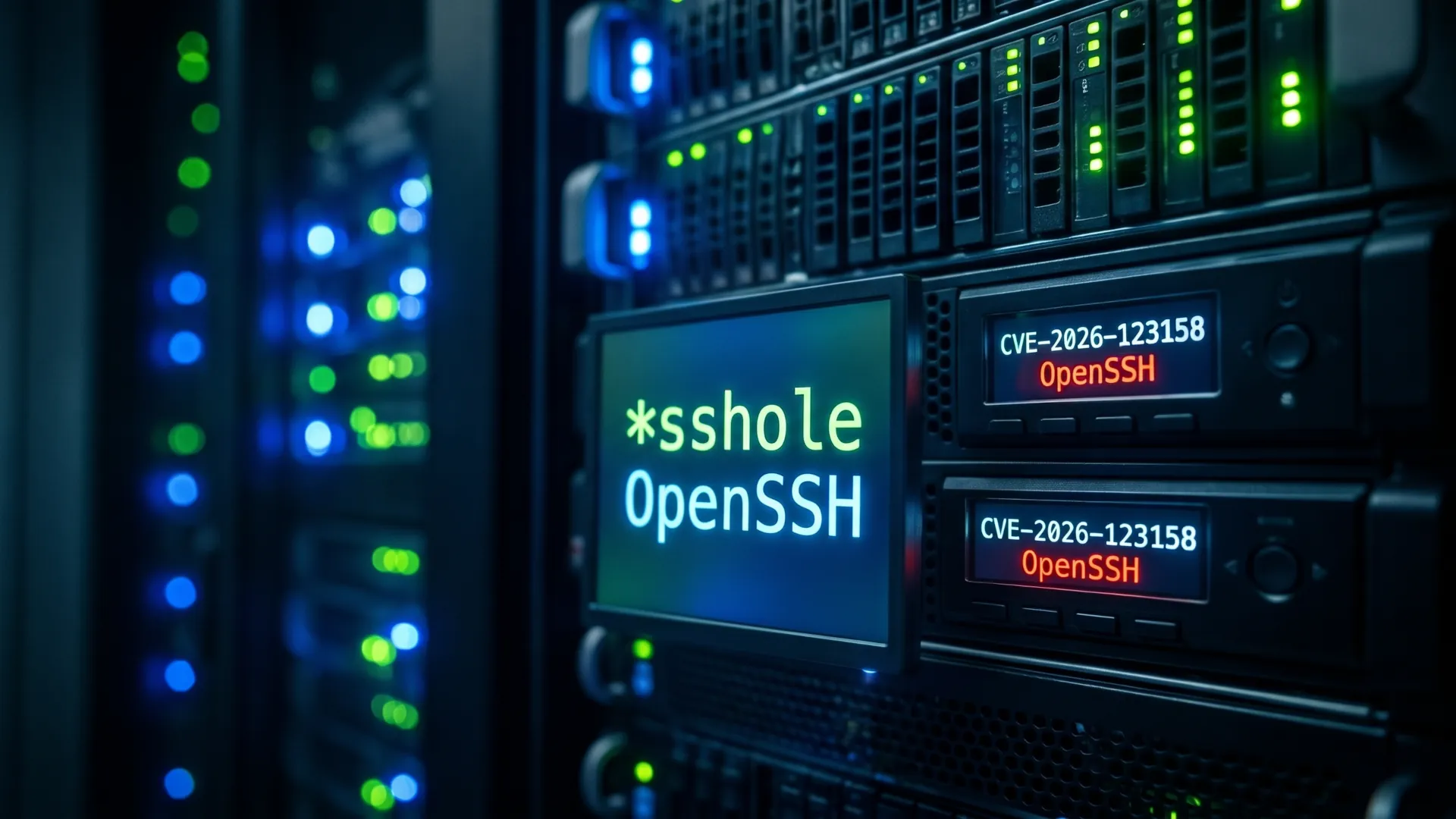
An Alpine server with OpenSSH by default and password authentication enabled accepts entry to any account without a password if the attacker sends a string of 257 characters or more. There is no need to know the username and password, nothing has to be guessed and there is no limit on attempts: one connection is enough. That is basically what the advisory says CVE-2026-123158 and scores 8.1 out of 10. OpenSSH released the patch on November 5 with version 10.6p2.
The flaw is not in sshd. It is in how the musl library returns an error from crypt() when the key exceeds 256 bytes: it responds with an asterisk, and that asterisk is exactly what /etc/shadow stores for accounts that have no password. OpenSSH compares the result with the stored field, both are *, and authentication passes. A single user with a real password on the machine is enough for all the others to become reachable.
The practical consequence is that the patch does not end with updating the package. Alpine published fixed versions for all its branches and warned that the running daemon remains vulnerable until it is restarted, something that does not happen on its own in a container or on a server that is only accessed via SSH. Alpine's advisory of November 5 says it clearly: update and restart, or disable password access in the meantime.
What exactly fails in musl and sshd?
When sshd is compiled without PAM (a security module on Linux), it checks a password by applying crypt() and comparing the result with the field of /etc/shadowFor accounts without a password, that field is a *, a string too short to contain a salt, so sshd takes the salt from another account on the machine and carries on.
That logic assumes that crypt() fails with a value that will never match a real hash, and that is where musl breaks the premise. With a key longer than 256 bytes it returns `` as an error indicator, sshd compares it with * and accepts.
The OpenSSH 10.6p2 announcement, signed by Damien Miller, placed the cause outside sshd even though the exploitation goes through it. That nuance matters for anyone who has to decide what to patch: the Alpine packages and openssh-server without PAM are the affected ones, not the distributions with glibc nor the installations with PAM active.
The origin of the exposure
The list of conditions is short, and all four must be met at the same time. Alpine with its usual openssh-server package, which runs without PAM. PasswordAuthentication yes, which is the default value if no one changed it. An account with * in /etc/shadow, which since Alpine 3.16 includes root in the base image. And another account with a hash $5$ or $6$ in the same file.
There are more systems running musl in production than the public conversation suggests: OpenWrt, Buildroot, Yocto and a good part of minimalist container images share the library. The SecurityWeek analysis lists those names and the detail that is most uncomfortable: accounts created with `adduser` without a password, users who arrive through a directory service with musl-nscd and the user alpine of the tiny-cloud images fall into the reachable category.
Excluded are machines with PasswordAuthentication nothe locked accounts and servers where no account has a hash. In practice, a server that is accessed only with a key and has no user with a password cannot be exploited this way, and that is the state any internet-facing machine should have been in for years.
What to do today, and in what order?
The first step is to update and restart. Alpine left patched packages in 3.21.10, 3.22.8, 3.23.8 and 3.24.4, with the versions of openssh that accompany each branch, from 9.9_p2-r1 in 3.21 to 10.6_p2-r0 in edge. The detail that gets overlooked is restarting the service: apk upgrade -U -a, replaces the binary, not the process that is listening.
The second step is to close the door while the update propagates. Setting PasswordAuthentication no in the sshd configuration and restarting solves the problem without touching the binary, provided it has first been verified that key-based login works and that the open session is still alive. Alpine recommends creating a file in /etc/ssh/sshd_config.d/ so as not to edit the original by hand.
The mistake to avoid is the usual one: applying the patch on the test server and leaving it pending on the production one because restarting sshd cuts the session. A sshd -t before the restart, and a second session open in parallel, prevent the awkward conversation with the team that gets locked out.
OpenSSH broke its own embargo
Miller explained the haste in the announcement: they learned of the problem the day before and decided to publish immediately because they have seen several cases of rapid rediscovery by AI agents, sometimes within hours.
For years the embargo has been the norm in security, and the argument for shortening it is that a flaw that can be found again with a model is not protected by silence.
That decision comes at a cost for those who administer systems. A patch published without a coordinated window leaves distributions scrambling to compile, scanners without a signature and teams without time to test. The CVE-2026-98432 in the kernel took the opposite path and served to show what happens when the patch arrives late: three weeks later, Ubuntu and RHEL still had no published fix.
The result this time is that the window between publication and exploitation was a matter of hours. Previdian recorded the first attempt less than nine hours after the CVE was assigned, with eight attempts from a single IP geolocated in Japan and root access confirmed on a honeypot running Alpine. This is not a campaign: it is someone reading the advisory and trying.
What to check if the server was exposed
Detection is simpler than in other incidents because sshd itself leaves a trace. Any line Accepted password for on an account that has no password is a red flag: users such as root with PermitRootLogin prohibit-password, accounts created to log in only with a key or the user alpine of the images in the cloud should never appear in that log.
If the server was exposed and there is no way to rule out an entry, Alpine's criterion is blunt: treat it as compromised. That means reviewing new authorized keys, users created during the window, use of doas and any process that cannot be explained, before trusting the machine again. The procedure for reading a CVE on the site itself serves as a reminder: the score does not tell you whether it affects you, the conditions do.
The lesson from this case is uncomfortable and has little that is new about it. Two libraries that did what their documentation promises, combined, turned the * of accounts without passwords into a valid credential. The flaw went eleven years without anyone seeing it, just as the Brotli that opened Node2Shell had been in the decoder no one looked at for years.
What does change is the speed. An authentication flaw in the server that manages access to a large part of Europe's infrastructure was found, patched and exploited in less than a week, and the advisory was written on the assumption that a model would find it again before a human would. For anyone administering systems, the practical conclusion fits in one sentence: the SSH password stopped being a convenience and became a surface that has to be shut down.