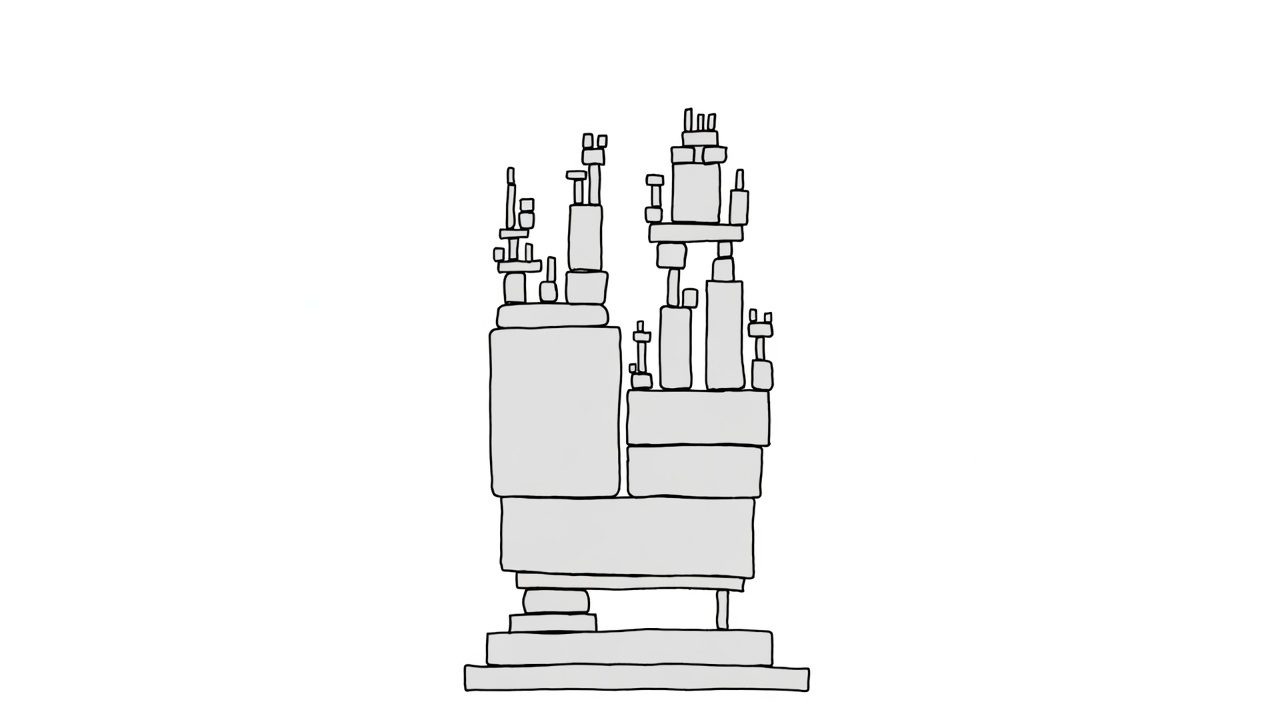
There is a very famous drawing on the internet, number 2347 in the popular webcomic xkcd, titled Dependency. It was created by the American illustrator and engineer Randall Munroe, a former NASA programmer, and it sums up the true nature of the 21st century better than any economics treatise or engineering manual.
In the panel you see a colossal structure, a vertical labyrinth of geometric blocks, passageways and gears rising like an immense, heavy tower of Jenga. It represents modern digital infrastructure. The invisible framework on which global commerce, communications, hospitals, satellites and the planet's economy rest. Yet when you look down at the base of that titanic tower, you discover that the whole structure does not rest on concrete foundations or on the pillars of a Silicon Valley multinational. It is held up, in an involuntary and implausible balance, by a single tiny block.
The greatest act of collective selflessness in the history of the human species
A small arrow points to that block with a note: A project that one person in Nebraska has maintained selflessly since 2003. The panel is an exact X-ray of our world. In fact, Munroe himself includes text that can be seen by hovering over the image: Someday ImageMagick will finally break for good and we'll have a long period of chaos as we attempt to rebuild civilization from the rubble.
We live under the illusion that the great tools that define our era, the phones we carry in our pockets, the systems that guide aircraft or the networks that move trillions of dollars every second, are the exclusive product of multibillion-dollar corporations or government projects. We like to think that behind technology there is a master plan, a bunker full of engineers with astronomical salaries guarding the pipes of progress.
But the reality is far stranger and, at times, dangerously fragile. The shiny logos belong to the tech giants, but the foundations, the main beams and the wiring of the world belong to strangers. People who, in the privacy of their rooms, often in the early hours and out of pure love for science, art or community, decided to give their work to humanity as a gift. The story of the digital era is not the story of capital accumulation. It is the story of the greatest act of collective selflessness in the history of the human species.
Tim Berners-Lee, inventor of the Web
To grasp the scale of this debt, we have to go back to the moment the world got connected. In the early 1990s, a British scientist working at CERN, Tim Berners-Lee, invented a system for organizing and sharing information over a network. He designed URLs, the HTML language and the HTTP protocol. In practice, he invented the World Wide Web. Had Tim patented his invention, he would have instantly become the richest person on the planet. Instead, he fought for CERN to release the technology entirely for free, free of rights and patents, in 1993. That selfless decision allowed the internet to go from being a scientific experiment to becoming the public square of humanity.
On that newborn network, ideas began to flow, but the tools to process them were missing. During the Christmas holidays of 1989, a Dutch programmer named Guido van Rossum was bored during the winter break and, to entertain himself, began designing a new programming language on his computer. He called it Python. He wasn't after money and he released it openly on the internet. Three decades later, Python is the most popular programming language on the planet and the universal language in which the artificial intelligence revolution is written. Every advance in machine learning that amazes us today rests on Guido's Christmas pastime.
Linux, the foundations of code
Almost at the same time, in 1991, a twenty-one-year-old Finnish student named Linus Torvalds wrote on a public forum that he was developing a free operating system, just as a hobby, and that it would be nothing big or professional. That hobby became Linux. Today, Linux runs 100% of the Earth's supercomputers, the vast majority of internet servers, the systems of modern cars and the base of Android phones. Wall Street, the big tech firms and NASA would shut down tomorrow if the code a student gave to the world stopped working.
However, Linux was hard to install and maintain in its early days. In 1993, an American student named Ian Murdock decided to solve this by creating a community-based, open and democratic version of Linux, where no company could impose its rules. He called it Debian (combining his name with that of his girlfriend, Debra). Debian became the solid rock of digital infrastructure: it is the direct base of Ubuntu (the most widely used Linux in the world) and of Amazon's cloud systems (AWS) that host platforms such as Netflix or Google.
cURL
As the internet grew, the need to connect those systems efficiently and securely became critical. In 1996, a Swedish developer, Daniel Stenberg, wrote a small tool to automate currency exchange in a chat room. That code evolved into cURL. Today, it is installed on more than 30 billion devices. It is in your car, in your television, in the robot exploring Mars and in the code of every app on your phone that connects to a server. Daniel continues to maintain this code tirelessly without receiving a single cent in royalties.
SQLite
And where is the data that travels through those pipes stored? In the year 2000, an independent programmer, Richard Hipp, needed a small database that required no installation for the software on some US Navy ships. Thus SQLite was born. Instead of commercializing it, Hipp released it entirely into the public domain, renouncing all his rights. Today, every smartphone on the planet silently uses dozens of SQLite databases to store your WhatsApp messages, your contacts or your photos.
OpenSSL
For all this information to travel securely, a shield is needed. In the late 1990s, a group of independent programmers developed OpenSSL, a cryptographic toolbox that generates the invisible https:// padlock in your browser. For more than a decade, this critical infrastructure that protected the passwords, emails and credit cards of two-thirds of the planet's servers was maintained voluntarily by barely a couple of people surviving on ridiculous donations.
BitTorrent
Alongside these transfer and security systems, the distribution of massive files found its own revolution in 2001 thanks to Bram Cohen, who created the BitTorrent protocol. By allowing users to download fragments of data from one another instead of overwhelming a central server, Cohen forever transformed data distribution on the internet. Today, this open network technology is the basis that the world's largest companies use to update their software and manage gigantic databases efficiently.
Bitcoin
This altruistic impulse eventually reached money and challenged the monetary monopoly that states have held for the past three centuries. In 2008, as the traditional financial system was collapsing in one of the worst crises in history, a pseudonym, Satoshi Nakamoto, published a nine-page document on a mailing list.
He did not found a company, he did not seek venture capital or apply for a patent. He simply handed the world the Bitcoin code, a technology capable of creating digital scarcity and trust without the need for a central bank. Satoshi went so far as to mine close to a million of his own coins in the network's early days, a fortune that today is worth tens of billions of dollars. In 2011, he wrote a brief email saying he was going to move on to other things, disappeared and never touched a single one of those coins. He gave up being one of the richest people on the planet so that his invention would remain a public and neutral good.
Ethereum
Shortly afterwards, a nineteen-year-old, Vitalik Buterin, understood that this same infrastructure could be expanded to create a decentralized world computer. He designed Ethereum, the network on which a good part of decentralized finance and stablecoins now rest. Vitalik continues to believe in and build the technical evolution of the network as an open space for everyone.
Invisible heroes
If the largest corporations on Earth disappeared tomorrow, the world would suffer a deep crisis, but the systems would stay on. If open source projects disappeared tomorrow, modern civilization would collapse within minutes. Planes would not take off, banks would not open, power grids would go dark and phones would turn into glass bricks.
This series is about the invisible heroes who do not appear on the covers of business magazines, but whose names are engraved in the lines of code that sustain our lives. It is an exploration of how open source software and the open source philosophy have managed to transform the world, showing that, sometimes, humanity's most colossal structure stays standing thanks to the astonishing and selfless effort of a few.