QuickShell: the toolkit that is redefining ricing on Linux
QuickShell has established itself as the reference tool for completely transforming the Linux interface, overcoming the traditional limitations of window managers. Thanks to its architecture on Qt6 and QML, this framework makes it possible to build fluid, highly customizable, low-consumption desktop environments that are setting the new standard for the ricing community.
On August 21, 2026, the newly created Omacom Foundation announced an initial fund of 8 million dollars (expanded to 10 million just hours later) to sustain Omarchy, David Heinemeier Hansson's (@DHH) Arch Linux distribution, and the open source projects it depends on.
One of those projects is QuickShell, the QtQuick framework that not only powers the Omarchy desktop but has become, in two and a half years, the reference tool of the Linux ricing community.
What is QuickShell and why does it matter?
Users of window managers such as Hyprland or Sway build their desktop from independent components: a compositor that organizes the windows, a status bar, a launcher, a notification daemon. Traditionally, each of these pieces is a separate program with its own configuration file and its own limitations. A complete mess that very few can handle correctly.
But QuickShell, published under the LGPL-3.0 license, tackles that problem from the ground up. Built on the basis of Qt6 and QtQuick, configured with QML, a declarative language that supports reactive bindings, QuickShell makes it possible to build with near-native performance, a high level of customization and low memory consumption.
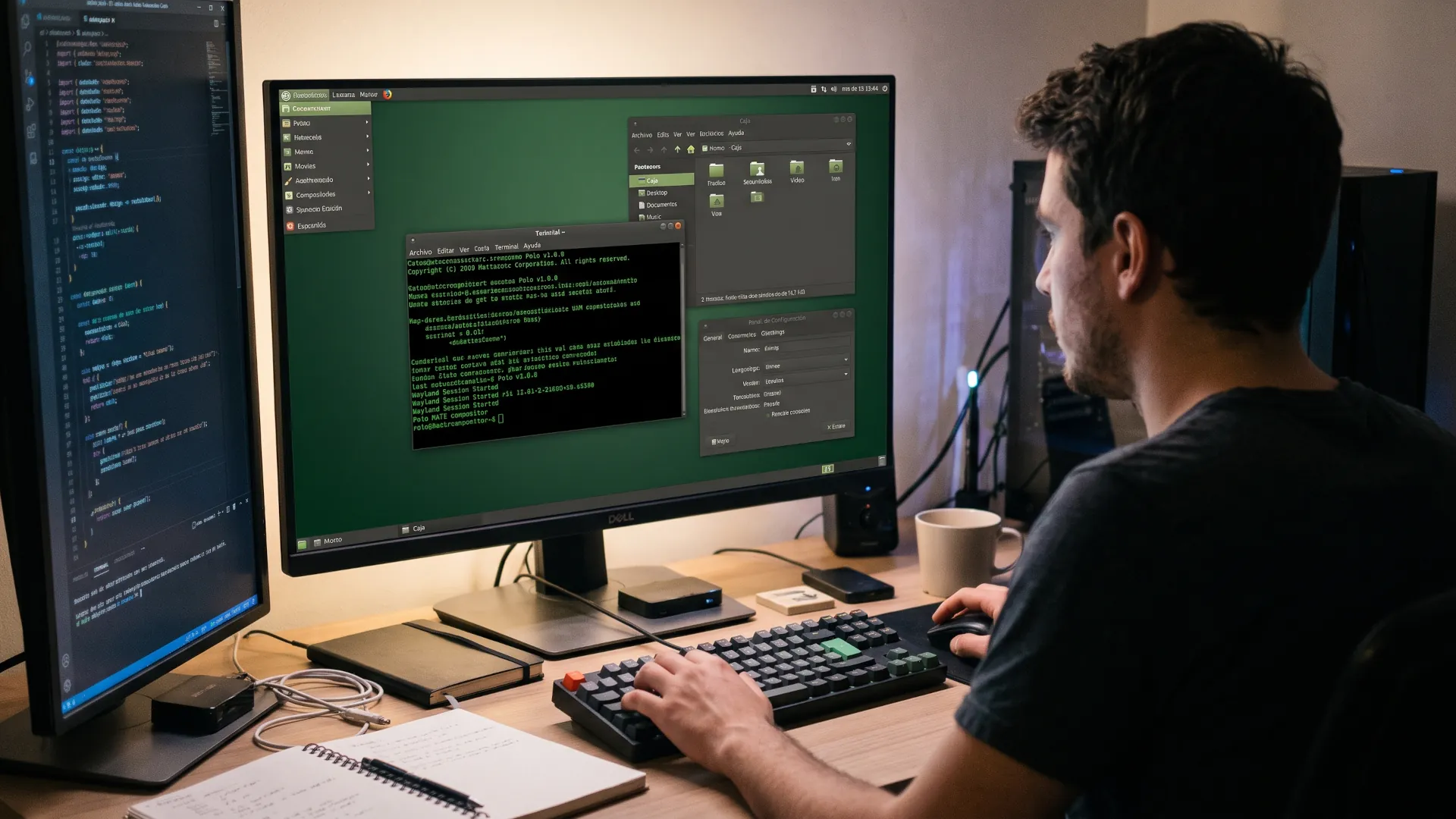
Imagine a beautiful, dynamic desktop that makes Mac OS look old and tasteless? Well, with QuickShell that is not a dream, it is a reality within your reach, and without spending a single euro.
On top of that core, QuickShell offers integrations that cover almost everything a shell needs. Wayland and X11 support for rendering graphics; workspace management in window managers such as Hyprland, i3 and Sway.
On top of that, audio control via PipeWire; Bluetooth via BlueZ; authentication via PAM (essential for lock screens); greetd for session managers; UPower for battery and power management; players compatible with the MPRIS protocol; and a system tray.
It also has hot-reload, meaning that changes to the QML code are applied live when the file is saved, and a language server for QML with autocompletion. More than a configurator, it is a development environment, ready to make the most of system customization.
The documentation is honest about the learning curve:
“QuickShell is a relatively low-level tool compared to simple bars like Waybar. When writing a configuration you don't just change styles and layouts, you practically program, which is considerably more complex.”
That complexity is precisely its appeal: whoever uses it is not limited by the options the bar's author decided to expose, but by their own skill with QML.
A community of more than 40 contributors
QuickShell is, at origin, the work of a single developer who goes by outfoxxed, based in the United States. The repository was created on March 4, 2024 and grew from zero. Today the repository on GitHub has around 2,900 stars, more than 180 forks and 40 contributors to the C++ core, with prominent developers such as bbedward, charlesrocket, cpwrs and nydragon.
The style is that of a project with a single central maintainer and a constellation of contributions. In the launch blog post for version 0.1, published on June 12, 2025, outfoxxed acknowledged that he had put off tagging a release for almost a year: “Soramane's excellent rice has led to a huge increase in attention for the project.”
Soramane's “rice”, that is, the customization of the desktop down to the last pixel, known as Caelestia, was the trigger that forced the author to stabilize the API and publish the first version, paving the way for packaging in distribution repositories. But perhaps a video shows the potential of the technology better than words.
Arch Linux (caelestia-dots)
Why has QuickShell conquered ricing?
To understand the rise of QuickShell you have to look at its predecessors. Waybar has dominated the status bars of Wayland desktops for years thanks to its simplicity: it is configured with CSS and JSON. But desktop animators want fluid transitions, widgets with interactive logic and fine control over every window. For all that, CSS falls short.
The most direct rival is AGS (Aylur's GTK Shell), a widget framework with GTK and JavaScript that was the de facto standard for ricing with Hyprland for years. However, the project has begun to decline for many reasons:
Performance: GTK3, the basis of AGS, “is much worse than GTK4 and Qt”, in the words of developers including end-4, above all because of the lack of graphics acceleration. The cost was real: the shell with AGS went from about 70 MB of RAM to 150-220 MB, but this is mitigated because Qt applications share libraries in memory.
Flexibility: in Qt, “I can define how a slider is drawn, which allows a Material 3 slider with little boilerplate and no hacks”. GTK components, with their predefined structure, can only be styled, not redefined.
Fewer breakages: the QuickShell API evolves on the basis of real features and does not overhaul the syntax the way AGS did.
Better Hyprland and Wayland APIs: QuickShell supports the hyprland_global_shortcuts_v1protocol, which sends shortcuts directly to the application without shell latency, and offers more precise control of layer-shell.
A toxic and closed community: GTK in the hands of GNOME is in the hands of a highly toxic community, to the point that it is considered the second most toxic in the open source world, behind only Nix. QT does not suffer from this problem, or at least not at the levels seen in GTK.
Three projects that demonstrate the reach of QuickShell
That combination explains the appeal of QuickShell. QuickShell is an environment in which the desktop stops being a set of half-cohesive programs and becomes a single process that controls almost everything, with hot-reload to iterate without restarting. Shaders, blur and interpolated animations, increasingly present in modern rices, find a natural home in QtQuick.
And from there we have projects as big as the ones we will mention now:
Omarchy: DHH's bet on the “made-to-measure desktop”
Omarchy is the Arch Linux distribution developed by David Heinemeier Hansson (DHH), creator of Ruby on Rails and CTO of 37signals, known for its “omakase” approach. That is, it is a set of carefully selected tools and settings, ready from first boot. QuickShell is one of its three pillars, the piece on which its entire interface is built.
On August 14, 2026, Omarchy 4.0, dubbed “Quattro”, was published, the biggest update since the project began, as it reimagines the entire desktop shell in QuickShell. The distribution removed a collection of independent components and replaced them with a single long-lived process called omarchy-shell, within which the bar, launcher, menus, notifications, OSDs, the audio, Bluetooth, network and display control panels, the lock screen and the polkit agent run as plugins.
The result is a system with a plugin architecture: third parties can install widgets or complete bars from a git repository with omarchy plugin add, and omarchyplugins.com catalogs the emerging ecosystem. DHH summed it up this way:
“Omarchy Quattro has given people the opportunity to experience what the malleable computer of the future looks like, and they like it (a lot!). Now it feels like a moral obligation to make that future more widely available.”
Caelestia: the rice that put QuickShell on the map
Caelestia, created by Soramane, is the configuration that unleashed the project's popularity. Presented as “a fluid and metamorphic shell for your Linux desktop”, it began on January 11, 2025 and today has more than 8,500 stars on GitHub, with 70 contributors. It is 85% QML code and combines QuickShell with Hyprland to offer a desktop of continuous animations: a central panel that appears on mouse hover with control panel, media, performance and weather sections, a unified launcher with command support and changing visual themes.
It was Caelestia that, as outfoxxed himself admitted, generated “a huge wave of attention” that forced the publication of version 0.1. If QuickShell is the engine, Caelestia is the showcase: the example that showed the community that QtQuick could achieve animations and visual refinements that neither AGS nor Waybar offered with that naturalness.
illogical-impulse: the migration that legitimized the change
Illogical-impulse are end-4's “usability-oriented” dotfiles, with more than 15,000 stars on GitHub. Their decision to abandon AGS — the most established framework in the niche — and rewrite the entire interface in QuickShell in the spring of 2025 was a huge vote of confidence and the moment when the ecosystem stopped seeing QuickShell as a curiosity and began treating it as the emerging standard.
Today their shell includes a bar, sidebars, a window overview, a dock, a lock screen, OSD, notifications and a session menu, all managed by a QuickShell process, with Material Design-style colors generated from the wallpaper. end-4 themselves publicly thanked “outfoxxed for being extremely understanding on my journey with QuickShell”. QuickShell's “About” page highlights Caelestia and Illogical-Impulse as reference configurations, alongside others such as nysh, by nydragon.
The Omacom foundation and the money arriving at the Linux desktop
But this whole movement of thousands of people dedicated to customizing Linux and improving their user experience is about to take a leap. On August 21, 2026, DHH announced the creation of the Omacom Foundation, a nonprofit organization created to “ensure this mission is fully funded, enduring and ready to accelerate”.
The initial fund amounts to 8 million dollars, contributed at a rate of one million each by the eight “founding patrons”: Tobi Lütke (cofounder and CEO of Shopify), Patrick Collison (cofounder and CEO of Stripe), Michael Dell (founder and CEO of Dell Technologies), Jack Dorsey (cofounder of Block and Twitter), Matthew Prince (cofounder and CEO of Cloudflare), Brendan Iribe (cofounder of Oculus), Jason Fried (cofounder of 37signals) and DHH himself. Just hours later, the announcement was updated with two additional million contributed by Drew Houston, cofounder and co-CEO of Dropbox, and Peter Steinberger, creator of OpenClaw, bringing the total to 10 million.
Making the Linux desktop something unforgettable
The foundation's purpose goes beyond paying for Omarchy's development. As DHH described it, it “will hold the trademarks, fund the infrastructure, promote the work and support the open source projects and developers that Omarchy depends on”.
And that is where QuickShell comes directly into play. Along with Arch Linux and Hyprland, QuickShell is one of the three core technologies on which Omarchy rests. Any plan to fund the infrastructure and the maintainers the distribution depends on necessarily involves a project whose author admitted that its popularity has outstripped his available time.
The foundation has already given a concrete example of the model: it has become the exclusive sponsor of Hyprland, Vaxry's compositor, with a three-year agreement extendable to five, designed so that its creator can devote himself full-time to development. As part of the agreement, the Hyprperks subscription program will be retired and its features will be free for everyone. It is a pattern that, applied to the rest of the stack — and QuickShell is the most obvious natural candidate after Hyprland — would change the sustainability of a project that until now lives off the spare time of a single developer.
QuickShell's immediate future, however, depends less on technology than on people. A project with a single central maintainer as a bottleneck, an API that is not yet stable before 1.0.
In fact, the author himself warns of changes that will break configurations. On top of that, there is a user base that grows every time a content creator publishes a new rice on Hyprland. The arrival of Omacom, with its stated commitment to the projects Omarchy depends on, is the strongest signal to date that this bottleneck could disappear.
The irony is pleasant. The “year of Linux on the desktop” has been announced for decades, but never before had a group of software billionaires put money on the table to fund the individual maintainers who actually build that desktop. QuickShell, the single-developer framework that began as a tool for enthusiasts and ended up as the visual engine of a distribution backed by 10 million dollars, has become, almost without intending to, the thermometer of whether that bet works. If it does, the way we interact with Linux will truly change.